
We are in a thrilling age of the multimedia and entertainment industry!
Do you know that the average internet user nowadays spends about 17 hours a week on video watching?
Online video keeps growing, from mobile live streaming to user-generated content, and every second of buffering costs viewers.
The speed and performance of a website are major factors in the ongoing digital warp speed; every click and action we make contributes to our online experience.
Thus, our focus as a social media app development company has to do with matching consumer interests with business objectives by providing flawless online experiences that engage consumers and help businesses grow.
Here come Content Delivery Networks (CDNs), the web optimization champions!
Regarding the matter of slow-loading websites, CDNs are the most efficient option. This article will provide you with an insight into the best CDN for website performance by comparing the top 10 CDN providers in 2026.
What is a Content Delivery Network (CDN)?
CDN is a network of servers strategically distributed at different places across the world. These servers would be strategically placed to cache and store online contents as close to user endpoints as possible to reduce latency and quicken load times.
CDN gives the quick delivery of critical assets needed for loading online content, such as HTML pages and JavaScript files, as well as images and videos.
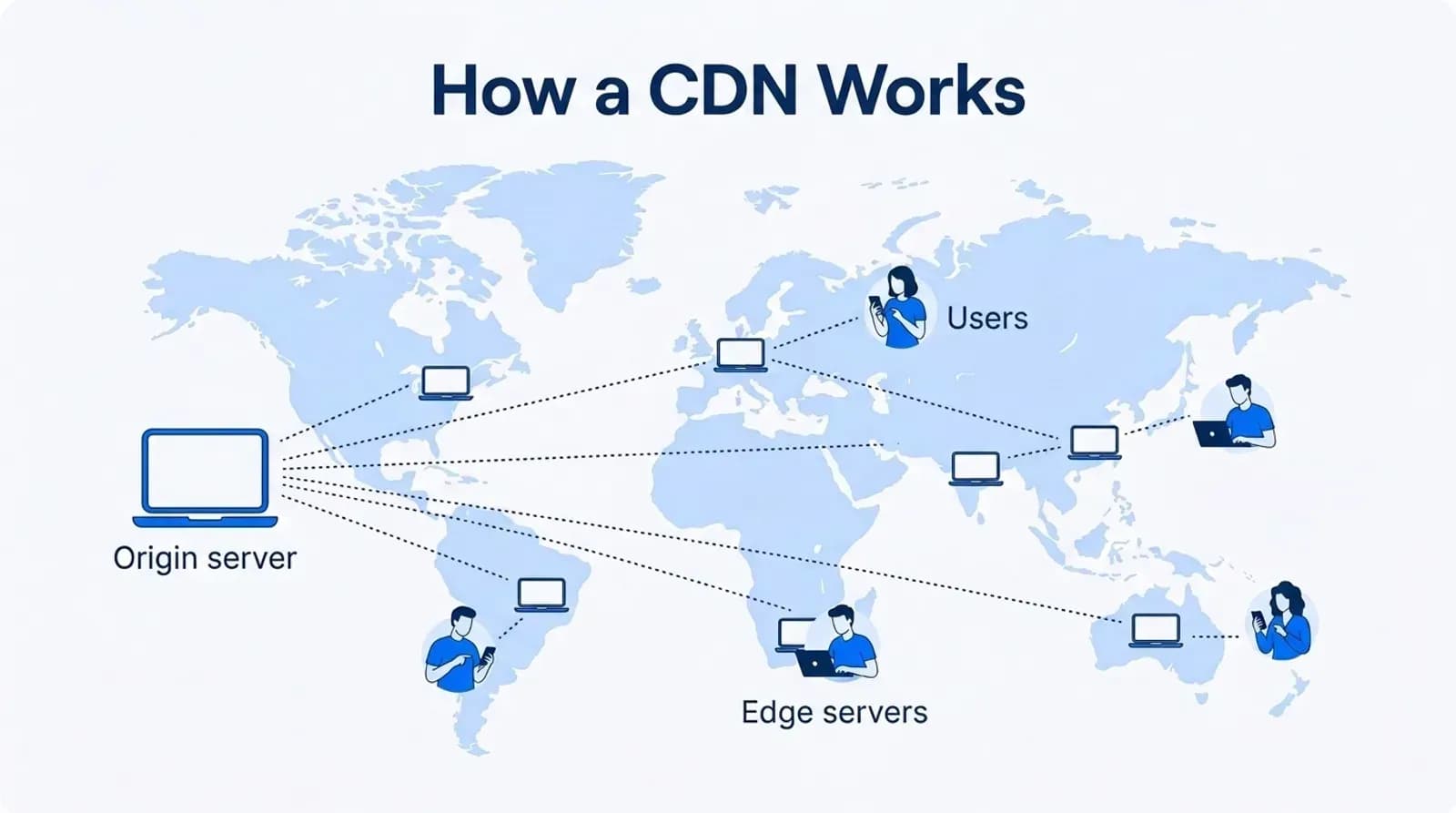
Finding the Best CDN for Your Website & Applications
Due to the rise in the demand for faster and enhanced end-user experience, the role of CDN services has become even more critical. Nowadays, CDNs carry a large share of all web traffic, which marks their key role in the digital economy.
The CDN market is led by a few big networks: Cloudflare alone is used by about 26% of all websites, according to W3Techs.
How to Select the Best CDN for Websites?
Figuring out the right Content Delivery Network (CDN) for your project is one of the essential steps for finding how to improve mobile app performance. Speed is what users notice first.
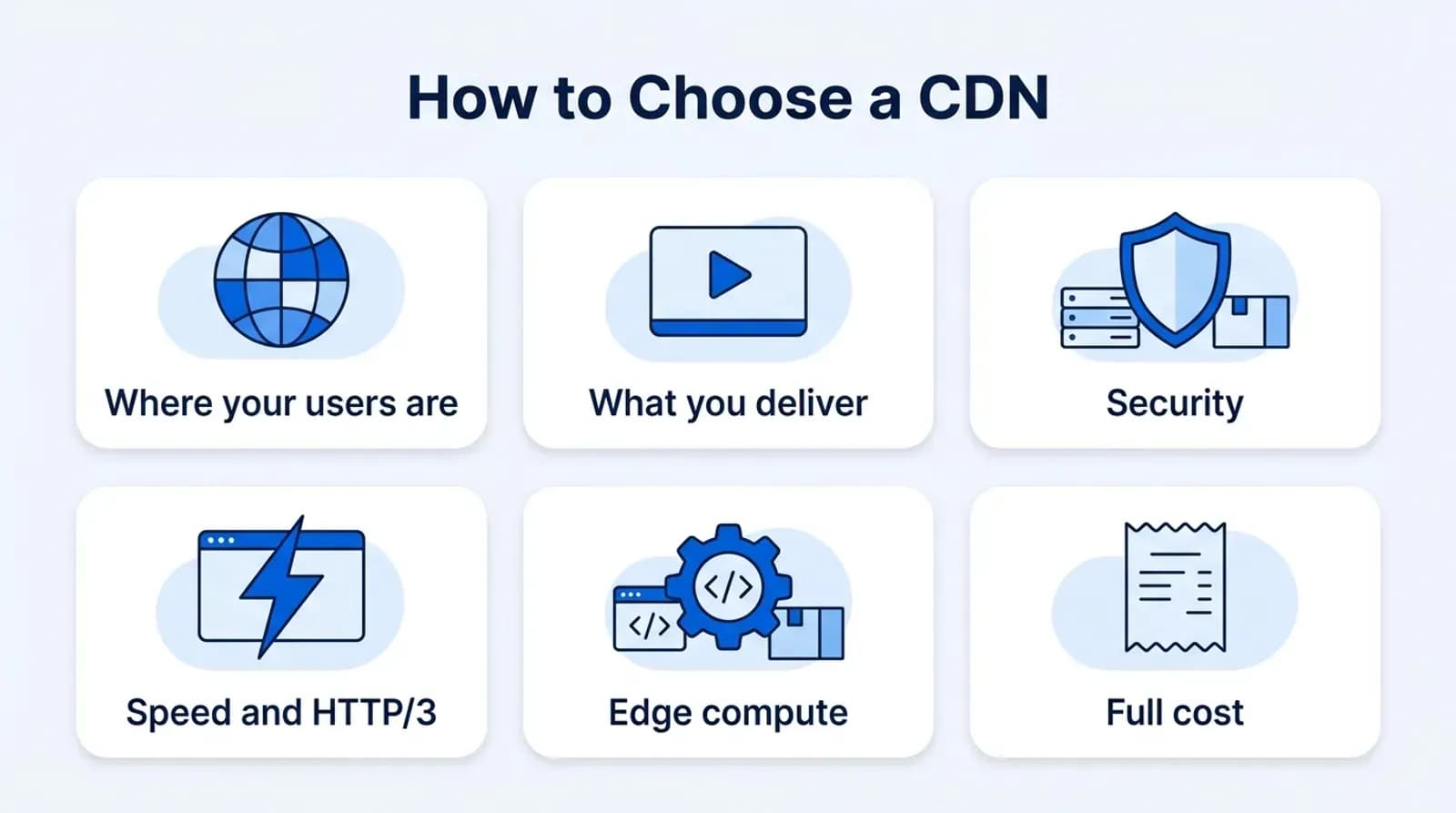
Below is a summary of the procedures you can follow to make a wise choice.
1. Assess Your Needs: First, it is necessary to analyze your project needs. Analyze parameters such as the type of content (static vs dynamic), average volumes of expected visitors, geographical locations of the visitors, and performance goals you foresee.
2. Understand CDN Features: Educate yourself about the features given by different CDN options. Focus on features like caching options, security aspects (including DDoS protection and SSL/TLS encryption), intrinsic scalability, analytics in real-time, and support for HTTP/3 (QUIC), IPv6 and WebSockets for real-time features such as chat.
3. Performance Testing: Subject the CDN providers to performance tests to measure their speed, robustness, and responsiveness. It is important to choose CDNs with a wide network of fast servers spread selectively around the world to minimize latency and gain quick audience access.
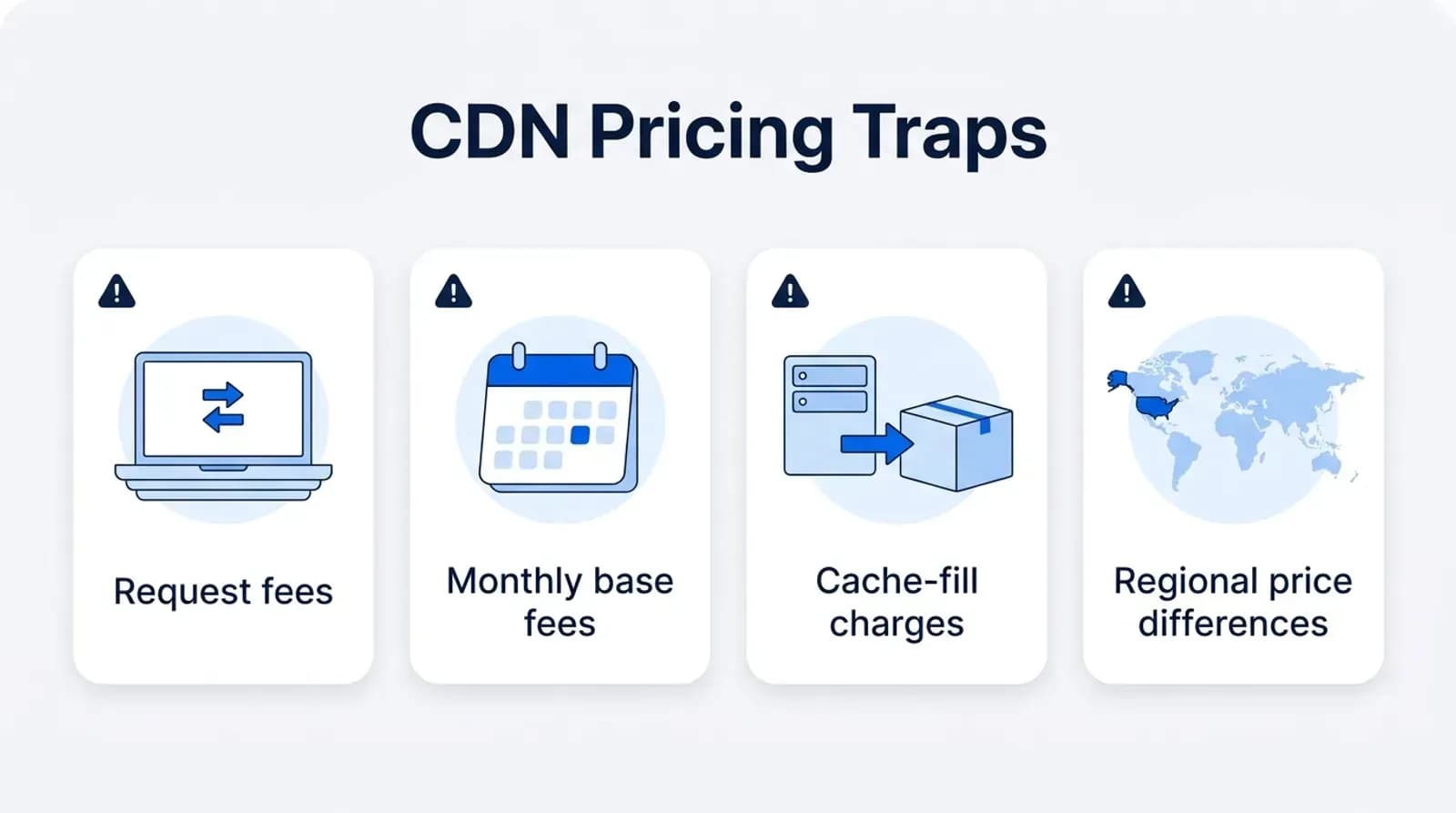
4. Cost Considerations: Also, note the price plans and the pricing structures of various CDN providers. To some, price is determined by the amount of bandwidth used, whereas others offer subscriptions based on features and tiers. Don’t forget to account for any extra costs such as request fees, base fees, cache-fill charges or premium features you may need.
5. Security Measures: It is crucial to adopt CDN providers that provide robust security features so that your content and infrastructure can be protected against cyber threats. Seek for aspects such as DDoS mitigation, WAF (Web Application Firewall), access control, and encryption options that can protect your data while maintaining compliance with legislation. These are also key recommendations for how to secure mobile apps.
6. Scalability and Flexibility: Pick a CDN that can scale with the size of your project. The provider should have scale-out and scale-up options including the possibility of adding more resources to easily adjust according to changing traffic demands without affecting performance or incurring extra costs.
7. Ease of Integration and Management: Take the integration degree with your existing infrastructures and content management systems (CMS) into account. Scout for CDNs that provide smooth implementation tools, APIs, and SDKs ready to be adapted to the most popular platforms and technologies.
8. Customer Support and SLAs: Assess the customer care level furnished by each CDN provider and among them include accessibility, response time, and the support channels provided. Review their Service Level Agreements (SLAs), you will understand uptime guarantees, performance commitments, and appropriate recourse in case of service interruption or breach.
These procedures let you decide the one suitable for your project purpose, plan, and budget.
Top 10 Best CDN Providers to Consider in 2026
Here are the leading CDN providers in 2026, with their network size, pricing and trade-offs, based on each provider’s own published figures.
1. CDNetworks – Best CDN for APAC Business Performance
CDNetworks is a Content Delivery Network (CDN) provider with a strong network in Asia-Pacific and more than 20 years of technology expertise. It has been part of China’s Wangsu Science & Technology since 2017. According to its network map, it runs 2,100+ CDN PoPs in 63+ countries and regions. Its platform combines performance acceleration, edge computing, and integrated security features such as WAF, DDoS protection, and bot management, making it a comprehensive solution for organizations seeking both speed and protection.
Pros
- Exceptional performance: Delivers faster, more reliable, and efficient content delivery globally, particularly in Asia and other emerging markets such as Latin America, Africa, and the Middle East.
- Global Coverage: 2,100+ CDN PoPs in 63+ countries and regions, 140,000+ servers and 140+ Tbps of CDN capacity for wide global reach and scalable traffic handling.
- Integrated Cloud Security: WAF, bot management, DDoS protection, and API security deliver comprehensive cloud-edge defense.
- Intelligent Cache Control: Enables fast cache purging and advanced key management to ensure content stays fresh and efficiently delivered.
- Streaming Strength: Optimized media delivery ensures smooth streaming, real-time playback, and fast content distribution.
Cons
- Brand Presence: Lower brand recognition in certain countries and regions.
- Advanced Configuration: Advanced features and configurations may require technical expertise.
- Custom Pricing: Pricing varies depending on the scope and type of solution and is not publicly listed.
Pricing
CDNetworks doesn’t list specific pricing on its website. It offers a 14-day free trial that you can request by filling out an online form. You can also contact its support team by email or phone to get a quote tailored to your needs.
My Review
CDNetworks offers a well-rounded suite of services that balance global performance with integrated security. With a network of more than 2,100 CDN PoPs, it demonstrates strong capabilities in content delivery, particularly within the APAC region and other emerging markets.
While some advanced features may require additional support, the platform’s dedicated support team provides guidance throughout the process.
I believe its proven reliability and mature support model make it a strong choice for businesses prioritizing a comprehensive, all-in-one solution for global acceleration and protection.
2. Cloudflare – Best CDN for Website Optimization
Cloudflare is an established Content Delivery Network (CDN) service provider that extends beyond the traditional CDN offerings. Cloudflare, one of the largest networks, offers CDN services, security features, DDoS protection, DNS, etc.
Pros
- Global Network: Cloudflare serves data from 335 cities in over 125 countries.
- Security Features: Cloudflare offers a range of security solutions, which include DDoS protection, WAF, SSL/TLS encryption, and bot mitigation.
- Easy Integration: Cloudflare works harmoniously with common platforms and reduces the complexity involved with CDN deployment and operation.
- Performance Optimization: Cloudflare improves website performance by optimizing web content delivery, which in turn reduces load times on web pages.
- Scalability: Cloudflare’s CDN infrastructure deals with traffic spikes & growing user requirements by default.
Cons
- Cache rules on lower plans: Some advanced caching and image features need a paid plan.
- Cost Considerations: Cloudflare also has a free plan but more expensive features and increased usage may incur extra costs.
- Support Limitations: Possibilities provided by Cloudflare may not be suitable for all users in meeting complex problems and their requirements.
Pricing
A free plan is available, and it includes unmetered DDoS protection. Pro costs $20 a month billed annually ($25 monthly) and Business $200 a month billed annually.
My Review
Cloudflare is one of the strongest all-round choices today, thanks to its easy setup, built-in security and very large network.
Businesses looking for advanced security and dependable support should choose Cloudflare’s paid plans. Through a seamless integration, it suits both small startups and fast-growing sites.
Although some features sit behind paid plans, Cloudflare still becomes a reliable option to boost the speed and security of the web.
3. Amazon CloudFront – Best CDN for User Experience
Amazon CloudFront is a Content Delivery Network (CDN) of Amazon Web Services (AWS) that allows for fast data, video, app, and API delivery with low latency and high transfer speed to users.
Pros
- Global Reach: CloudFront has 750+ PoPs in 100+ cities across 50+ countries, plus embedded PoPs inside internet provider networks.
- High Performance: AWS’s infrastructure is employed to ensure fast and reliable delivery of content, with the effect of lowering latency and boosting user experience.
- Integration with AWS Services: It seamlessly blends with other AWS services like S3, EC2, and Lambda for smooth content delivery workflows.
- Security Features: Provides DDoS protection, SSL/TLS encryption, and access control mechanisms to secure the data and apps.
Cons
- Complex Pricing Structure: CloudFront’s pricing model could be complex to understand, if your traffic is variable, it could incur additional (and unexpected) expenses.
- Limited Edge Computing Capabilities: CloudFront Functions and Lambda@Edge cover most edge logic, but setup is more involved than on some rivals.
Pricing
Pay-as-you-go with an always-free tier of 1 TB of data transfer and 10 million requests a month. AWS also offers flat-rate plans that bundle CDN, WAF and DDoS protection.
My Review
Amazon CloudFront is a natural fit for apps already running on AWS. It works closely with other AWS services, which simplifies setup, and its global edge network delivers content quickly.
It scales automatically with traffic surges, and its security features protect content from common attacks.
However, analyzing the usage patterns and fine-tuning the configurations to lower costs requires close attention and frequent adjustment.
4. Microsoft Azure Front Door – Best CDN for Azure Apps
Microsoft’s CDN now runs through Azure Front Door. Azure CDN Standard from Microsoft (classic) retires on September 30, 2027, so new projects should start on Front Door Standard or Premium.
Pros
- Global Presence: 192 edge locations across Microsoft’s global network.
- Security: Premium adds a managed WAF and bot protection.
- Real-Time Features: WebSocket is supported on both Standard and Premium tiers, useful for chat and live updates.
- Integration with Azure Services: Works smoothly with Blob Storage, App Service and other Azure services.
Cons
- Base fees: A monthly base fee applies even at low traffic.
- Migration: Teams on classic Azure CDN must migrate before the 2027 retirement.
Pricing
Front Door Standard costs $35 a month and Premium $330 a month, plus data transfer and request charges.
My Review
Azure Front Door is the natural choice for apps already on Azure, with strong security on the Premium tier.
The monthly base fee makes it less attractive for small, low-traffic projects.
5. Akamai – Top-Tier CDN for Website Enhancement
Akamai is one of the oldest and largest CDN providers, with video and image optimization, edge compute and security. It also took over customers from StackPath and Edgio when those CDNs shut down, including about 100 StackPath enterprise contracts in 2023.
Pros
- Global Network: Akamai runs an extremely broad and global CDN network with more than 4,300 edge points of presence in over 130 countries and about 700 cities to ensure quick content delivery.
- High-Performance: By utilizing the massive infrastructure available to it, Akamai guarantees top-performance content with low latency and fast speed.
- Security: Akamai comprises of advanced security functions like DDoS protection, WAF, and SSL/TLS encryption that protect from cyber threats.
- Reliability: Using redundant architecture and distributed network design, Akamai improves reliability, guaranteeing that the content remains available all the time.
- Scalability: Akamai’s CDN infrastructure automatically scales according to surges in traffic and higher load requirements ensuring reliability during busy periods.
Cons
- Cost: Akamai’s services are rather expensive compared to other CDN providers’ offerings, especially for a small business or one on a limited budget.
- Complex Configuration: It could be a challenging task for those who are not used to CDN technologies and without technical expertise and experience to set up and configure Akamai’s services.
- Customer Support: Some users have had varied experiences with Akamai’s customer service, mentioning a lag in response times and the hardest part in solving problems quickly.
Pricing
Pricing is tailored to your needs and features, and is usually higher than most competitors.
My Review
It is the performance that I value the most. Its wide international network guarantees fast delivery which is a must in the digital age when you need to be ahead of the competition.
Its custom pricing can be overwhelming for smaller teams, and it is usually one of the more expensive options.
6. Fastly – Best CDN for Lightning-Fast Delivery
Fastly is an established CDN provider that uses the edge cloud platform for quicker content delivery and enhanced website and application speed.
Pros
- Edge Cloud Platform: Fastly offers an edge cloud platform by which a network with 622 Tbps of capacity built from fewer, more powerful PoPs is used to distribute content with a low latency and high transfer speeds for website and application performance optimization.
- Real-time Analytics: Provides instant analysis of CDN performance with a view into traffic patterns, usage trends, and performance metrics to facilitate data-driven decision-making.
- Advanced Caching: Fastly is the platform that provides sophisticated caching abilities with immediate purging and surrogate keys. This helps the users to efficiently manage and control cached content.
- Security Features: Provides solid security features like DDoS protection, Web Application Firewall (WAF), TLS encryption, and token authentication to prevent cyber threats.
Cons
- Cost: Fastly’s services are typically relatively expensive compared to other CDN providers, especially for businesses with large or complex requirements.
- Fewer locations: Fastly uses fewer, larger PoPs than some rivals, which can matter in regions it covers less densely.
Pricing
Fastly now offers a free tier for testing and small projects, then usage-based pricing, with larger packages for business customers.
My Review
Fastly is known for very fast delivery, instant purging and powerful edge compute, which suits dynamic sites and apps.
Fastly’s advanced caching and security features allow users to worry less, but setting up and configuring the service may need some technical knowledge.
7. Google Cloud – Best CDN for Website Responsiveness
Google Cloud CDN delivers content from Google’s global edge network and works closely with other Google Cloud services. For video, Google also offers Media CDN.
Pros
- Global reach: Cloud CDN caches content at edge locations around the world on Google’s own network.
- Integration with Google Cloud: If you are already using Google Cloud services, then Google Cloud CDN smoothly integrates with them allowing you to manage your content delivery with no hassle and alongside your other Cloud services.
- Competitive pricing: Google Cloud CDN can be cost-effective as compared to the pricing of other CDN providers which will interest businesses that look to optimize their expenses.
- Generally good performance: By using Google Cloud CDN, users have their content optimally served in a timely and reliable manner, which usually translates to an acceptable performance for the associated applications and websites.
Cons
- Smaller network compared to some leaders: While Google’s network infrastructure is almost perfect, other CDN providers may have even larger networks that could affect performance in some regions.
- Fewer features compared to Cloudflare/Akamai: Google Cloud CDN can lack some of the advanced features offered by prominent services such as Cloudflare and Akamai. This could be a drawback for customers who need more advanced functions than just the delivery of some content.
Pricing
Billed per use: cache egress starts at $0.08 per GiB in North America and Europe, plus cache-fill and lookup charges.
My Review
Google Cloud CDN is an attractive option for companies that are already using Google Cloud Platform as it ensures smooth integration and is cost-effective. The disadvantage is that it may not be the most suitable solution for those who are cloud-agnostic and favor a CDN that has more advanced features.
Its ease of use and simplicity within GCP alongside the fact that it is very convenient makes it a popular choice for users who prefer convenience over advanced features.
8. KeyCDN – Best CDN with Higher User Satisfaction
KeyCDN is a content delivery network (CDN) service that is appreciated for its ease of use and high performance. It is provided with a free SSL certificate and the setup process is not complicated, which is good for small to medium sites. On the other hand, it may have a smaller network compared to the large competitors.
Pros
- Very affordable: KeyCDN features competitive pricing that makes it appealing to cost-conscious websites or apps.
- Free SSL: SSL encryption is included at no extra cost, making transmission of data safer.
- Simple to use: KeyCDN offers an intuitive user interface and configuration process that eliminates the need for technology and expertise. This makes it user-friendly.
- Good performance: However, KeyCDN is not only cheap but provides good performance when it comes to the user-wide distribution of content.
Cons
- Smaller network than major players: KeyCDN’s network is not as broad as one of some bigger CDN providers, which may lead to certain areas’ performance deterioration.
- Limited advanced features: KeyCDN may be missing some of the advanced features that major competitors are offering, which might be a potential deal breaker for power users who have more specific needs.
Pricing
Pay-as-you-go from $0.04 per GB in North America and Europe, with no request fees, which suits small and medium sites and apps.
My Review
KeyCDN is a good solution for sites and apps seeking to optimize costs. However, it may have some shortages in high traffic volumes or specialized services due to its low-scale network and restricted features.
It’s beginner-friendly and offers good performance but will lack the scalability of higher-tier CDN providers.
9. Bunny.net – Best Budget CDN
Bunny.net is a low-cost CDN popular with small businesses and app startups. It replaces StackPath in this list: StackPath shut down its CDN in November 2023.
Pros
- Very low prices: Among the cheapest per-GB rates on the market.
- Global network: 119 PoPs on its standard network.
- Extras: Video streaming, image optimization and edge storage as add-ons.
Cons
- Smaller enterprise features: Fewer advanced security and compliance options than the largest providers.
Pricing
From $0.01 per GB in Europe and North America, with higher rates in other regions and a small monthly minimum.
My Review
Bunny.net gives excellent value for budget-conscious projects that still want global reach.
Large enterprises with strict security needs may prefer a bigger provider.
10. CDN77 – Best CDN with Excellent UI
CDN77 is a CDN focused on high-traffic video and content delivery, with 235 PoPs across 135 countries and 330 Tbps of capacity. It now targets larger customers rather than small sites.
Pros
- Large network: Strong capacity for video and high-traffic delivery.
- User-friendly: This platform provides an intuitive interface and simple configuration, suitable even for users with no deep technical knowledge.
- Free SSL: SSL encryption is built for no charge, allowing safe data transmission for websites and applications.
Cons
- Performance variability by region: While CDN77 normally performs well, the performance may not be consistent globally.
Pricing
Plans are built for high volumes, with monthly packages and custom enterprise quotes rather than small pay-as-you-go accounts.
My Review
CDN77 suits businesses with heavy video or download traffic that want a large network and predictable monthly plans.
Small projects will find its entry plans too large for their needs.
What Else to Check Before You Choose in 2026
- HTTP/3 and WebSockets: faster connections on mobile networks and support for chat or live features.
- Video: if your app streams video, look at video-specific options such as Cloudflare Stream, Google Media CDN or CDN77.
- Image optimization: resizing and modern formats at the edge cut load times on phones.
- Edge compute: Cloudflare Workers, Fastly Compute and CloudFront Functions run logic close to users.
- Pricing traps: request fees, monthly base fees, cache-fill charges and higher rates outside North America and Europe.
Conclusion
In summary, if you are looking for the best CDN for your website and are comparing the top CDN providers, focus on things like performance, cost, and geographic coverage. Each provider has certain advantages, like being affordable, reliable, efficient, or user-friendly.
By focusing on your website’s particular requirements, you would be able to select the right CDN to optimize content delivery and provide the user with a good experience.
Additional Resources
Common questions
What is the best CDN for a website or app in 2026?
There is no single best CDN. Cloudflare is a strong all-rounder with a free plan, CloudFront suits AWS apps, Azure Front Door suits Azure apps, and Bunny.net suits tight budgets.
Is there a free CDN?
Yes. Cloudflare has a free plan, Amazon CloudFront has an always-free tier of 1 TB a month, and Fastly now offers a free tier for small projects.
Do mobile apps need a CDN?
Yes, if your app loads images, video or files. A CDN serves them from a location near each user, which makes the app faster and lowers load on your servers.
What hidden costs should I watch for?
Request fees, monthly base fees such as Azure Front Door’s, cache-fill charges and higher prices in regions outside North America and Europe.
Is Azure CDN still available?
Azure CDN Standard from Microsoft (classic) retires on September 30, 2027. Microsoft’s CDN now runs through Azure Front Door.

Arun Andiselvam
LinkedInI am a startup veteran who has built five brands. I sold the first, an SEO tool, for a six figure exit, and now lead Appkodes, building custom mobile and web apps for founders and businesses. I bootstrapped every one of them from day one.