
Every few weeks a founder asks us some version of the same question. Can we add short video feature to website plugin style, drop something in, point it at a few files, and have a swipeable feed live by Friday? It's a fair question. The ask looks small from the outside: one player, one vertical scroll, done.
The trouble is that short video isn't a player. It's a feed system, and a feed behaves in ways a single embed never has to. This article walks through what that difference actually costs in engineering terms, covering where a plugin genuinely earns its place and where it quietly leaves you holding the parts that matter most.
Why "just add a video player" breaks on a real feed
A single <video> tag is fine for one clip on one page. The viewer lands, presses play, watches, leaves. Nothing competes for bandwidth, and nothing has to be torn down.
A feed is different. Clips mount and unmount continuously as the viewer swipes. Each transition is a chance for something to stutter. Most teams don't discover this during the demo with three test videos. They discover it on clip eight, in a real session, on a mid-range Android phone over patchy mobile data.
The hard engineering problem in short video isn't playback. It's the half-second before and after a swipe. What's already loading, what's being discarded, and what's being held in reserve matters most. Get that wrong and users feel it right away, even if they can't name what's wrong.
What a short-form video integration needs to feel native
People compare your feed to the ones on their phone, whether that's fair or not. Matching that feel comes down to three behaviors, and none of them show up on a feature list.
Instant start, not a spinner
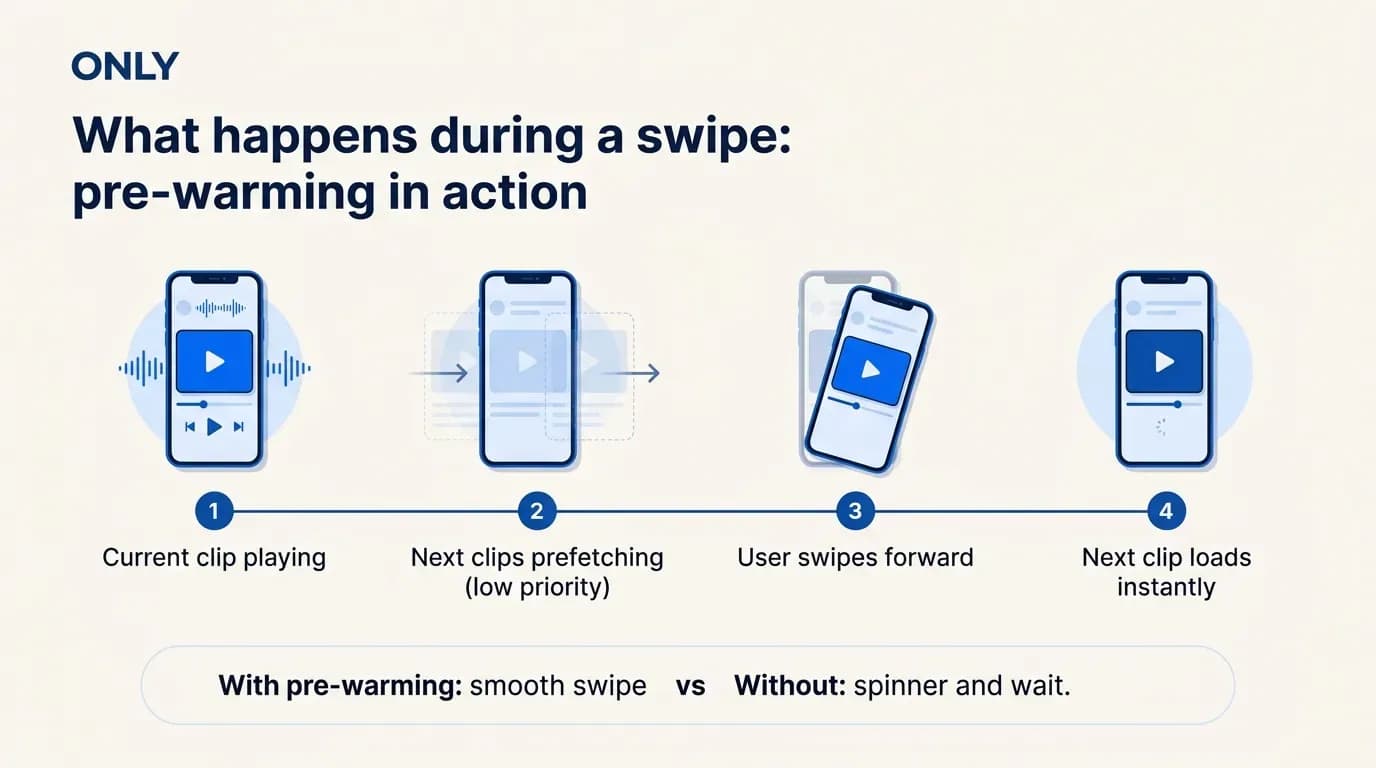
A clip should begin on the lowest-quality rendition available. That way the first frame paints the moment the viewer lands on it, then steps up in quality once there's bandwidth headroom. A brief soft start is invisible to someone swiping, but a spinner is not. This single behavior is the clearest difference between a bolted-on player and a feed built for purpose.
Pre-warming what's coming next
While the current clip plays, the next one or two should already be fetching in the background at low priority. Swiping forward then costs nothing, because the data is already there. The clip just swiped away from should stay warm as well. People swipe back constantly, and a reload on the return trip feels broken.
Mounting discipline
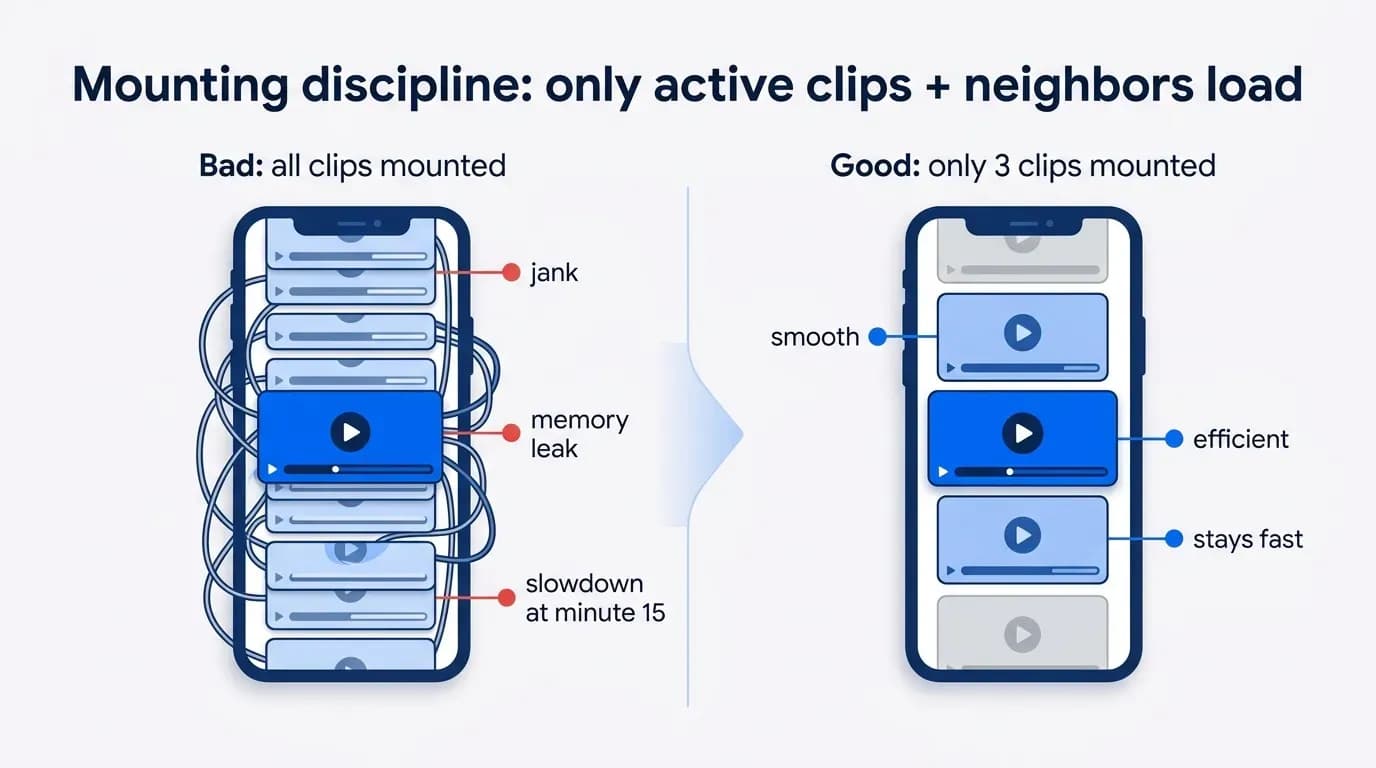
Only the clip on screen and its immediate neighbors should hold a real video element. Mounting an entire feed at once works for the first ten seconds, then degrades steadily after that, which is why bolted-on feeds get slower the longer the session runs. Discipline about what's mounted is what keeps a swipeable video feed smooth at minute fifteen.
Can a plugin add a short video feature to your website?
Partly, and it depends what you mean by the feature. A short video feed plugin will get a player onto a page quickly. It handles basic vertical scrolling and satisfies the surface-level ask. If you want to add a video feed to your CMS so visitors can thumb through a dozen clips on a landing page, that's a reasonable path and a cheap one.
What it rarely ships is the warm-ahead prefetching, the adaptive start, or the mounting discipline described above. Those aren't checkbox features a plugin author advertises. They're implementation decisions buried in the playback layer, and plugins tend to optimize for broad compatibility rather than one feed feeling flawless.
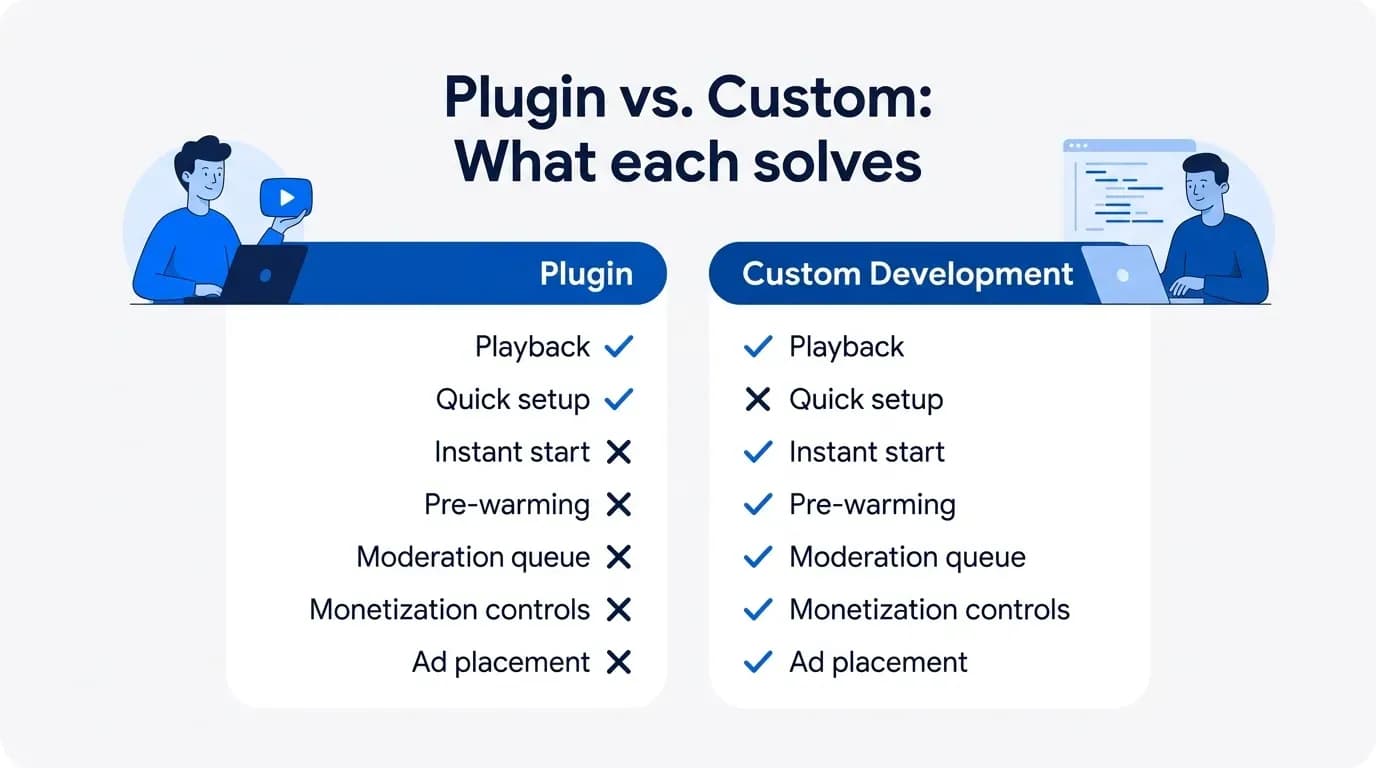
Most plugins also stop at playback. They hand you the front end and nothing behind it, with no approval queue, no tagging, no monetization controls, and no moderation tooling. For a short-form video integration that only needs to look good, that's acceptable. For one that needs to run every day, it isn't.
What running a short-video feed involves beyond the player
Three workstreams sit behind any feed that stays live for more than a month.
Content operations come first. This means ingesting or importing video, cutting it into clips, and tagging and categorizing so the ranking logic has something to work with. Someone also has to approve what actually goes public, and without a queue, someone is doing this by hand in a database.
Then there's video feed monetization. That means gating premium clips behind a subscription, placing upsell cards and ad slots at a cadence that doesn't drive people away, and wiring a payment processor like Stripe so revenue actually lands. Ad placement every third clip performs very differently from every tenth, so you need the controls to tune it.
Finally, there's compliance and trust. An age gate needs to render before content does. A report-a-clip flow matters, alongside a takedown process with a clear owner and a blocklist of material that must never publish. A playback-only plugin leaves all of this to be built or managed manually, usually by you.
Buy a plugin, buy a script, or build it custom?
Here's the honest version. If the goal is a simple embedded feed with no payments and no user-generated uploads, a plugin or a marketplace template is the right call.
Don't spend a development budget on something a weekend of configuration can cover. The calculation flips once the feed has to convert. Subscriptions, premium gating, ad slots, a moderation queue, and analytics on which clips retain viewers change the math entirely. At that point the gaps in a template typically cost more hours to patch than writing the feed logic directly would have. We see this constantly with script buyers who get a full clone app running in a day and then spend four months fighting someone else's architecture to add one payment flow.
That's the same trade-off facing anyone weighing a short video app for existing website versus a packaged plugin. It's cheap to acquire and expensive to extend once real usage arrives.
What Appkodes builds when short video is a real feature, not a widget
Our short video app development work covers vertical feeds, in-app editing, and a ranking engine. It's built with the warm-ahead prefetching and adaptive-start logic that makes native apps feel instant.
The system is built API-first, so the feed, the admin tools, and the payment layer are separate pieces that talk to your existing site rather than replacing it. Theming follows your brand without a rebuild of what you already have.
We agree a fixed price and a fixed launch date before work starts. Scope drives both, so we size them together first. Once agreed, a founder adding video to an existing product knows the budget and the date up front rather than discovering them later.
Eighteen years and 1,000+ businesses served means this isn't the first feed we've built this way. Custom short video development is a well-worn path for us rather than an experiment.
FAQ
Can I add a short-video feed to my existing website without rebuilding it?Yes, provided the feed is built as a self-contained module, meaning a viewer feed, admin content tools, and an API that integrates with your current platform instead of replacing it. Your CMS, your users, and your existing content stay exactly where they are.
Will a video plugin be good enough, or do I need custom development?It depends entirely on scope. A plugin handles uncomplicated playback well. Monetization, moderation, and a swipeable video feed that feels native to people used to the big apps usually require custom work.
How long does it take to add a working short-video feature?Costs and timelines vary with scope, including number of integrations, moderation depth, and payment complexity. What we can do is agree a fixed price and a fixed launch date before work begins, so there's no ambiguity once we start.
Do I need PK Battles or virtual gifting if I'm just adding short video?No. PK Battles and virtual gifting belong to live streaming app development. A short-video feed stands on its own with feed, playback, content operations, and monetization components.
Get a quote before you build
Short video added well means three things working together. The feed, the content pipeline behind it, and the monetization layer on top all matter. A player bolted onto a page gives you one of the three and the illusion of the other two.
If you already have an audience and a platform, the fastest honest answer is a scoped conversation about what your feed actually needs to do. Talk to us about a fixed price and fixed launch date for your short-video feature, agreed before we start.

Arun Andiselvam
LinkedInI am a startup veteran who has built five brands. I sold the first, an SEO tool, for a six figure exit, and now lead Appkodes, building custom mobile and web apps for founders and businesses. I bootstrapped every one of them from day one.