
Remember Omegle? Tap a button, meet a stranger on video, skip to the next one. For 14 years it was the internet’s favourite way to talk to someone new, until it wasn’t. In November 2023 its founder shut it down for good, and millions of users went looking for somewhere else to go.
Most of them landed on OmeTV. Today Americans search for OmeTV around four million times a month, more than every other random video chat app put together. So if you are thinking about building a random video chat app, OmeTV is the model worth studying.
In this guide, you will see how an app like OmeTV works, everything you need to launch one, the new app store rules you cannot ignore, and the ways these apps actually make money.
What Happened to Omegle, and Why OmeTV Took Over
Omegle closed on 8 November 2023. In a letter on its homepage, founder Leif K-Brooks said that fighting misuse of the site had become no longer sustainable, financially nor psychologically, after years of abuse reports and a lawsuit.
The demand did not go away with it. OmeTV caught most of those users because it offered the same simple experience, on web, iOS and Android, with active moderation from day one.
That is the first lesson for anyone building in this space: the idea is not the hard part. Safety is.

How Does an App Like OmeTV Work?
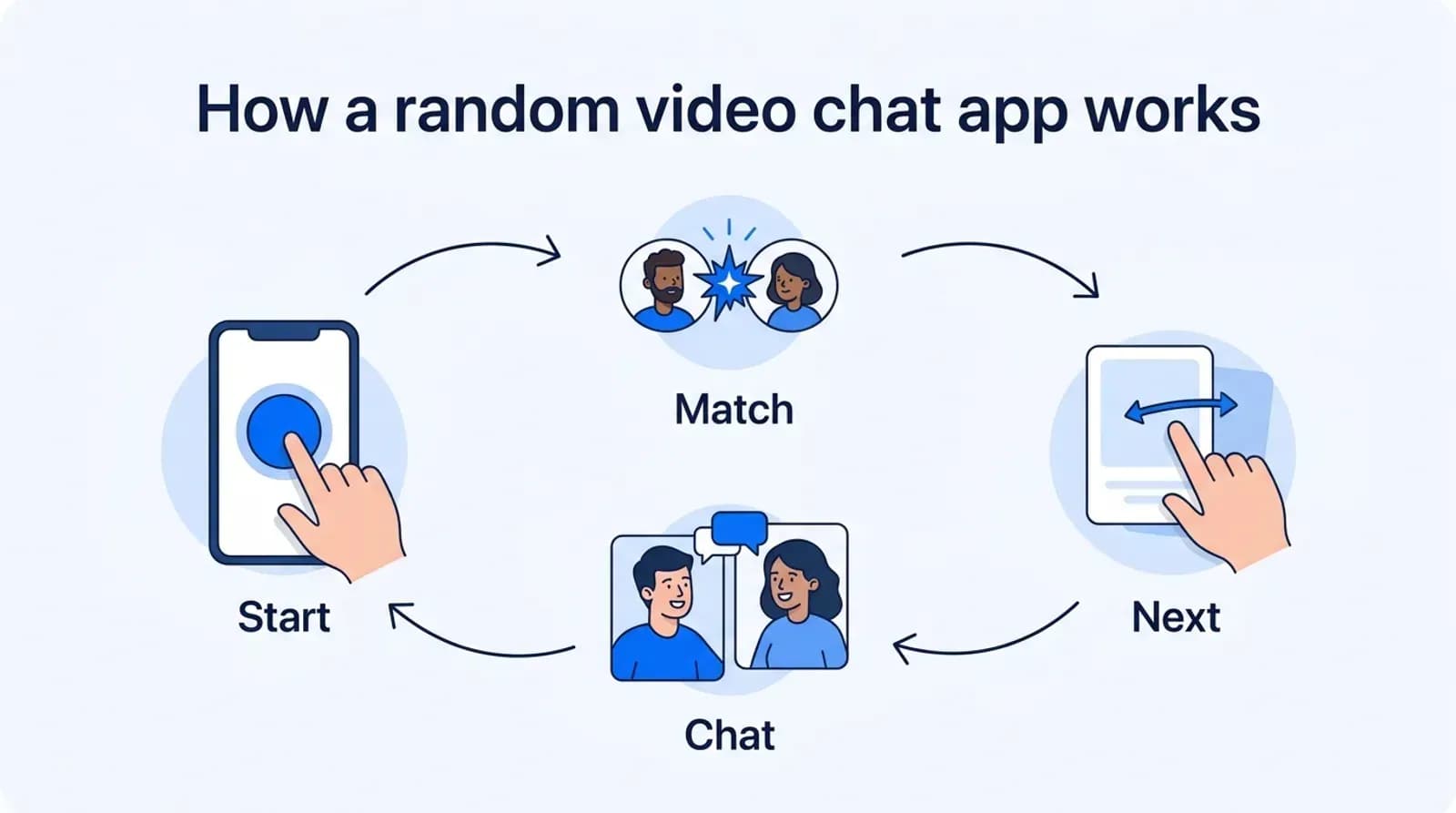
The experience is simple on purpose. A user opens the app, picks a few preferences, and taps start. Within a second or two, they are on a live video call with a stranger somewhere in the world. If the conversation clicks, they keep talking. If not, one swipe takes them to the next person.
Behind that single tap, a lot is happening:
- Matching: a matching server pairs users who are waiting, by language, country or interests.
- Connecting: the two devices set up a live video call, directly where the network allows or through a relay server when it does not.
- Moderating: the call is checked in real time, and users can report or block anyone instantly.
- Skipping: when either user taps next, the call ends and both go back into the queue.
OmeTV vs Other Random Video Chat Apps
OmeTV is not the only name in the market. Here is how the leading apps compare, with how often people search for each one in the US every month (Google Ads data, 2026):
| App | Best known for | Monthly US searches |
|---|---|---|
| OmeTV | The largest free audience, on web, iOS and Android | 4,090,000 |
| Monkey | Mobile-first, popular with Gen Z | 1,000,000 |
| Emerald Chat | Interest matching and stricter moderation | 301,000 |
| Chatroulette | The original, launched in 2009, with an older audience | 165,000 |
| Azar | Live translation, strongest outside the West | 74,000 |
The takeaway? The market is big but not crowded at the top. Each leader owns one thing: size, a generation, safety or a region. A new app wins the same way, by owning a niche, a language or a market that the big names serve poorly.
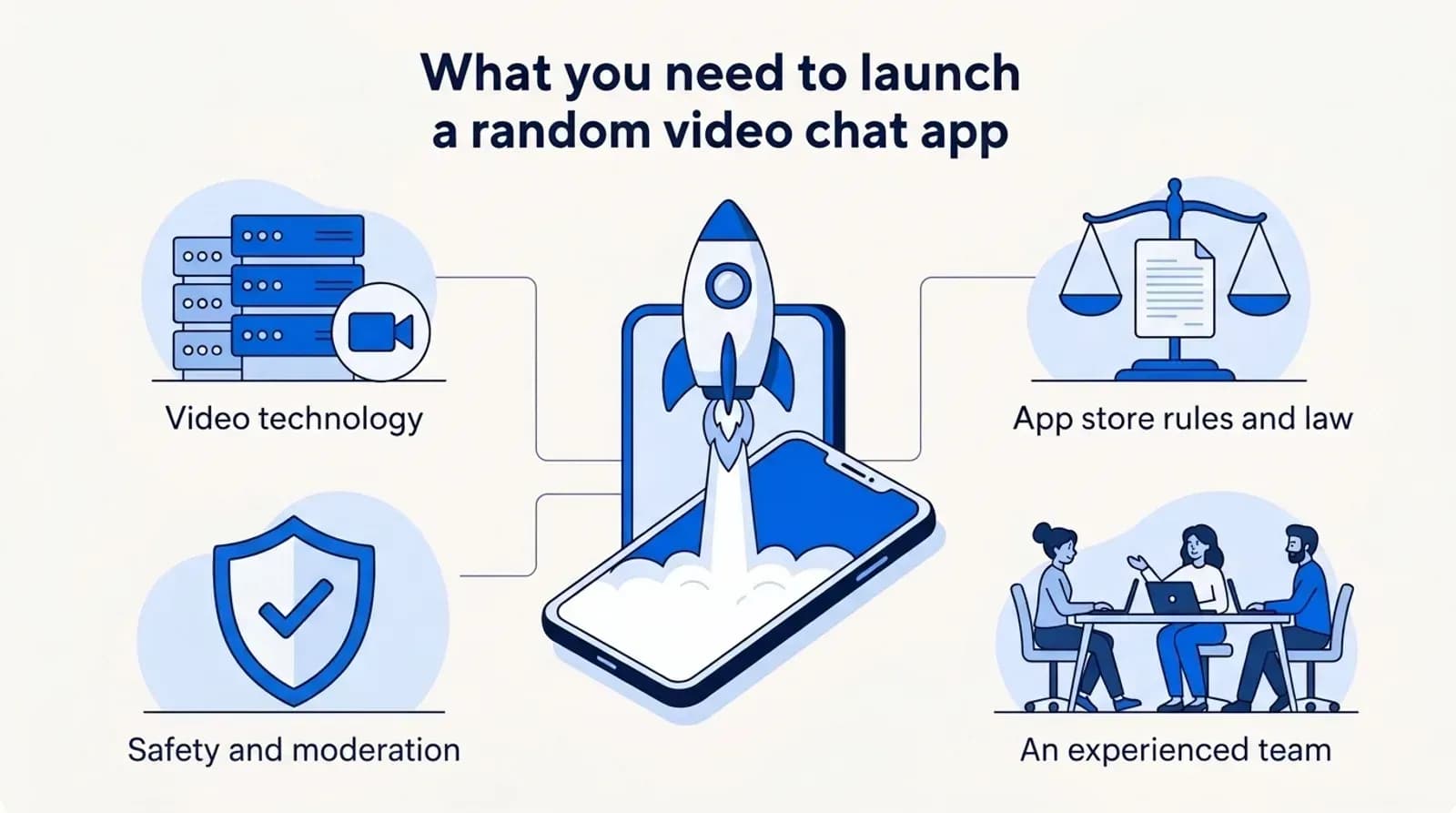
What You Need to Launch an App Like OmeTV
Here is the honest list. Miss any of these, and your app either will not scale, will not pass app review, or will not survive its first viral moment.
1. Real-Time Video Technology
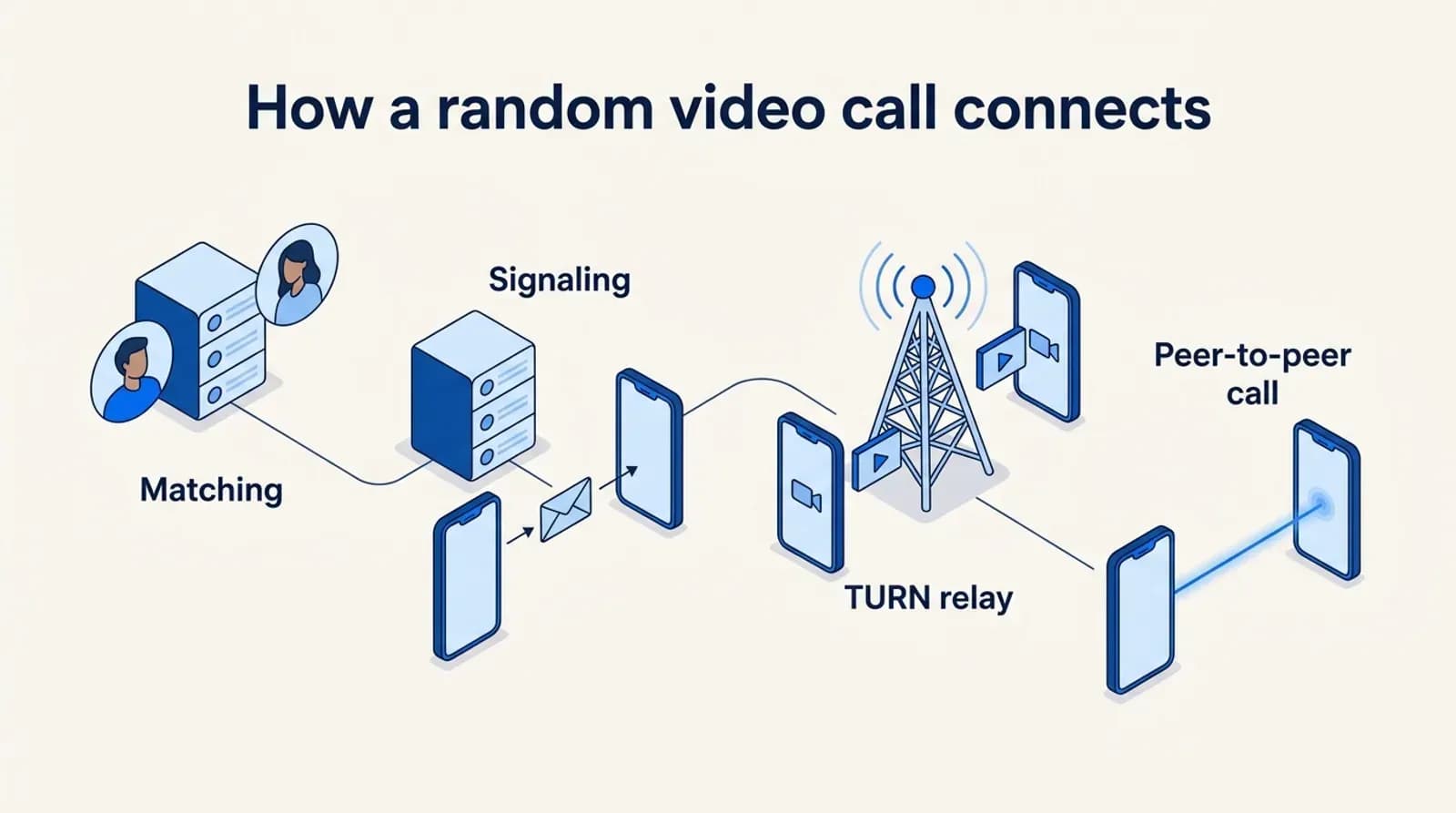
Random video chat runs on WebRTC, the open standard that powers video calls in browsers and apps. It keeps the delay low enough that a conversation feels natural. Around it, you need:
- A signaling server that introduces two devices so they can start a call.
- A matching engine that pairs users in real time, with filters for language, country or gender where you offer them.
- TURN relay servers for users whose networks block direct connections. These carry the video when peer-to-peer fails, and they are one of the biggest running costs as you grow.
- Servers in several regions, so a user in Brazil is not routed through Europe to reach someone next door.
2. Safety and Moderation from the First Call
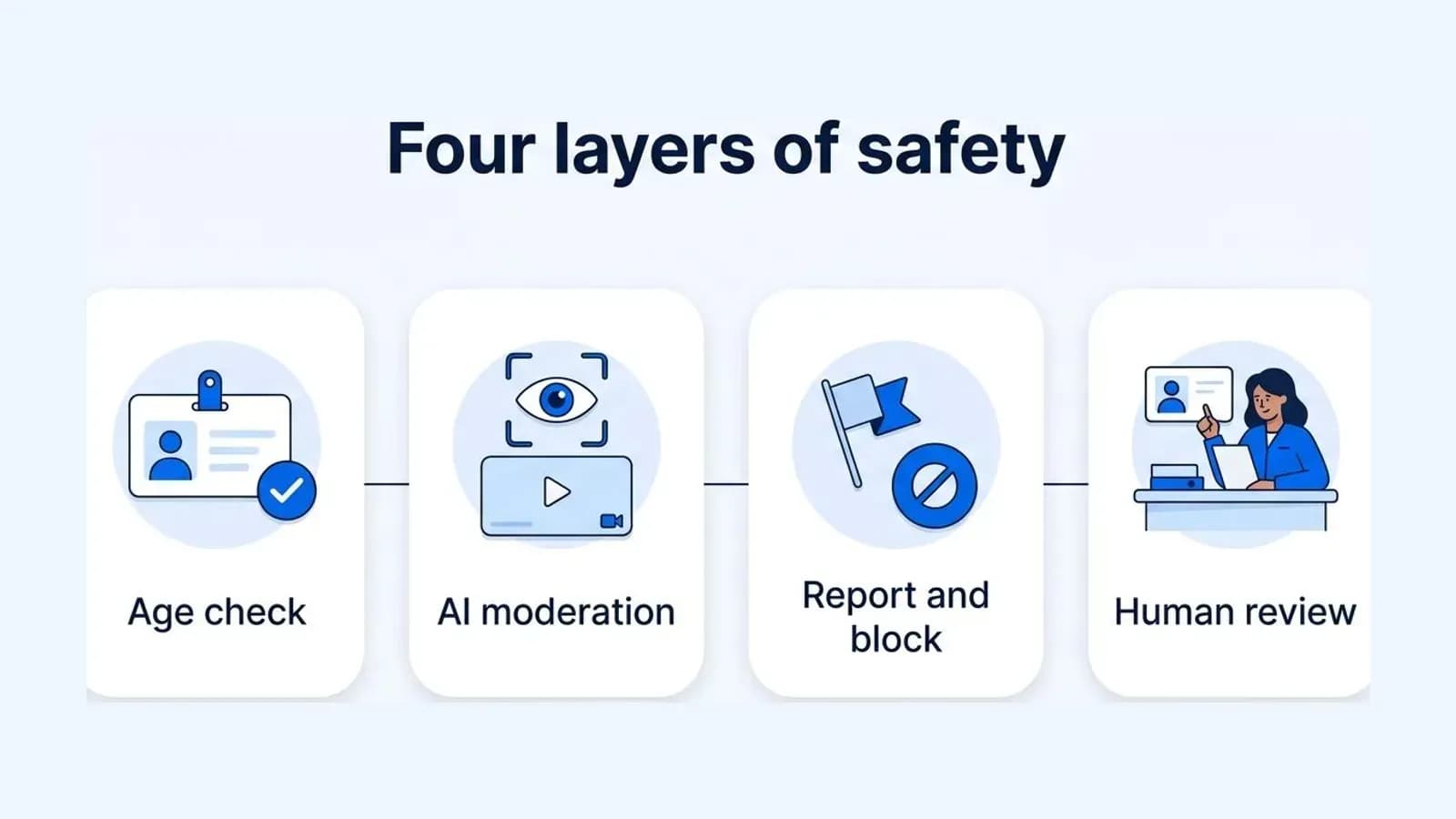
This is where Omegle failed, and where every serious competitor now invests the most. A random call can last three seconds, so moderation cannot sit waiting in a queue. You need several layers working together:
- Age checks at sign-up, adults only by default.
- AI moderation that scans video frames in real time and ends calls that break the rules.
- Report and block buttons one tap away, on every call.
- Human review for reports, with bans that follow users across devices.
3. App Store Rules and the Law
This is the part most guides leave out, and it matters more than ever. In February 2026, Apple updated its App Review Guidelines to say that apps used mainly for random or anonymous chat, or Chatroulette-style experiences, do not belong on the App Store and may be removed without notice.
So what does that mean for you? Launch on the web and Android first, where most random video chat traffic already is. For iOS, build the app so it is not anonymous: verified accounts, profiles, a content filter, reporting, blocking and published contact details. Many successful apps in this space position themselves around social discovery with verified users, rather than anonymous roulette.
The law is moving the same way. In the UK, the Online Safety Act has required highly effective age checks since July 2025 for services that children could reach, with fines of up to 10% of global turnover. Several US states now require age verification too, and GDPR applies to every user in Europe. Plan for age assurance and data protection from day one, not after launch.
4. The Right Team
A random video chat app is really four products: the user app, a moderator console, an admin panel and the video infrastructure behind them. You need people who have built real-time video before, because the difficult problems (dropped calls, slow matches, abuse at scale) only show up with real users.
Must-Have Features for an App Like OmeTV
Here is what each side of the platform needs in its first release:
For users
- One-tap start and swipe to skip
- Filters for language, country and interests
- Text chat and live translation during the call
- Friends list to reconnect with people they liked
- Report and block on every call
For moderators
- A live queue of reported calls
- Warnings, temporary bans and permanent bans
- User history across devices
For the admin
- Users, reports and bans in one dashboard
- Coin packs, prices and subscriptions
- Revenue, retention and time-in-call reports
How to Monetize a Random Video Chat App
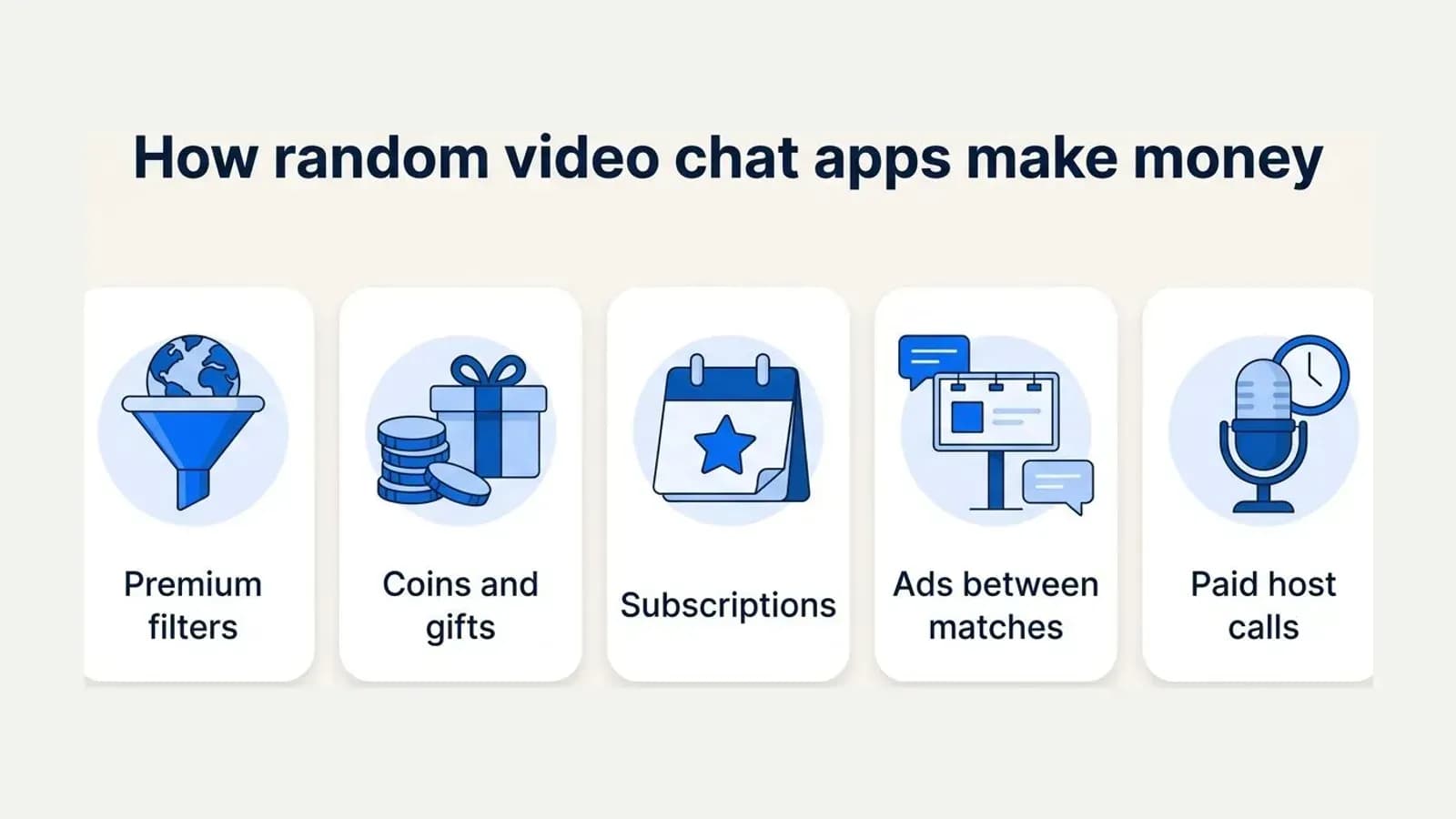
Most random video chat apps are free to join. That is how they get their audience. The money comes from people who want a better experience. Here are the models that work, with real examples. For a wider look at the options, see our guide to startup monetization strategies.
1. Premium Filters
The model most random chat apps run on. Matching is free, but choosing who you match with, by gender or country, costs money. It works because the users who care most about who they meet are also the most willing to pay.
2. Coins and Gifts
Users buy coin packs and spend them on filters, extra matches or virtual gifts during a call. Azar, the highest-grossing one-to-one video chat app, sells gems that unlock region and gender filters. Its owner, Hyperconnect, was bought by Match Group for $1.725 billion in 2021, which tells you how well this model can work.
3. Subscriptions
A monthly plan bundles the extras: unlimited filters, no ads, profile boosts and priority matching. Subscriptions give you steady, predictable revenue, which makes every other decision easier.
4. Ads Between Matches
Short ads shown between calls, never during one. They earn money from the users who never pay, as long as you keep them brief enough not to drive people away.
5. Paid Calls with Hosts
Some apps let hosts, such as language tutors or creators, earn by the minute while the platform keeps a share. It turns a random chat app into a marketplace and opens a second revenue stream.
How to Get Your First Users
A random video chat app has a problem most apps do not: it is useless when it is empty. Nobody wants to wait two minutes for a match. So plan your launch around density, not reach:
- Start with one market and one language. A full queue in one country beats an empty one worldwide.
- Win the searches in your niche. Rank for the terms your audience uses, such as video chat in their own language or country.
- Work with creators. Short videos of real, fun conversations are the best advert for this kind of app.
- Reward invites with coins. Every user who brings a friend makes matching faster for everyone.
Mistakes That Sink Random Video Chat Apps
Most apps in this space do not fail for lack of users. They fail for one of these reasons:
- Launching without real moderation. One viral incident can end an app, as Omegle showed.
- Building for iOS first. Under Apple’s current rules, an anonymous random chat app may be removed without notice.
- Ignoring relay costs. Video bandwidth grows with every user, so price your premium features to cover it.
- Too many ads. An ad after every skip drives away the free users who fill the queue for everyone else.
- Skipping age checks. In the UK, Europe and a growing number of US states, they are now the law.
How Much Does It Cost to Build an App Like OmeTV?
The cost depends on what you launch with: which platforms, which filters and payments, how much moderation, and where your users are. The biggest ongoing costs are video relay bandwidth and moderation, which both grow with your audience.
At Appkodes, you do not get a vague range. You get a costed plan: the build is split into releases, and each release has a fixed price and date agreed before we start. Most first releases of a random video chat app go live in about 30 days, web first, then iOS and Android.
How Long Does It Take to Launch?
With a team that has built video chat apps before, a first release with matching, video calls, moderation, reporting and the admin basics can go live in about 30 days. Payments, coins, translation and the iOS app follow in later releases, each with its own date.
Build Your Random Video Chat App with Appkodes
Omegle proved how much people want to meet someone new. OmeTV proved that the demand is still there, as long as the platform is safe. The opportunity now is to build something that does both, for your audience, in your markets.
At Appkodes, we design and build random video chat apps new for your business, with matching, moderation and monetization built in from the first release, on a fixed price and a fixed date. Talk to our team and turn your idea into a platform people come back to.
Common questions
What is the most popular random video chat app?
OmeTV is the most popular random video chat app today, with around four million searches a month in the US. Other big names include Monkey, Emerald Chat, Chatroulette and Azar, which is strongest outside the West.
How much does it cost to build an app like OmeTV?
It depends on your platforms, features and audience, and on how much moderation you need. At Appkodes, you get a costed plan with a fixed price for each release, agreed before the build starts.
Can a random video chat app be published on the App Store?
Not as an anonymous chat app. Since February 2026, Apple says apps used mainly for random or anonymous chat do not belong on the App Store. Launch on web and Android first, and build the iOS app around verified accounts with full moderation.
How do random video chat apps make money?
Mostly from premium filters for gender or country, coins and virtual gifts, and monthly subscriptions. Many also show short ads between matches, and some let hosts earn from paid calls.
How long does it take to build an app like OmeTV?
A first release with matching, video calls, moderation and the admin basics can go live in about 30 days. Payments, filters and the iOS app follow in later releases.

Arun Andiselvam
LinkedInI am a startup veteran who has built five brands. I sold the first, an SEO tool, for a six figure exit, and now lead Appkodes, building custom mobile and web apps for founders and businesses. I bootstrapped every one of them from day one.