
Do you know, your app may be running in danger of losing customers?
A customer is eager to purchase from your app, but just as he is about to pay, doubts creep in. Is their payment processing secure? Will my data be kept private?
Here is why your app depends on a trusted eCommerce payment gateway.
A frustrating payment experience can easily turn down your conversion. All you need is a reliable and flawless payment system especially when the security issues are at an all-time high.
This blog is going to provide you with a solution to boost your sales and retain your customers. Read till the end to learn how to provide a safe payment experience to your users with simple strategies.
What is an Ecommerce Payment Gateway?
Ecommerce Payment gateway is an essential tool that empowers ecommerce businesses to handle credit card processing and process online payments effectively and safely. It will simplify the ecommerce navigation process as it assures the easiest checkout for all users.
It functions as an intermediary between your e-commerce platform and the payment processor, enabling secure transactions of payment information and accept credit card payments, debit card payments, net banking, digital wallets, mobile payments, and cryptocurrencies smoothly and securely.
The use of ecommerce payment gateways remains important to entrepreneurs who are currently in the process of building or redesigning their online stores to enhance user experience, establish trust, and increase business.
These days, customers think about every method they can pay like using gift cards, cash on delivery, Buy-Now-Pay-Later, and many more. You are risking losing out on important revenue, if your app doesn’t have these contemporary payment options. Here is why it is crucial for your app’s success to integrate a comprehensive online payment gateway.
Importance of the Payment Gateway
Nowadays payment gateways are much required for every e-commerce platform, as they facilitate seamless, safe, and efficient transaction processes.
With the growing need to provide customers with a perfect experience in product selection through e-commerce platforms, the demand for efficient and secure payment gateway solutions is set to grow, thus further driving the growth of the market.
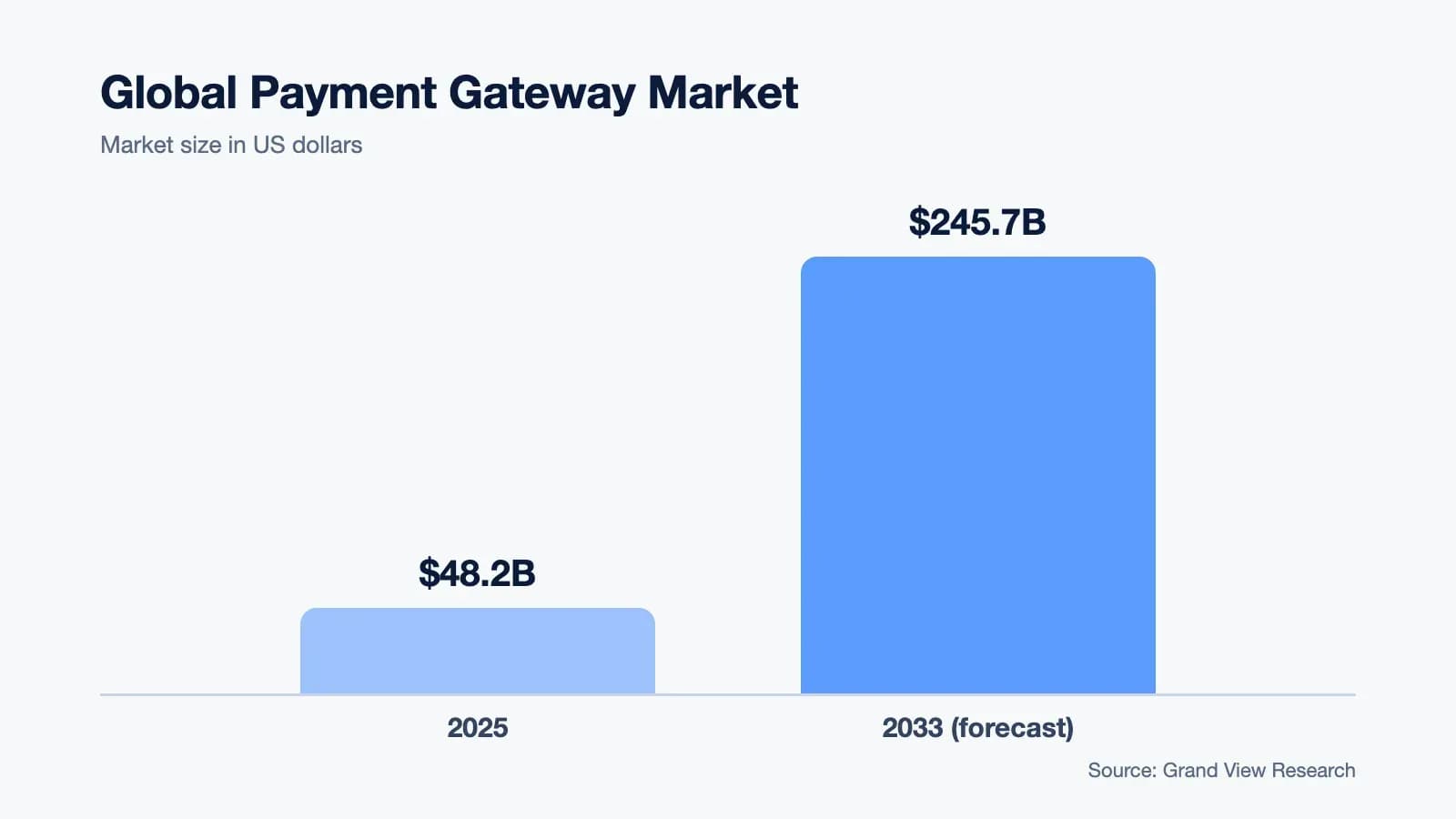
Online shopping makes payment gateways like Stripe, PayPal, and Square truly advanced along with adding features of Payoneer, Wise, and Dwolla into platforms such as Shopify, WooCommerce, BigCommerce, and Magento.
All these integrations empower merchants to have a range of payment processing methods, from cards to digital wallets and even cryptos, thereby adding experience-centeredness and engagement from clients.
Increasingly important payment methods are being provided via payment gateways so that speedier transactions and wider business reach can be achieved as e-commerce grows.
These solutions are driven by major factors such as mobile commerce, cross-border transactions, and growing demand for convenient online payment solutions, and hence expect a huge spur in this market.
We will explore the role of an ecommerce payment gateway and why your app needs it.
How Ecommerce Payment Gateways Enable Secure On-site Payments?
The foundation of a secure on-site payment is eCommerce payment gateways, which use encryption and transaction monitoring to safeguard crucial data and protect customers from fraud. This secure and streamlined process not only helps protect sensitive information but will also improve the customer’s overall shopping experience and can potentially increase the likelihood of purchasing from your small business.
When you sell online you need to be clear about how the payment gateways work. Let us discuss the steps in this process more clearly.
Step 1: Customer Enters Payment Details at Checkout Page
It starts when a customer purchases the e-commerce site. They input their preferred payment details, including credit card details, in the relevant boxes. This step must be easy to use by the users to ensure the process is completed.
To accept payments, businesses need to facilitate various accepted payment methods, ensuring customers can easily input their preferred payment details.
Step 2: Data is transmitted in a Secure Form (API) to the Payment Gateway
After the customer completes the order by entering the payment details, the information is encrypted and sent to the payment gateway’s processor. This secure payment gateway transmission also means that sensitive customer data is protected from fraud and cyber crimes. The gateway encrypts the information to ensure that it remains secure while in transit.
Step 3: The Gateway Transfers the Customer to the Payment Site
The ecommerce payment gateway will either request the customer to be redirected to a secured page for the payment process or automatically process the payment on your site.
This step is crucial in keeping the user experience consistent because a slow or confusing payment step makes people abandon the cart.
Step 4: The Gateway Sends an Authorisation Payment Request to Payment Processors
It then sends information to the payment processor which relays the communication to the customer’s bank. The payment processor, utilizing the merchant account, is responsible for the transfer of transaction details and asks for authorization from the bank.
Step 5: The Bank Confirms the Available Funds and Authorizes the Transaction
Next, the customer’s bank checks the availability of the funds and looks for any fraud. And if the bank confirms that everything is in order, the transaction is approved. This is immediately communicated back through the payment processor to the gateway. Whether they pay through an email payment link or a website, the process remains largely the same, ensuring a seamless and secure payment experience for your customers.
Step 6: Payment Approval Sent to the Customer and the Merchant
Lastly, the payment gateway informs the customer and the merchant that the payment transaction has been completed. The customer gets a receipt of the successful payment and can now expect their order to be processed. On the other hand, the merchant is alerted of the transaction for the fulfillment of the order.
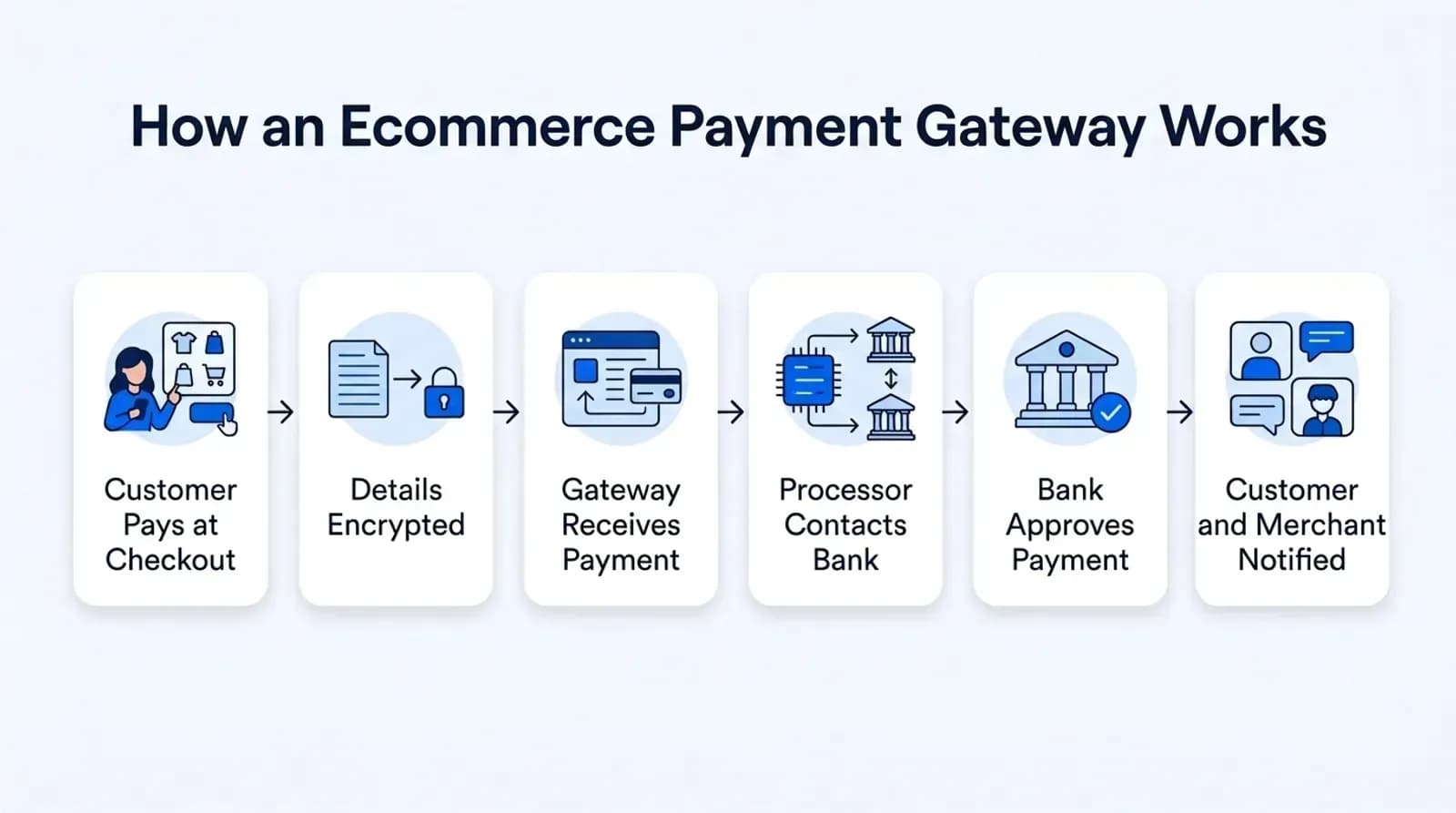
Working of Ecommerce Payment Gateways
Payment Gateways vs Payment Processors
| Aspect | Payment Gateway | Payment Processor |
|---|---|---|
| Function | Supports data about payment flow from the merchant’s app or website to the payment processor. | Processes the payment data acquired from the payment gateway and moves money between the buyer’s and merchant’s accounts, therefore handling the actual transaction. |
| Role in Transaction | Acts as a middleman safely forwarding consumer payment data to the payment processor. | Verifies the customer’s payment information and approves the financial transfer to the merchant’s account, therefore processing the payment. |
| Security | Encrypts and locks private payment data to stop data leaks and fraud during transfer. | Often managing chargebacks, returns, and other financial activities, ensures a safe completion of the payment. |
| Integration | Included in the merchant’s app or website to give consumers the user interface needed to enter payment information. | Usually linked to several payment gateways to handle payments from different sources, works behind the scenes. |
| Features | This may call for further capabilities such as multi-currency support, fraud detection, and regular billing. | Mostly emphasizes making sure cash is moved precisely and that transactions are handled quickly. |
| User Interaction | Directly exchanges payment information with the customer during the checkout process. | Interacts in the background to finish the payment process; does not engage the consumer directly. |
| Example | Stripe | Fiserv (First Data) |
Online transactions depend on knowing the differences between payment gateways and processors. Though their purposes differ, both are essential for guaranteed seamless, safe payments. Some companies, such as PayPal, blur these barriers by assuming several roles. Taking PayPal as an example, it handles the actual fund transfer in addition to helping to transmit payment data securely and through transactions. Stripe and Adyen work the same way, acting as both the gateway and the processor, which is why many startups use one of them for both jobs.
Main Types of Payment Gateways
Small business or any enterprise needs to know the different types of payment gateways while we navigate the world of online payment which is quite complex. Each type we have discussed below has its special qualities that satisfy different users’ needs.
Let us comprehend the primary form of payment gateways that are currently active.
1. Hosted Payment Gateways
This type offers a simplified payment solution. It redirects customers to a secure payment gateway page managed by a gateway provider. You can be less responsible for handling sensitive data and can ensure compliance with PCI DSS Standards.
For these very reasons, the gateways are getting increasingly popular, especially among small business owners, with many now offering AI-powered fraud detection, cryptocurrency payments, mobile wallets, and e-wallet services such as PayPal and Google Pay.
This is quite attractive to many merchants as it supports simplicity of setup and maintenance. But still, this method has its limitations. You can have less control over the checkout process. The real challenge you need to face is fully customizing the look and feel of the payment process transactions. Also redirecting to another page can disrupt your customers’ path and can influence the conversion rates too.
Compliance is the other reason founders pick hosted pages. Under PCI DSS v4.0.1, mandatory since March 2025, a full redirect to the provider’s page keeps your compliance scope smallest, an embedded payment form needs checks on the scripts running on your payment page, and a direct API integration puts the full set of requirements on you.
2. Self-Hosted Payment Gateways
Increasingly, businesses are demanding features for customization in payment solutions. Their self-hosted gateways are now enabled with multi-currency support along with AI-driven fraud alerts.
Businesses have been able to utilize these gateways in subscription modalities and Buy Now, Pay Later (BNPL). Buy now, pay later accounted for $342 billion of online spending in 2024, and Worldpay expects it to reach $500 billion by 2030, which pushes more businesses toward flexible, self-hosted options.
While being low in transaction costs and giving complete control, self-hosted gateways are not so easily used; they require technical know-how for security compliance, along with the high initial implementation and sustaining costs.
If you run a high-volume business, then this type will be more helpful. Self-hosted payment gateway will let your eCommerce store gather payment status straight on your online store while assigning transaction authorization to a third-party payment provider processor, therefore balancing convenience and control.
This approach provides more adaptability in matching the checkout experience to the brand’s character and can result in lower transaction fees. For flawless payment gateway integration and regular maintenance, you need to have technical knowledge that will gain you responsibility for security and compliance.
3. On-Site Payment Gateways
In this method, your online store handles the entire payment process, from collecting to authorization, and gives top priority to complete control and a flawless brand impression. Customers can have an uninterrupted journey throughout their checkout process. You can easily customize the payment page and make it more flexible for your users.
Instant card processing, QR code payments, and voice-assisted transactions are other relevant improvements that go along with often using smart electronic devices.
Trust at checkout matters: Baymard Institute found that 19% of shoppers abandon a purchase because they don’t trust the site with their card details, and 9% because there aren’t enough payment methods.
This approach also expects you to have greater technical knowledge as you need to bear the responsibility for security and PCI DSS Compliance. It is advisable to have dedicated IT resources for your business.
4. API-Hosted Payment Gateways
This approach is similar to the previous one where you can customize the checkout process. Just by using the API of the payment gateway provider, all transactions are handled within your app. There will not be any redirects and the payment process will not be interrupted.
A successful implementation is highly required to guarantee the safe processing of payment data and flawless API integration. You need solid technical expertise in API integration and its maintenance.
In addition, real-time payment is widely used due to API gateways that allow provision for immediate bank transfer and near-instant settlement to facilitate online transactions by speed and efficiency.
Many payment gateway providers now lead with API-based solutions, but it would demand a lot of technical expertise to set up and maintain, not to mention security since it involves a large amount of transactions for businesses.
5. Local Bank Integration Gateway
In this method, the payment is directly linked to the payment processing mechanism of the local banks. The idea became popular because businesses have begun using local payment solutions to reach target market demographics and also to reduce transaction fees. This is a highly trusted approach as customers prefer transactions conducted by known financial institutions.
This trend is driven by the rise of real-time account-to-account payments: India’s UPI handled a record 24.5 billion transactions in August 2026, and Brazil’s Pix processed 79.8 billion transactions in 2025.
An important limitation of local bank payment gateways is that they usually have less customization options and they usually require particular knowledge of the local banking systems and regulations which usually makes them less flexible as compared with other payment gateway types.
The entire payment process follows the respective bank’s procedures. Again, customization becomes a question. The arrangement and maintenance might be difficult and call for particular technical knowledge and tools
Supporting local real-time payment systems is the way forward for businesses that want to stay in line with the ever-evolving financial ecosystem.
We have provided all reliable types of payment gateways. Now we can understand you are in a dilemma to find the one that perfectly fits your business.
Do not worry, we can guide you with some essential tips to choose the right payment gateway for your eCommerce store.
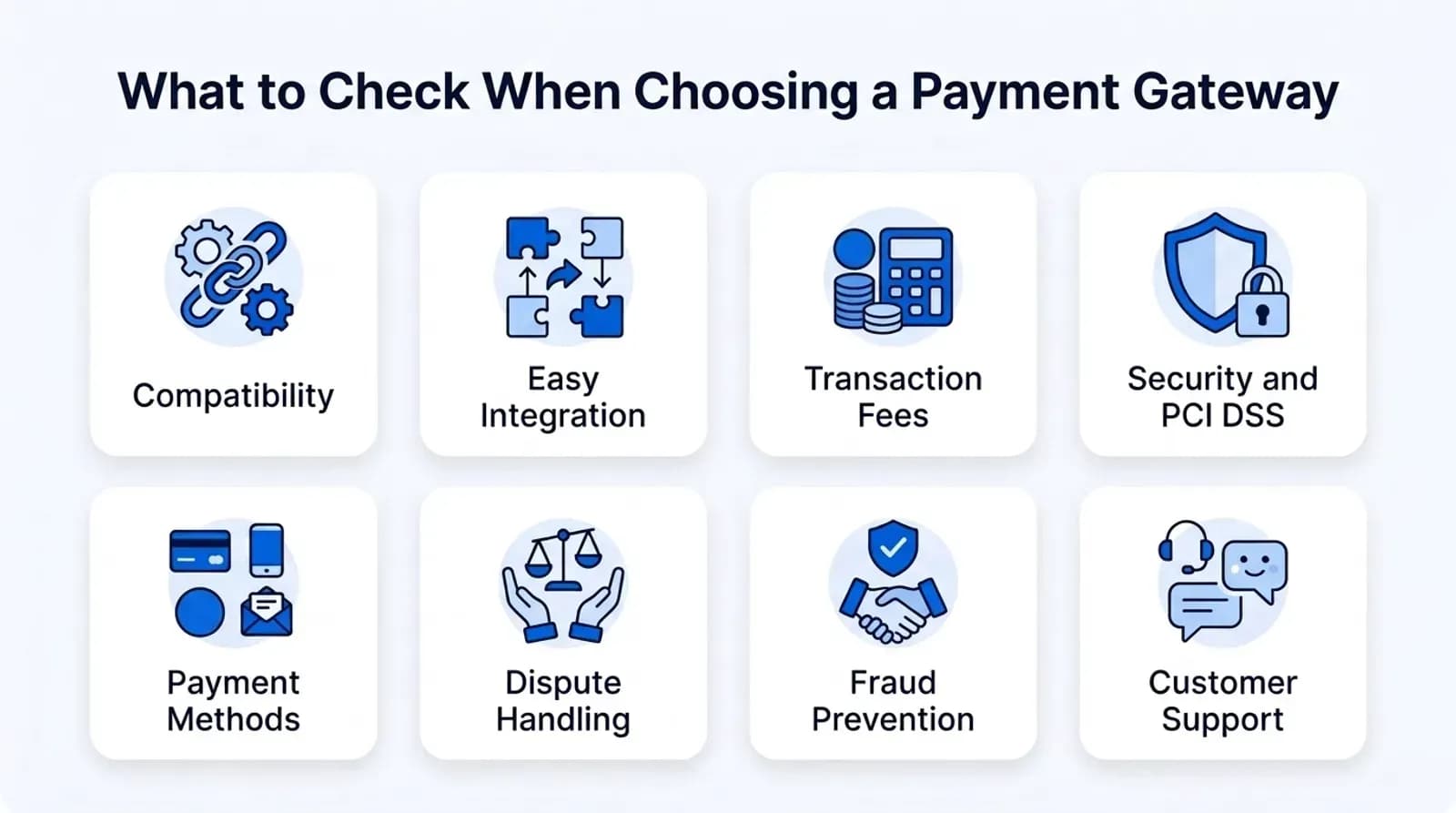
Factors to Consider While Choosing an Ecommerce Payment Gateway
10 Tips to Choose the Right Payment Gateways
Choosing an ecommerce payment gateway is important for your e-commerce business. Below are the important aspects to bear in mind to help you identify the best funnel for your business.
1. Compatibility
Check to see whether the payment gateway is suitable for your business and will work with your shopping cart.
The gateway should work perfectly with the platforms you choose – whether it is popular eCommerce platforms like Shopify or WooCommerce or your self-built site. This guarantees that the work will flow seamlessly and the amount of coding required is minimal.
2. Integration
Determine how flexible the ecommerce payment gateway is for integration with your existing technology. Choose gateways that support rich APIs, plugins, or modules that promote seamless integration.
A gateway that can integrate with minimum technical problems will also save you time and resources which you can use in other aspects of your business.
3. Transaction Fees
The fee structure is an important issue. Payment gateways can also have other fees such as fixed transaction fees, setup fees, and monthly fees. These costs should be presented in transparent and easy-to-compare formats for different gateways.
One should not forget the fact that lower transaction fees can negatively influence their income if one processes a large number of transactions as a result.
4. Security Measures
Security is also a concern when dealing with such sensitive payment details. Check if the ecommerce payment gateway abides by industry guidelines such as PCI-DSS and ensures data encryption is top-notch.
They protect your customers’ data and help establish confidence in your e-commerce platform as they minimize fraud and data loss.
5. Supported Online Payments
Multiple payment methods meet different customers’ needs and may also improve their shopping experience.
Select a payment service provider that has options for various forms of payment including credit and debit cards, PayPal, Apple Pay, Google Pay, and alternative payment methods such as savings accounts or buy now pay later. This flexibility can result in higher conversion rates and customer satisfaction rates.
6. Dispute Management
Evaluate the gateway’s tools and processes for handling chargebacks and disputes. Look for features like automated dispute resolution, clear communication channels, and evidence-collection tools. Consider the gateway’s success rate in resolving disputes in favor of merchants.
7. Assess Monthly Transaction Volume
Determine the number of transactions to be processed in a month to select a gateway that can handle these transactions. Understand which payment solutions your clients want to use like credit cards, e-wallets, and alternative payments.
8. Gather Feedback and Assess Gateway Reliability
Visit review websites to collect feedback from other customers. To assess how frequently the gateway runs without any halts or technical hitches, focus on the reliability comment. Know how easy it is for the customer and merchant to use the gateway. Assess the effectiveness of the customer service group.
9. Evaluate Fraud Prevention and Detection Capabilities
Ensure that the gateway ensures sensitive data is protected during transactions by implementing the strongest encryption methods possible. Identify gateways with strong capabilities in fraud prevention and detection technologies.
10. Customer Support
Timely and reliable customer support is crucial for resolving any problems and keeping workflow under control, especially when dealing with payment processing fees. The payment gateway should also provide support services such as around-the-clock availability, multiple means of communication (phone, email, live chat), and a good knowledge base.
Top 5 Best Online Payment Gateways
Below are some of the leading and best payment gateway providers’ lists and I have ordered them based on the ease of use, API and developer document availability, customer support, and effective dispute management system.
1. Stripe
Stripe, one of the best payment gateways, is also recognized for its developer resources and strong API, allowing seamless integration with different e-commerce systems. It offers many alternative payment options with leading payment card industry such as credit cards, digital wallets, and local other payment methods. Stripe also comes with features such as subscription billing and one-click purchasing, and it has added stablecoin accounts for businesses.
2. PayPal
PayPal is a well-known and trusted ecommerce payment gateway in the world market. Having a PayPal account allows for trade in several currencies and processes credit card payments, bank transfers, and PayPal balances. Its easy-to-use interface and strong buyer protection policies make it popular with PayPal customers. Its developer-focused Braintree gateway is now sold as PayPal Enterprise Payments.
3. Square
Square offers a smooth payment interface via its retail tools and hardware for physical payment. It supports online and offline payments and therefore, it is suitable for businesses that have both online and brick-and-mortar stores. Square also has some great business management tools such as invoicing and inventory management.
4. Authorize.Net
Authorize.Net is a trusted ecommerce payment gateway that provides support for several payment options. It has fraud detection, subscription billing, and a simple online terminal for credit card transaction acceptance. Authorize.Net is also well known for its excellent customer support and wide range of integration possibilities.
5. Amazon Pay
Amazon Pay uses Amazon’s established customer base and brand recognition to facilitate a simple way of making payments. Customers pay using their Amazon accounts to shop on your site, providing a trusted checkout experience. The platform can manage multiple payment requests at a time. Amazon Pay is compatible with a wide range of devices and platforms, and on Shopify, it now runs only through Shopify Payments.
Do You Know? Payment gateways are the secure portals that handle online transactions. But how do they fit with different ecommerce models? B2C vs. C2C Payments: B2C ecommerce website transactions (business-to-consumer) need fast, familiar payment options, while B2B transactions may require various payment methods or higher credit limits. Also understanding what is C2C ecommerce is important so that your gateway could be made flexible enough to handle these variations. Headless Hustle: Headless commerce platform is something vital to get aware of as it separates your store’s front-end (what customers see) from the back-end (payment processing). Ensure your chosen gateway integrates smoothly with your headless setup for a seamless checkout experience.
Payment Trends to Plan For
Card payments are changing fast. Mastercard plans to end manual card entry for online shopping in Europe by 2030, replacing it with stored tokens and payment passkeys, and Visa offers the same with Click to Pay and Visa Payment Passkey. AI shopping agents are the next step: Visa Intelligent Commerce and Mastercard Agent Pay let AI agents pay on a shopper’s behalf. Choose a gateway that already supports tokens, wallets, and passkeys, so your app is ready as these roll out.
Overcoming the Challenges of Ecommerce Payment Gateways
On one hand, most payment gateways have several advantages, but they also have several disadvantages. The following are some of the practical limitations while they process payments and their ways of circumvention.
International Payments
International payments may be difficult due to the costs of currency conversion, different state rules and regulations, and also higher charges. Customers might leave the cart if they are experiencing issues with their chosen means of payment or when the checkout is not localized.
Solutions
- Select a payment gateway that supports multiple currencies so that the customers can make transactions in their local currency. This helps make the checkout process easier and more fun.
- Provide your payment gateway with the popular methods of localized payments used in different regions like Alipay in China or SEPA Direct Debit in Europe.
- Inform your customers of any additional fees that may be incurred for international online purchases during the checkout process. Transparency in fees can create confidence and help to avoid cart abandonment.
Security Vulnerabilities
Ecommerce Payment gateways are subject to cyber threats such as data breaches and fraud. Payment security is a critical component of E-Commerce.
Solutions
- Make sure to employ a PCI-DSS payment gateway. This set of security standards aims at preventing card information theft during and after a transaction.
- Choose an ecommerce payment gateway that utilizes effective data encryption techniques to protect transaction-related information. Encryption makes sure that even if the customer data is intercepted it remains unreadable unless authorized.
- Use the fraud protection solutions offered by the payment gateway. Other features such as address verification, CVV checks, and real-time monitoring can be other forms of fraud detection and prevention.
- It is also crucial to carry out routine security audits on your payment processing systems. These audits can assist in pinpointing weaknesses and guarantee that your security strategy is current and protective against future threats.
I strongly believe that solving these issues will lead to a better payment processing system and your customers will enjoy safer transactions. Addressing the issues of international payments and security weaknesses will not only protect your business operations but also win the trust of your international clientele.
Build Your Payments Right with Appkodes
Now that you understand the importance of an ecommerce payment gateway, the next step is building an app that uses it well. You need the right ecommerce app development services to work with.
Appkodes designs and builds every ecommerce app new for its client and integrates the payment gateway that fits your market, whether that is Stripe, PayPal, Razorpay, or local options like UPI and Pix.
Our team evaluates your business needs, checks whether the chosen ecommerce payment gateway suits your criteria, and plans around transaction volume, accepted payment methods, and international payments. We can also add an ecommerce loyalty rewards program to strengthen your customer base.
This means smoother payment processing, more customer trust, and more sales for your platform.
From integration to ongoing maintenance, you get a costed plan at a fixed price before work starts, and most first releases go live in about 30 days.
Tell us about your ecommerce app to get started.
Common questions
What is the difference between a payment gateway and a payment processor?
The gateway securely collects payment details in your app and passes them on, while the processor moves the money between the customer’s bank and yours. Providers like Stripe and Adyen handle both.
Which payment gateway is best for a startup app?
Stripe and PayPal are the usual choices for global apps thanks to their APIs and wide payment support. In India, Razorpay and UPI-ready gateways are common. Pick the one that supports your customers’ preferred payment methods and currencies.
Should I use a hosted gateway or an API integration?
A hosted page is quickest and keeps your PCI DSS scope smallest. An API integration gives you a fully branded checkout but puts more security and compliance work on you.
How much do payment gateways charge?
Most charge a percentage of each transaction plus a small fixed fee, and some add setup, monthly, or cross-border fees. Compare the full cost at your expected volume, not just the headline rate.

Arun Andiselvam
LinkedInI am a startup veteran who has built five brands. I sold the first, an SEO tool, for a six figure exit, and now lead Appkodes, building custom mobile and web apps for founders and businesses. I bootstrapped every one of them from day one.