Getting a prescription is rarely the hard part.
Staying on treatment is.
For people managing multiple medications, the effort does not end at the clinic. It continues with refill reminders, lab tests, pharmacy visits, follow-up calls, and waiting in line. Miss a pickup, and the medicine runs out. Miss a refill and treatment pauses. Over time, these small breaks begin to affect daily life, work, and health.
This problem was never about access to medicine.
It was about the system around it.
As medicine home delivery and digital coordination entered the healthcare sector, something changed. Refills arrived on time. Prescriptions were managed quietly in the background. Pharmacist support became easier to reach. Medication shifted from a recurring task to a reliable process. Patients stayed on treatment longer. Outcomes improved.
This shift revealed something bigger.
Medicine delivery is no longer a convenience feature. It is becoming a healthcare infrastructure.
- For pharmacy owners, it’s a way to extend care beyond the counter.
- For operations teams, it’s a way to manage deliveries efficiently.
- For healthcare platforms, it’s a chance to offer seamless medication fulfillment.
- For founders, it’s a space to build ventures that truly matter.
The question today isn’t if medicine delivery matters. It’s how to do it responsibly.
The opportunity is growing fast. IMARC puts India’s online pharmacy market at $4.30 billion in 2026, rising to $14.08 billion by 2034, though estimates vary with how the market is defined. Proven business models exist and digital workflows are in place, but the rules are still being settled, so execution and compliance matter most.
This guide shows how to launch an online medicine delivery venture like 1mg, with a first release live in about 30 days. If you are ready to build something that patients rely on, this is your starting point.
What Defines a Medicine Delivery Venture
A medicine delivery venture is often mistaken for a logistics or quick-commerce business. In reality, logistics is only one operational layer. At its core, medicine delivery is a healthcare service that directly impacts patient safety, treatment outcomes, and long-term trust.
Unlike standard e-commerce, medicines are not interchangeable products. Every order is linked to a prescription, a medical condition, and a defined dosage schedule. Delivering the correct medicine, in the correct strength, at the correct time is part of the treatment itself, not just fulfillment.
Because of this, on-demand medicine delivery businesses operate within the healthcare ecosystem, not outside it. Errors, delays, or substitutions are not customer experience issues alone; they are clinical risks.
Why This is a Healthcare-First Service, Not Just Logistics
In medicine delivery, speed matters, but accuracy matters more. Convenience matters, but safety comes first. A healthcare-first approach ensures that every operational decision supports proper treatment rather than just faster delivery.
This means prescriptions are verified by qualified professionals, medicines are stored and handled according to guidelines, and patients have access to pharmacist support when clarification is needed. It also requires strict regulatory compliance, proper documentation, and systems designed for accountability.
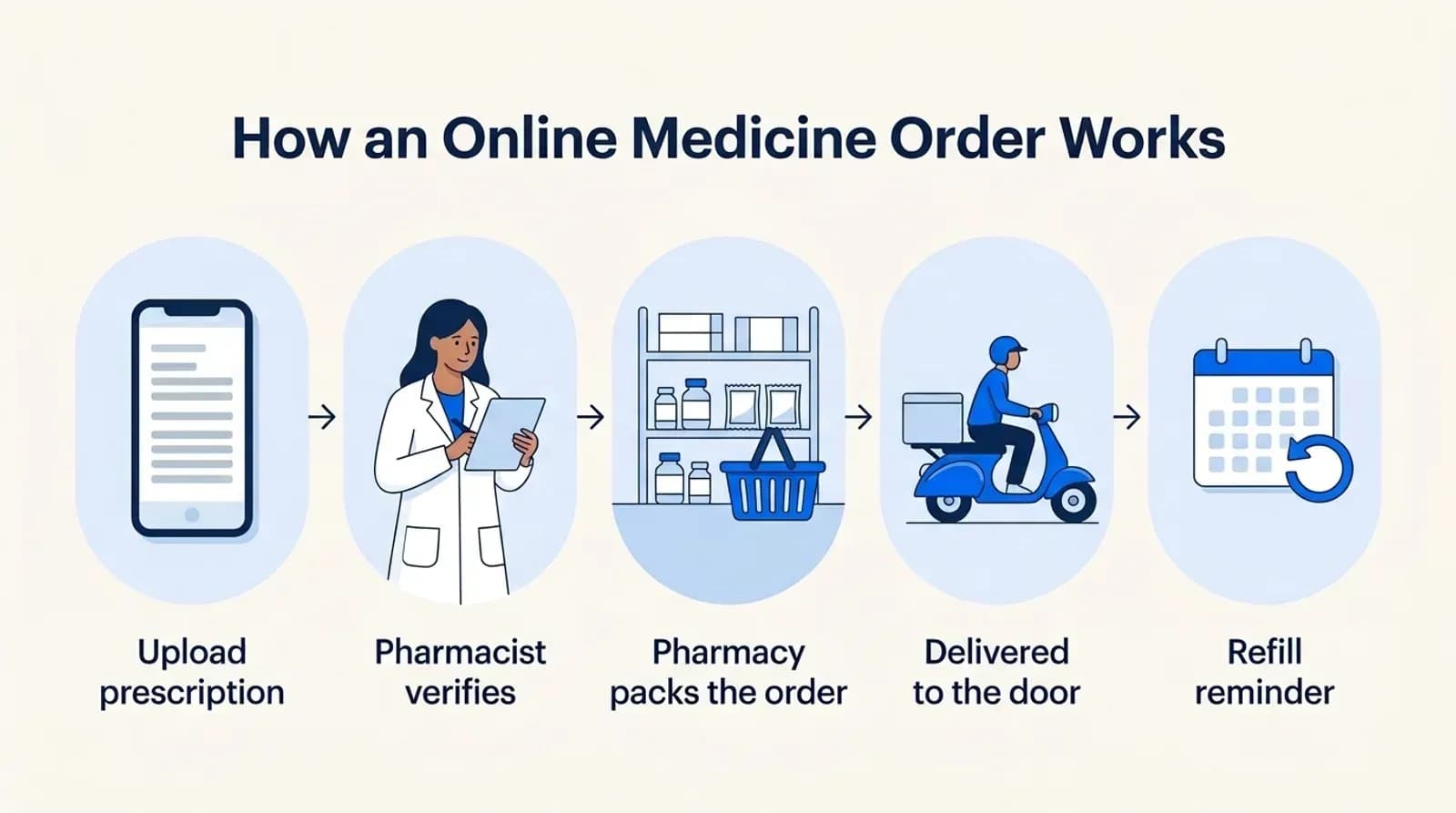
The most successful medicine delivery platforms did not win because they moved faster than others. They succeeded because they delivered responsibly and consistently, earning trust from patients, doctors, and regulators alike.
Key Stakeholders in the Medicine Delivery Ecosystem
A medicine delivery venture doesn’t operate in isolation. It is part of a complex ecosystem, where multiple stakeholders work together, which keeps medicine delivery high-quality and reliable.
If any link in the chain fails, patient care can be compromised, which is why understanding this ecosystem is one of the first steps in learning how to launch an online medicine delivery venture like 1mg.
1. Pharmacies
Pharmacies are the backbone of the system. They store medicines, manage inventory, and ensure that prescriptions are filled accurately. In a delivery model, pharmacies also oversee proper packaging, labeling, and quality control before the medicine ever leaves the building.
2. Pharmacists
Pharmacists are the frontline guardians of patient safety. They verify prescriptions, check for drug details and interactions, clarify dosage instructions, and answer patient questions. Even in a delivery model, their role is critical: they ensure that every patient receives the right medicine, in the right dose, at the right time.
3. Prescribers
Doctors and other prescribers initiate treatment by issuing prescriptions. They keep patient data accurate and up to date, and they may need to communicate with pharmacists if there are changes or special instructions.
4. Patients
Patients are the ultimate focus of the ecosystem. Their adherence, engagement, and feedback determine the effectiveness of the system. A successful medicine delivery service makes the experience as convenient, transparent, and supportive as possible for patients.
5. Delivery Partners
Delivery partners handle the last mile, transporting medicines safely and on time. Their accountability is clear: ensure medicines reach the patient in the condition, timing, and temperature required. Mistakes at this stage can directly affect patient health and trust.
How to Start a Medicine Delivery Business
Starting a medicine delivery venture isn’t offering shipping. It’s building a system that patients, pharmacists, and prescribers can rely on. Here’s a practical roadmap to get started.
#1 Understand the Market and Patient Needs
Before you build anything, pause and look at the world through your patient’s eyes. Imagine juggling multiple prescriptions, long pharmacy lines, and calls to doctors for refills. Think about the frustration, the missed doses, the constant mental load.
Who are the people most likely to want a solution that brings medicine to their door?
What hurdles do they face every week just to stay on track?
Which medications are essential to their daily routine, the ones they cannot afford to miss?
Data can tell you part of the story, but it’s listening that reveals the real gaps. Sit down with patients, pharmacy staff, and care providers. Hear their experiences. Notice the patterns. Observe where the system breaks and where a small intervention could make a huge difference.
This isn’t just research. It’s empathy in action. And it’s the first step in creating a medicine delivery online service that patients will trust and actually use, day after day. Because understanding comes first, everything else follows.
#2 Create a Business Plan
Once you’ve walked in your patients’ shoes and understood their challenges, it’s time to chart your path forward.
Think of a business plan not as a stack of documents, but as a story. Your story about how to launch an online medicine delivery venture like 1mg, outlining how it will operate, grow, and make a real difference.
Every great plan has a few critical chapters:
- Vision and Mission: Why does your service exist? What gap are you filling in patients’ lives? This is the “north star” that will guide every decision.
- Service Offering: Which medicines will you deliver? Will you offer home delivery, pick-up points, or both? How will you support patients along the way?
- Operating Model: Will you keep inventory and deliver directly, or partner with pharmacies? Each choice affects how you scale, manage compliance, and serve patients.
- Compliance and Regulatory Strategy: Licenses, pharmacist oversight, safe storage, and data privacy rules aren’t just boxes to check; they’re the foundation of trust.
- Operations and Logistics: How will prescriptions flow from doctors to patients? How will you manage inventory, packaging, and delivery? Reliability is everything.
- Financial Planning: Know your startup costs, automation and operating expenses, and a high-level revenue model. But remember, profit comes second to patient safety and adherence.
- Risk Management: Identify potential pitfalls early. Delivery delays, compliance lapses, and data issues can all impact patients’ health. Have strategies to prevent them.
- Growth Plan: Scaling isn’t just about more orders. It’s about growing responsibly without compromising safety or reliability.
A strong business plan does more than map your path. It tells the world (partners, regulators, and investors) that you’ve thought it through, that you understand the ecosystem, and that your venture is built on trust, care, and precision.
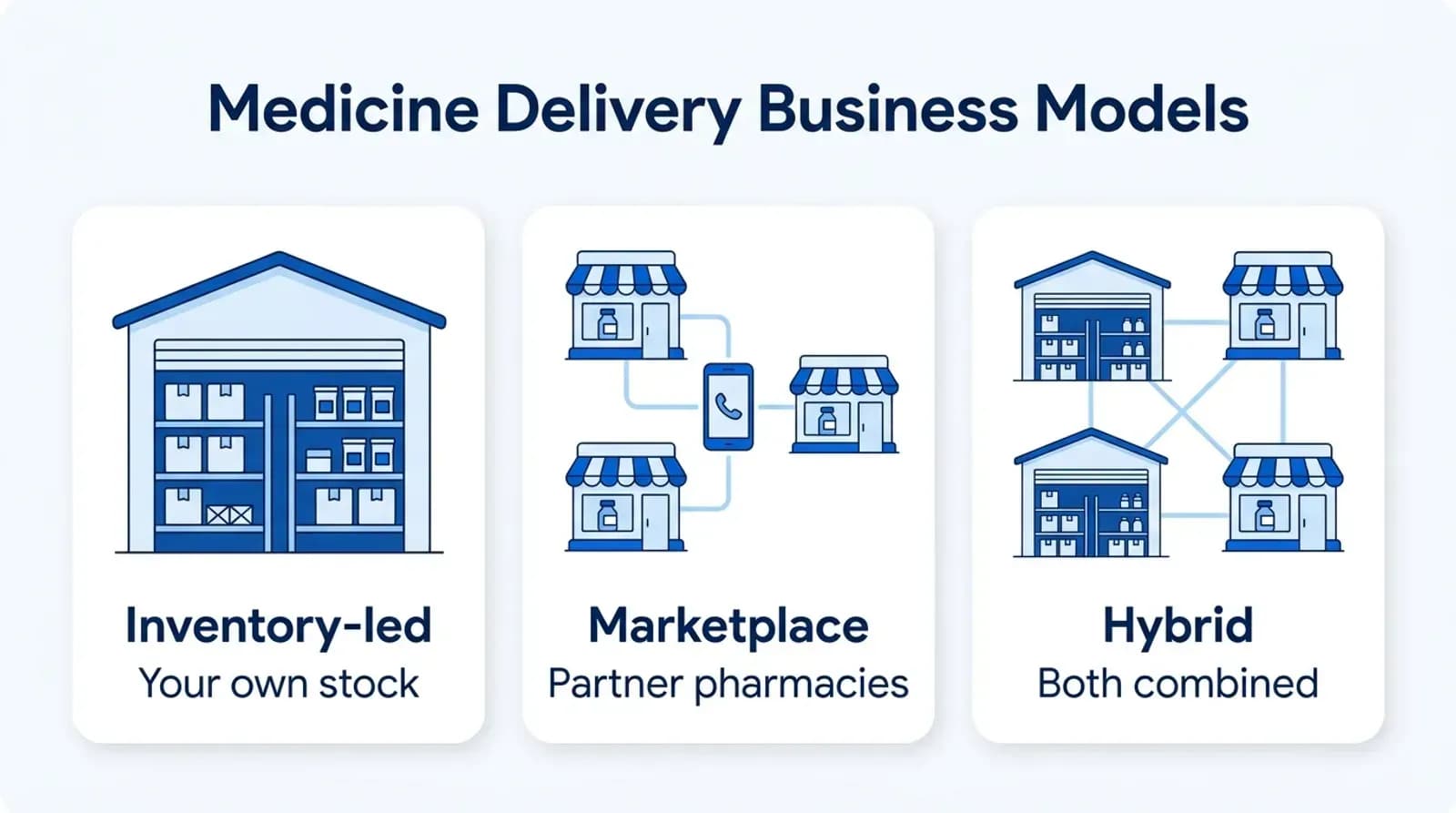
#3 Choose the Right Operating Model
Before building an app, onboarding pharmacies, or planning deliveries, the most important decision is how your medicine delivery business will operate day to day. Your business model determines your capital requirements, speed of launch, and ability to scale.
a. Inventory-Led Model
In this model, you purchase, store, and keep an up-to-date inventory yourself. Orders are fulfilled from your own warehouse or licensed pharmacy.
This gives you higher control over pricing, availability, and service quality, but it also comes with higher upfront costs, stricter regulatory compliance, inventory risk, and slower expansion. This model works best for well-funded companies with strong operational experience.
b. Marketplace (Partner Pharmacy) Model
Here, you work with licensed partner pharmacies that fulfill orders placed on your platform. You handle customer acquisition, prescription verification, order routing, and delivery coordination, while pharmacies manage stock levels.
This model allows faster market entry and lower capital investment, making it the most common starting point for first-time founders. Each partner still needs its own drug licence, and prescription checks remain your platform’s job.
c. Hybrid Model
A hybrid approach combines both models, using owned inventory in high-demand categories or core cities while relying on partner pharmacies elsewhere. This improves margin control in mature markets without slowing early growth. Many large platforms evolve into this model after validating demand. This is like a one-stop shop for healthcare needs.
#4 Set Up Regulatory & Compliance Foundations
Starting a medicine delivery venture isn’t just about logistics; it’s about delivering healthcare safely. Before you can send your first prescription, you need to lay a foundation that ensures patient safety, legal compliance and operational reliability.
India’s Rules for Online Medicine Delivery in 2026
India still has no final e-pharmacy law. The draft e-pharmacy rules published in 2018 were never finalised, and the government has repeatedly told the Delhi High Court it needs more time. Online sales run under the Drugs and Cosmetics Act, 1940, its 1945 Rules and a 2020 notice that allows home delivery.
The debate is still live. Chemists held a nationwide strike against online medicine sales in May 2026, but in September 2026 a government panel kept home delivery in place and asked for stricter enforcement.
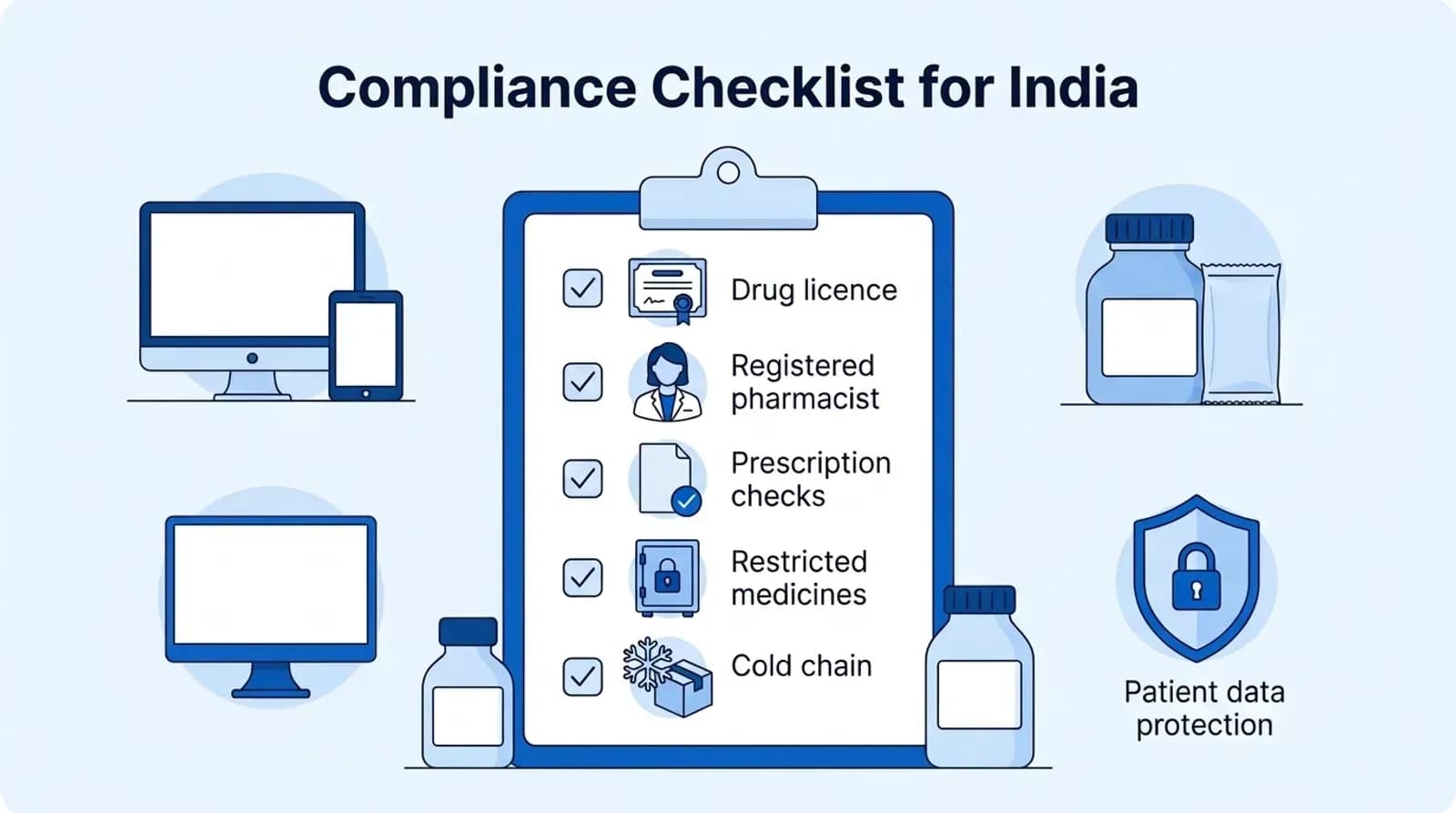
What this means for your platform:
- A drug licence for every pharmacy that stores or sells medicines, whether yours or a partner’s.
- A registered pharmacist who checks every prescription before dispensing.
- Prescription-only sale of Schedule H and H1 drugs, with an H1 register kept for three years.
- No online sale of Schedule X and narcotic drugs.
- Cold-chain handling for temperature-sensitive medicines.
- Consent and data rights under the Digital Personal Data Protection Act and its 2025 Rules.
- Teleconsultation under the Telemedicine Practice Guidelines, so users without a prescription can get one.
If You Launch in the US
A US launch needs a state pharmacy licence, non-resident licences for each state you ship to, a licensed pharmacist, DEA registration for controlled substances, and HIPAA-compliant handling of patient data.
Non-compliance in medicine delivery can lead to serious consequences. Regulatory violations may result in criminal charges, heavy fines, or even imprisonment in severe cases.
Businesses also face civil liabilities such as lawsuits, compensation claims, and license cancellations, while professionals involved risk suspension, permanent blacklisting, or loss of credibility.
Why a Digital App is Non-Negotiable for Medicine Delivery
For founders and pharmacy operators, the real risk of running medicine delivery without a platform is loss of operational control.
Orders arriving through calls, WhatsApp, or basic web forms create fragmented workflows, prescriptions sit in different places, inventory levels are checked manually, and delivery coordination depends on individuals rather than systems.
As order volume increases, teams can no longer answer operational questions with certainty: Which prescriptions are pending verification? Which SKUs cause repeat stockouts? Where are delays happening in the last mile? Without centralized visibility, decision-making becomes reactive, not strategic.
A structured web + mobile platform restores control at scale. The web system acts as the operational command center for prescription validation, pharmacist oversight, inventory movement, compliance logs, and reporting, while the mobile layer supports execution for delivery staff and field operations.
This separation allows founders to standardize processes, reduce dependency on individuals, and scale without increasing risk. Businesses that operate only on the web struggle to execute in real time; those without a platform struggle to govern at all. In practice, digital infrastructure isn’t about features; it’s about making the business manageable as it grows.
Build an App Like 1mg
Before building an app, start with market research. Identify cities with high demand, study prescription patterns, and analyze competitors like 1mg, PharmEasy, Netmeds, Apollo 24|7 and Truemeds to uncover gaps.
Next, define core features for your three main users: customers, pharmacies, and delivery partners. Customers need medicine search with generic alternatives, prescription upload, secure payment, and real-time tracking. AI-assisted search and refill reminders can be added as features.
Admins require pharmacy management and analytics dashboards, while delivery partners need route optimization and status updates. Developers turn these requirements into secure and modular app features.
Choosing the right tech stack is essential. Back-end frameworks like Node.js, Django, or Spring Boot, combined with front-end tools like React Native or Flutter, databases, cloud hosting, payment gateways, and mapping APIs create a robust infrastructure capable of handling thousands of users.
UI/UX design ensures the app is simple, readable, and easy to navigate, especially for elderly users. Developers optimize wireframes into interactive prototypes, creating a polished, intuitive experience.
Development and integration cover frontend, backend, and logistics. Backend manages data, authentication, prescription uploads, and refill reminders, while frontend handles screens, interactions, and notifications.
Logistics integration ensures optimized delivery routes, real-time tracking, and cold-chain support, with notifications via push messages, SMS, or email.
Finally, launch a first release in about 30 days with a soft rollout in one city, followed by a wider launch. Use SEO, social media, referral programs, and analytics to monitor engagement, retention, and growth, ensuring your medicine delivery app scales smoothly while meeting user needs.
Set Up Delivery & Last-Mile Operations
This is where planning meets execution. Regardless of how strong your platform or pharmacy workflows are, the operation succeeds only if medicines are delivered safely and on time.
A dependable last-mile setup depends on digital coordination, not manual input or judgment. Orders should be auto-assigned to delivery partners based on distance, delivery priority, and medicine type, while real-time order tracking keeps operations teams fully aware of progress.
At handover, delivery confirmation must be system-verified through OTPs, QR scans, or digital signatures, creating clear proof of delivery and accountability without slowing the process.
Equally important is how exceptions are handled. Failed deliveries, prescription rejections, last-minute stock issues, or unavailability at the doorstep should trigger predefined system actions rather than ad-hoc decisions.
The platform must guide next steps: re-delivery, restock medicines, pharmacist intervention, substitution approval, or refunds while maintaining traceability.
Returned medicines require special handling: they must be quarantined, assessed for compliance eligibility, or routed for proper disposal. A structured reverse-logistics process ensures regulatory integrity, protects patient safety, and keeps operations predictable even when things don’t go as planned.
Lesson from 1mg: How it Evolved into a Leading Medicine Delivery Platform
1mg didn’t start with delivery vans or pharmacy partnerships. It started with a simple but powerful idea: people deserve clear, trustworthy information about the medicines they take.
At a time when patients had to rely on vague labels or hurried conversations at pharmacy counters, 1mg stepped in to explain what medicines contained, what alternatives existed, what side effects to expect, and how prices compared.
By putting information first, 1mg earned something far more valuable than early revenue: trust. People came back not to buy, but to understand. And as they did, 1mg learned how users search, compare options, and think through their treatment choices. These everyday behaviors quietly shaped what the platform would become next.
As the platform grew, a clear pattern emerged. The same people reading about medicines often needed to buy them soon after. Instead of rushing into e-commerce, 1mg took a slower, more careful path. It partnered with licensed pharmacies, added prescription checks, and brought pharmacists into the workflow.
Along the way, it tracked prescriptions, validations, and order progress to make sure convenience never came at the cost of safety.
This shift changed what 1mg stood for. It was no longer just a place to look things up; it became a place where patients could research, decide, and receive care in one continuous flow.
Over time, 1mg began storing prescription histories and medication records, making repeat orders and long-term treatment easier for users who rely on regular care.
Why Did Chronic Care Become the Real Growth Engine for 1mg?
The biggest leap came when 1mg leaned into everyday health needs rather than one-time purchases. Monthly refills, diagnostic tests, and long-term treatments became central to the experience.
Instead of chasing discounts and deals or impulse buys, the platform focused on becoming part of a patient’s routine. Trust grew through consistent, compliant execution and pharmacist oversight.
That long-term thinking paid off. Tata Digital acquired a majority stake in 1mg in 2021, and Tata 1mg’s revenue reached about ₹2,936 crore in FY26, with its loss narrowing to ₹287 crore. It is now opening physical stores and faster delivery alongside the app.
India’s Online Pharmacy Competition in 2026
- PharmEasy: the largest independent player, which raised $216 million in 2024 at a 90% cut in valuation. It absorbed Medlife, which stopped operating in 2021.
- Netmeds: owned by Reliance Retail since 2020.
- Apollo 24|7: the digital arm of Apollo’s pharmacy chain.
- Truemeds: focused on lower-cost generic medicines.
- Quick commerce: Zepto launched Zepto Pharmacy in 2025, and Swiggy Instamart and Blinkit also sell medicines in fast delivery.
To compete, most new ventures focus on a niche: chronic-care refills, a single city with fast delivery, generic medicines, or a chain of existing pharmacies going online.
Launch Readiness Checklist for an Online Medicine Delivery Service
Before going live, ensure everything you’ve built works seamlessly under real-world conditions. Use this checklist to validate readiness.
End-to-End Flow is Validated
- Prescription upload, pharmacist review, approval, and rejection paths are tested
- No order moves to fulfillment without clinical verification
- Inventory reservation, packing, dispatch, and delivery tracking function as a single flow
- Proof of delivery (OTP, scan, or digital confirmation) is reliable
Compliance is Operational, Not Theoretical
- A licensed pharmacist actively oversees prescription decisions
- Prescription storage and retention meet regulatory requirements
- Controlled and temperature-sensitive medicines follow defined handling protocols
- Patient data access, logging, and security controls are live
People and Partners are Prepared
- Pharmacy partners understand verification, packing, and escalation rules
- Delivery teams are trained on handover, failed deliveries, and returns
- Internal teams know when and how to intervene during exceptions
SOPs are Documented and Followed
- Prescription verification and clarification processes are clearly defined
- Fulfillment, delivery, and reverse logistics procedures are documented
- Complaint handling, incident reporting, and escalation paths are established
Launch is Controlled and Measurable
- Rollout is limited to a defined geography or user group
- Live dashboards are closely monitored during early orders
- Feedback from operations and partners is captured and acted on before scaling
Partner with Appkodes to Launch Your Online Medicine Delivery Business Faster
Starting an online medicine delivery business requires more than an idea; it demands a scalable digital foundation. Appkodes helps you move from concept to execution by building a custom medicine delivery app. A first release starts from $8,000, with a costed plan at a fixed price, and most first releases go live in about 30 days.
When you partner with Appkodes, you gain access to mobile app development experts who understand healthcare workflows, pharmacy requirements, and advancing technology. From creating a mobile app to post-launch optimization, every stage is handled with precision.
Here’s how Appkodes supports your online medicine delivery journey:
- Single platform architecture to manage users, pharmacies, orders, and delivery of medication seamlessly
- Support for multiple shipping addresses, making it easy for users to order medicines for family members or different locations
- Detailed medicine information and clear prompts to help users follow dosage instructions safely
- Live stock levels, ensuring customers only order what pharmacies can fulfill
- Pharmacy onboarding tools that help pharmacies obtain, manage, and update their medicine catalogs efficiently
- Customer-focused features designed to attract customers and improve repeat orders in healthcare apps
- Continuous monitoring to correct software bugs, enhance security, and improve user experience as you grow
Whether you’re developing an app from the ground up or planning to roll out a medicine app in phases, Appkodes builds an app that adapts as your business scales.
We design and build every app new for its client, so your healthcare app is not just launched but built to last. Talk to us to plan your medicine delivery app.
Common questions
How much does it cost to build a medicine delivery app like 1mg?
With Appkodes, a first release starts from $8,000, with a costed plan at a fixed price. Pharmacy integrations, teleconsultation and multi-city delivery add scope.
Can I launch a medicine delivery app in 30 days?
Yes, as a first release. With Appkodes, most first releases go live in about 30 days, then you add features and cities as you grow.
Is online medicine delivery legal in India?
Yes, but the e-pharmacy rules are still in draft. Sales run under the Drugs and Cosmetics Act, with licensed pharmacies, pharmacist checks and prescription-only sale of Schedule H drugs.
Which business model is best for a new medicine delivery venture?
Most founders start with a marketplace of licensed partner pharmacies, which needs less capital, then add owned inventory in high-demand cities later.
Who are 1mg’s main competitors?
PharmEasy, Netmeds, Apollo 24|7 and Truemeds, plus quick-commerce apps such as Zepto, Swiggy Instamart and Blinkit that now deliver medicines.

Arun Andiselvam
LinkedInI am a startup veteran who has built five brands. I sold the first, an SEO tool, for a six figure exit, and now lead Appkodes, building custom mobile and web apps for founders and businesses. I bootstrapped every one of them from day one.