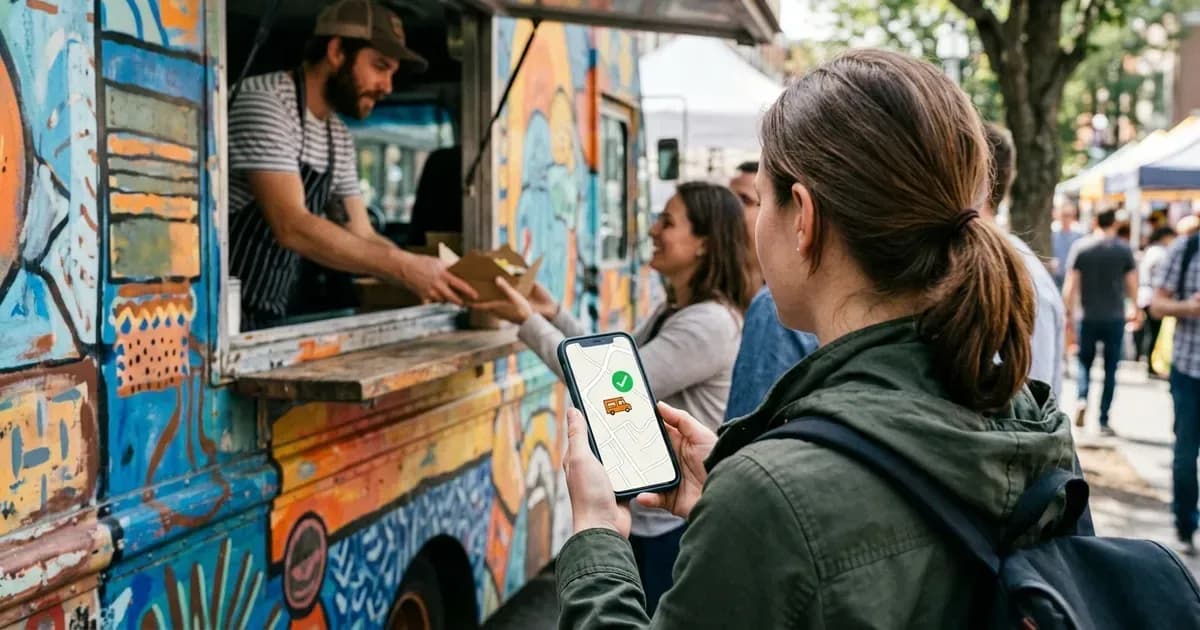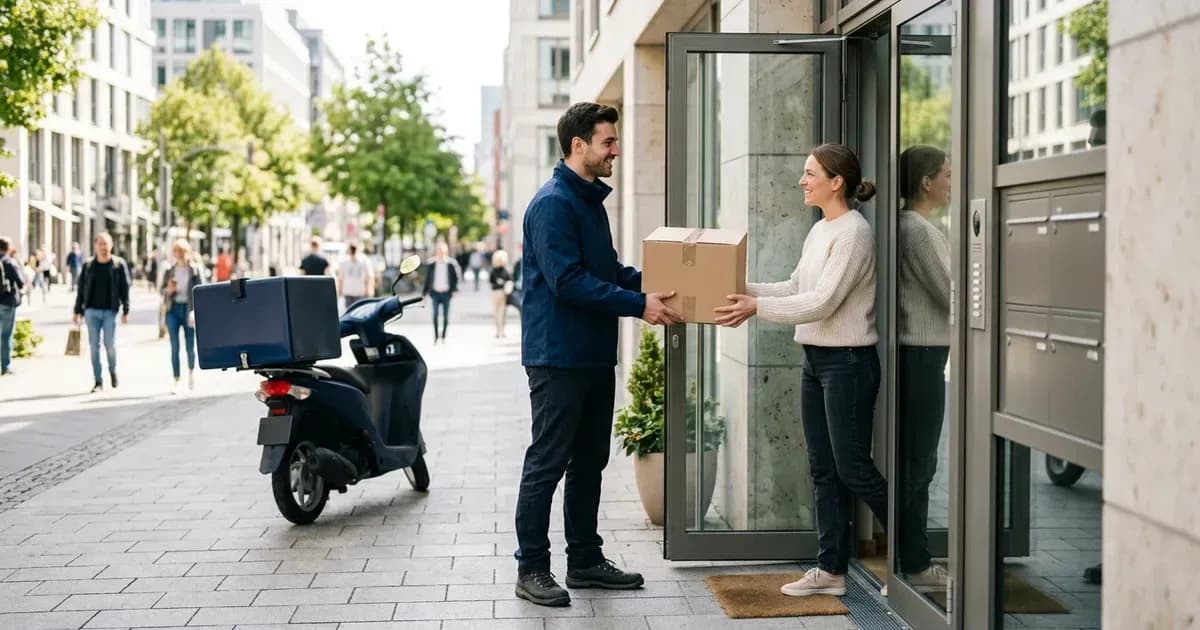
You’re at home waiting for a package you ordered yesterday. You pull out your phone and open an app and there’s a real-time map showing your delivery getting closer to your doorstep.
This is no longer a luxury, this is the new normal. In our digital age, the demand for courier services has skyrocketed due to the rapid growth of e-commerce and the need for fast delivery.
At the heart of this revolution is the process of creating a delivery app for the niche on demand. These apps have changed the way to start a delivery business by offering features like real-time tracking, route optimization, and automated dispatching, making operations more efficient and customers happy.
For example, integrating mobile apps with tracking technology has enabled same-day delivery companies to optimize routes and give consumers accurate estimated times of arrival.
This makes now the perfect time to find out all about how to start a courier business.
Why Start a Courier Business?
You need to start a courier business right now for the following reasons,
- High demand for online shopping has created a need for fast and reliable delivery services.
- Low Startup Costs for starting a courier service are a huge advantage.
- Scalability lets your small courier business expand based on demand.
- Flexibility allows you to operate locally, nationally, or even specialize in niche deliveries (food, medical supplies, or legal documents)
By leveraging these technologies, entrepreneurs can start a cost-effective, scalable courier business and be successful in a competitive market.
Now that we’ve covered the landscape and the technology available to you, let’s get into the practical steps to start a courier business with zero investment.
Which is the Perfect Time to Start a Courier Business?
The courier industry is growing rapidly, it’s the perfect time to enter this market. Let’s see why now is the best time to start a courier business:
Global and Regional Courier Industry Growth
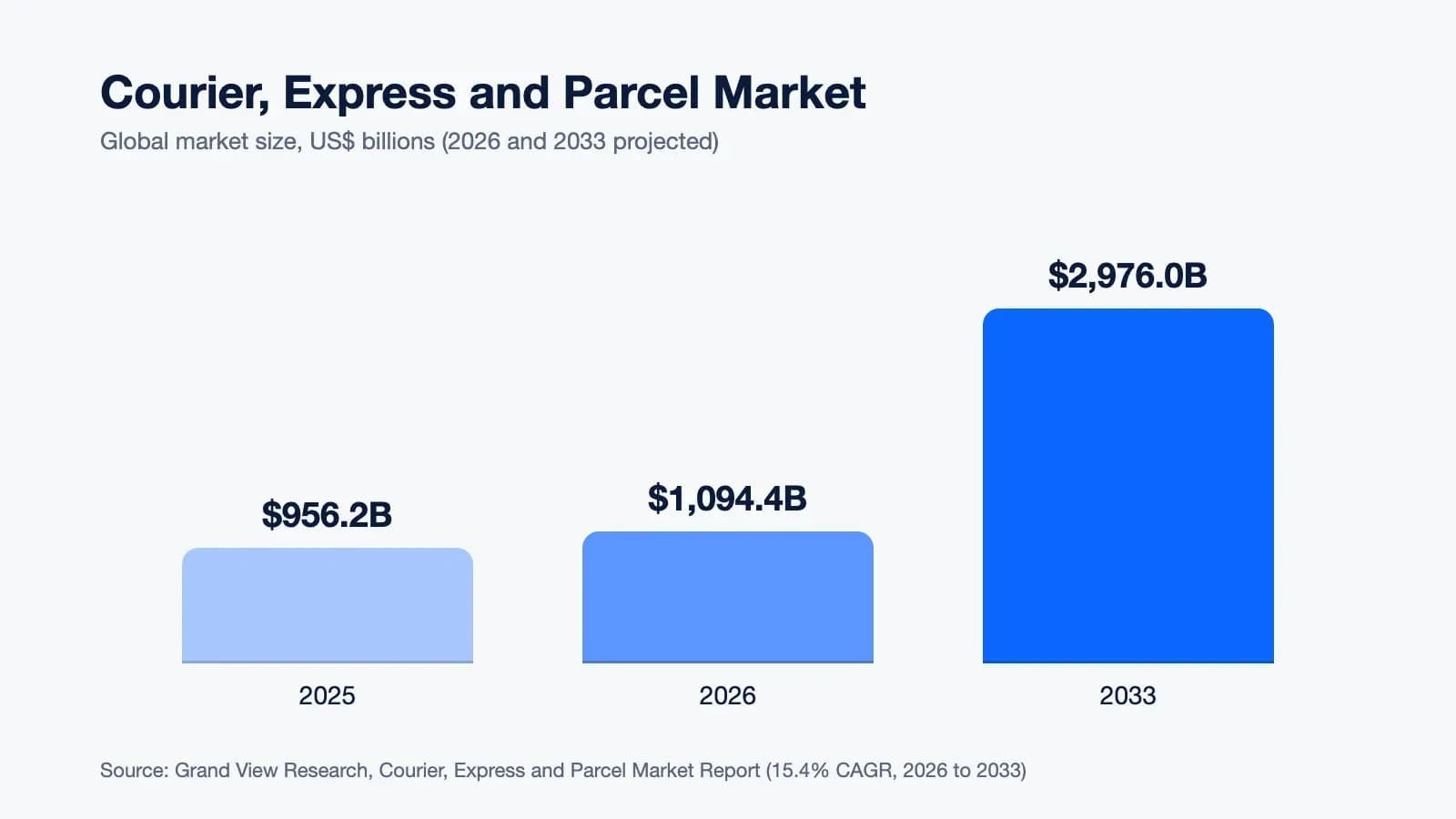
The global courier, express and parcel market was valued at approximately $956.2 billion in 2025 and is projected to grow at a compound annual growth rate (CAGR) of 15.4% from 2026 to 2033, reaching an estimated $2.98 trillion by 2033. This growth is mainly driven by the growth of e-commerce and the need for fast delivery.
Regionally India is seeing a lot of progress in quick commerce. Big players like Reliance are entering the market and trying to change the retail game by offering 10-30 minute delivery and leveraging their huge supermarket network. This is in line with the projection that quick commerce sales in India will reach $6 billion this year from $100 million in 2020. It went further than that: quick commerce orders in India were worth about US$7.6 billion in FY2025, more than double the year before.
How’s the Shift Towards Hyperlocal and Same-Day Deliveries Post-Pandemic?
The Covid pandemic has accelerated consumer demand for fast delivery services and hyperlocal and same-day delivery has seen a big shift.
In India, we saw successful startups like Blinkit (formerly Grofers, now part of Zomato’s parent Eternal), Zepto, and Swiggy Instamart all focused on ultra-fast delivery. Together, these three now handle almost all quick commerce orders in India.
These services have redefined the way we shop for groceries by delivering in minutes to the ever-increasing demand for convenience.
Globally big retailers are adapting to this trend. For example, Walmart has converted its thousands of physical stores into delivery hubs and can deliver millions of items same day including groceries. This has made the forerunners like Walmart a serious challenger to e-commerce giants like Amazon.
What are the Courier Business Opportunities?
The courier industry is booming, thanks to eCommerce. Also, hyperlocal delivery services and increasing consumer demand are contributing a lot. Entrepreneurs and business owners looking to get into this space have abundant opportunities. That, too, if they use technology to minimize investment and maximize efficiency, they are on the greener side.
Why Start a Courier Business in 2026?
Demand for fast and reliable delivery services is skyrocketing, driven by eCommerce, food delivery, and hyperlocal logistics. So, consumers want instant, trackable deliveries. Now, this is making technology-driven courier businesses more profitable than ever. By using automation and mobile apps, entrepreneurs have a great chance to make a difference with minimal investment, reduce operational costs, and maximize efficiency.
Yes, now creating such a scalable and competitive courier service is possible.
Online Shopping, Food Delivery & Hyperlocal Logistics Market Research
- eCommerce is growing, and more and more consumers are opting for doorstep delivery over in-store purchases. According to recent studies, global eCommerce sales are expected to reach about $6.9 trillion in 2026, making delivery solutions more necessary than ever.
- Food delivery and quick commerce (grocery, pharmacy, and essentials) are going mainstream. With platforms like Swiggy Instamart and Blinkit delivering in minutes, customers expect ultra-fast delivery for all products.
- Hyperlocal logistics is bridging the gap between businesses and customers. This has paved the way for same-day or even one-hour deliveries, making courier services a part of urban commerce.
Rising Customer Expectations for Faster Deliveries
- Today’s consumers want speed and transparency. Businesses that can’t meet these expectations will lose customers to competitors who can.
- Real-time tracking, AI-driven route optimization, and automated dispatching are no longer optional but must-haves for any courier business.
- Companies that use mobile apps to streamline delivery processes can provide better service at lower cost, making them more competitive in the market.
What are the Challenges of Traditional Courier Businesses?
Traditional courier businesses face many problems that increase costs and reduce efficiency. High operational costs, manual processes, and no automation lead to delays and mismanagement. And depending on third-party aggregators eats into your profit margins, making it tough to scale and compete.
High Operational Costs
- Traditional courier businesses need really huge investments. You need to take care of vehicles, warehouses, and staff. This makes it difficult for startups to compete.
- Rising fuel prices and inefficient route planning increase expenses, and reduce profit margins.
- Manual tracking and paperwork slow down operations. They may cause delays and errors in delivery.
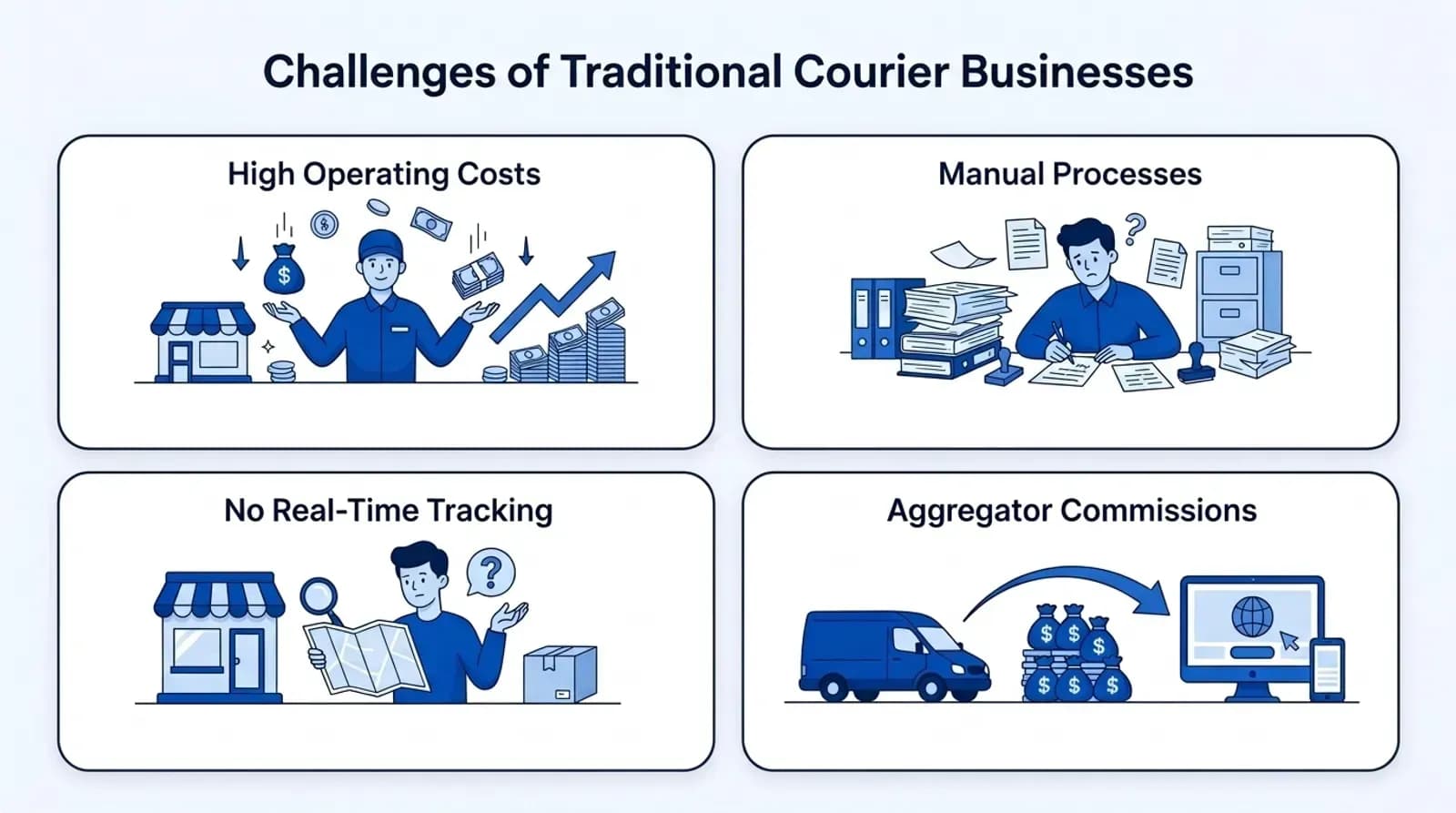
Inefficiency due to no Automation and Real-Time Tracking
- Many small and mid-sized courier businesses still use manual processes. This leads to inefficient operations and delays in deliveries.
- Without real-time tracking and automated dispatch, businesses find it hard to optimize routes. Also, they can’t allocate resources and provide users with accurate delivery times.
- No data-driven insights make it tough for courier businesses to scale and improve.
Dependence on Third-Party Aggregators
- Many small courier businesses need third-party delivery platforms like Uber Freight or Porter to get orders, paying high commissions on each transaction.
- This dependence cuts into your profitability and prevents you from building your own brand and customer base. And when a platform fails, its couriers lose their orders overnight: Dunzo went offline in January 2025.
- Having an independent courier app allows you to reduce dependence on aggregators, control your pricing, and maximize revenue.
How do Technological Solutions Fix the Problems in Traditional Courier Models?
Traditional courier businesses face many problems. A few among them are inefficient route planning, no real-time tracking, and high operational costs. But these can be fixed with the help of the growing technology. Find out how it works,
Route Optimization and Real-Time Tracking
Modern delivery management software uses AI to optimize routes and provide real-time tracking, for better efficiency and customer satisfaction.
Decentralized Distribution
Companies are setting up local distribution centers and fulfillment hubs near urban areas to reduce delivery times and logistical headaches of long-distance transport.
Flexible Workforce Solution
The use of third-party logistics providers and gig economy workers, like independent couriers and drivers, is becoming more common. So, now businesses scale up their delivery capacity quickly to match fluctuating demand. And, with these solutions new entrants can overcome traditional problems and milk the growing demand for courier services.
Now, taking into account the strong market growth, changing customer expectations, and technological innovations, this is the right time to start a courier business. And, with minimal investment and maximum profit.
Having established the market and the timing, let’s get into how to start your own courier business with minimal investment. The best of all is to start a courier business that proves to be profitable.
What’s the Solution?
A tech-first courier business model with a custom-built courier app can fix these problems and allow founders to start a courier business with minimal investment and maximum profit.
By automating dispatch, optimizing routes, and enabling customer interaction a courier app allows businesses to operate efficiently. This cuts off the burden of high costs.
Why I Need to Start a Courier Business App?
For years starting a courier business meant high capital investment – buying vehicles, hiring drivers, setting up warehouses, and managing complex logistics. But technology has changed this industry so you can start a courier service with minimal investment and maximum efficiency and profit.
An on-demand courier app eliminates many important traditional barriers. It lets you focus on smooth delivery operations without heavy upfront costs. Here’s how,
Low Setup Costs – Stop investing in a fleet of vehicles. You can choose to operate on an asset-light model by connecting with independent drivers through an app. Through this you can eliminate the need for setting up offices or warehouses means operational costs are minimal.
Better Customer Experience – Customers want speed, convenience, and transparency. An on-demand app offers real-time tracking, digital payments, instant booking, and automated notifications – more trust and retention.
Automated Operations – Manual operation comes with inefficiencies and delays. AI-driven route optimization ensures faster deliveries with lower fuel costs, automated order allocation, driver management, Etc. Even payment processing is seamless now.
By using an app-based approach courier businesses can reduce costs, improve service, and scale faster – the gap between investment and profit.
How to Start a Courier Business in 2026 with Zero Investment?
Starting a courier business no longer needs huge capital for vehicles, warehouses, or an extensive workforce. Choose the right business model, technology, and automation entrepreneurs to explore the logistics industry. This is how to make maximum profits with zero investment.
To be clear, zero investment here means no fleet, no warehouse and no big payroll. Your one real investment is the courier app itself, and it replaces most of the costs a traditional courier company carries.
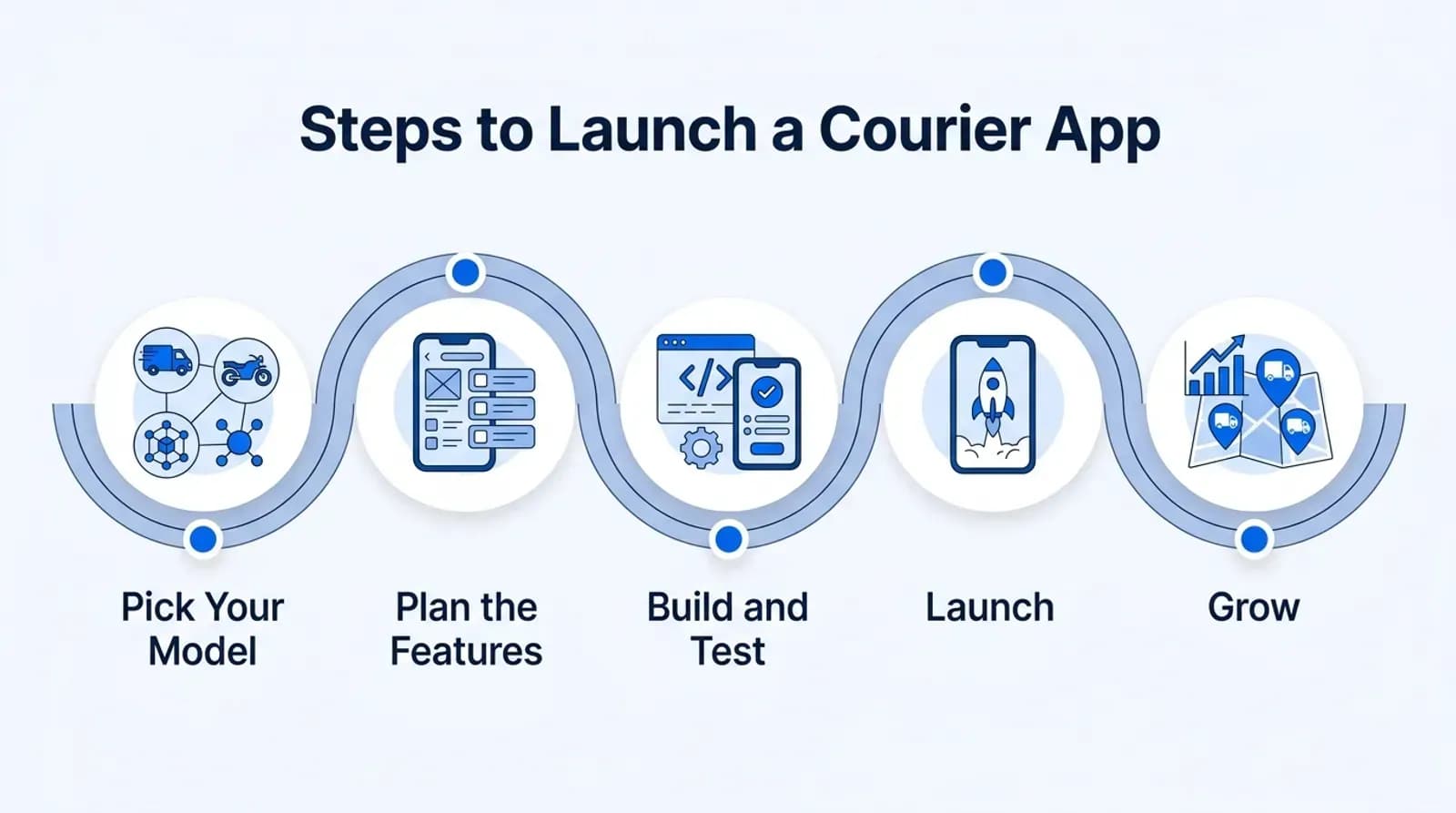
Ready to get started? By using an app-based approach, courier businesses can reduce costs, improve service and scale faster – the gap between investment and profit. The image below has the general steps involved in launching a courier delivery app.
Step 1: Choose the Right Courier Business Plan
Selecting the right business model lays the foundation for your courier service. The model you choose impacts operational costs, scalability, and market demand.
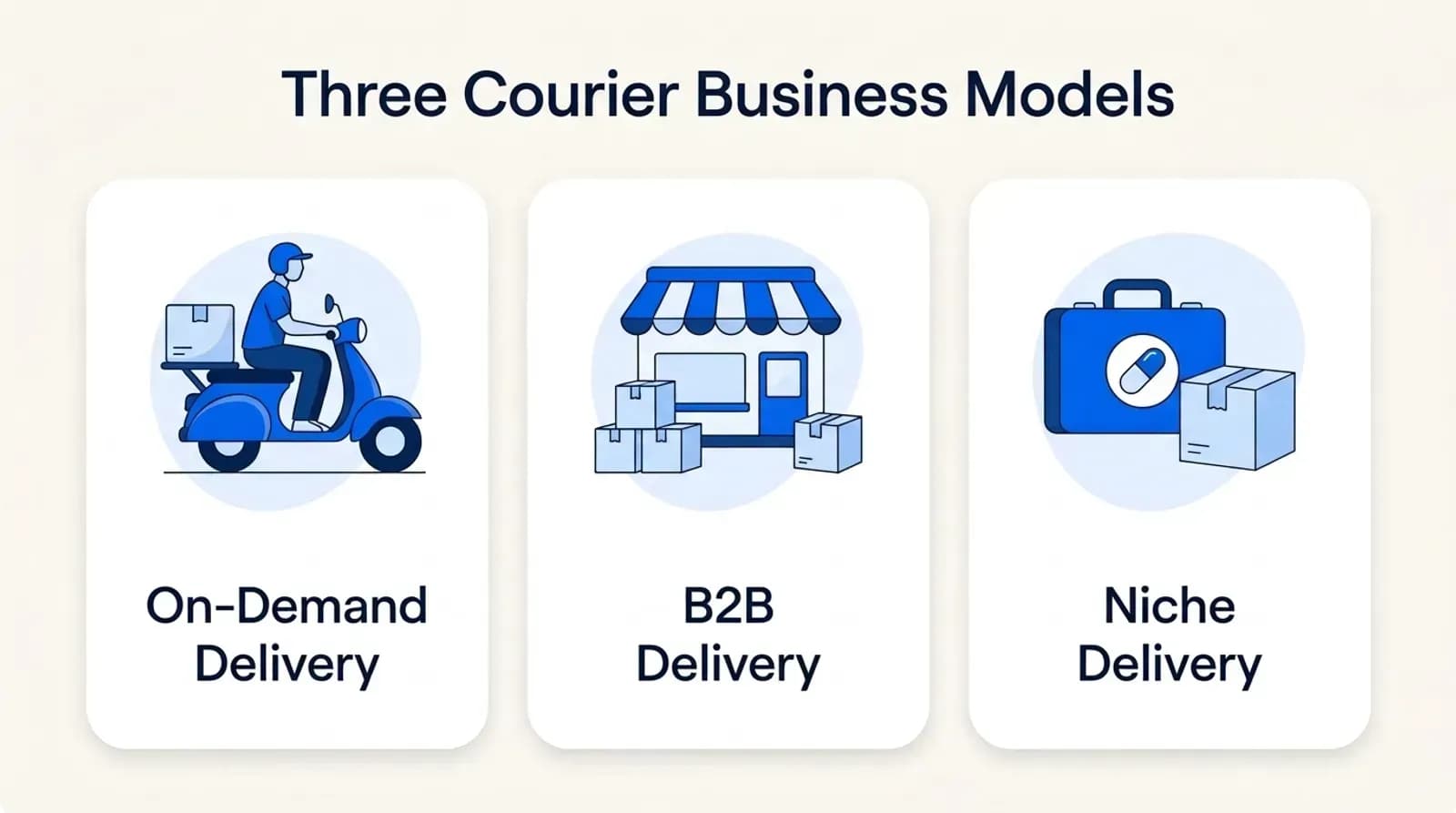
Independent On-Demand Delivery Service
This model is for individuals or small businesses that can do well with ad-hoc deliveries. Customers request deliveries through an app, and nearby couriers accept the job. Doing it this way minimizes infrastructure costs as it relies mostly on freelance drivers.
Partnering with Local Businesses (B2B Delivery)
Many small and medium businesses need regular deliveries of products, documents, etc. With on-demand B2B delivery services, you can build a steady revenue stream without requiring an extensive fleet.
Niche-Specific Delivery
Specializing in a particular industry allows you to stay unique with your courier service. Popular niche options include,
- Medical courier services (delivering pharmaceuticals and lab samples with strict handling protocols).
- Grocery and food delivery (working with restaurants and supermarkets for fast, last-mile fulfillment).
- Peer-to-peer (P2P) courier services (connecting individuals who need packages delivered within a city).
Find below the three courier business models side by side.
Step 2: Develop Your Own Courier App
A courier business’s efficiency and cost-effectiveness mostly depend on its technology. Stop spending on physical assets like a fleet and invest in a feature-rich mobile app to streamline operations and customer experience. AI features like route planning and smart pricing can sit inside it from day one.
Why a Custom-Built Courier App?
- A custom-built app is planned around your delivery model, your city and your customers, so you pay only for the features you need.
- It is yours: your brand, your pricing and your customer data, with no licence fees and no shared code to work around.
- It does not have to delay your launch. A focused first release with booking, tracking, payments and a driver app goes live quickly, and the rest follows as your orders grow.
Essential Features to Start a Courier App
To operate efficiently and reduce manual intervention, a courier app should have the following,
- Customer booking for a smooth interface for customers to book orders easily.
- AI-powered route optimization for faster and cheaper deliveries.
- Real-time tracking for customers and admins.
- Automated payment & invoicing for secure digital payment options and automated invoicing for businesses.
- Delivery agent management system to assign orders, track agents in real time, and manage overall courier platform performance efficiently.
Pro Tip-> Choose the Best App Development Company Choosing a delivery app development company is the best choice you can make as it gives you, A costed plan at a fixed price, built around your courier model. A focused first release that goes live fast, with more features added as you grow. Advanced features that boost efficiency and customer experience without high overhead costs.
Step 3: Leverage Third Party Logistics
Fleet ownership is one of the biggest expenses in the courier industry. Instead, business owners can reduce costs by partnering with third-party logistics providers.
- Partner with Freelance Drivers Going with the gig economy model allows businesses to hire independent couriers on a task basis. This eliminates fixed vehicle costs, insurance, and driver salaries.
- Collaborate with Existing Logistics Providers Partnering with local or national delivery networks allows businesses to deliver without maintaining their infrastructure. This is ideal for scaling without a big investment.
Step 4: Automate Operations
Automation saves costs and boosts service. With AI-powered features, you can deliver more efficiently.
- AI Route Planning to plan routes reduces fuel costs and delivery time, making operations more profitable.
- Auto-Assign Deliveries are based on driver availability and location, so delivery is faster and less manual.
- Push Notifications to customers about order status to reduce customer inquiries and support costs.
Step 5: Monetize Profitably
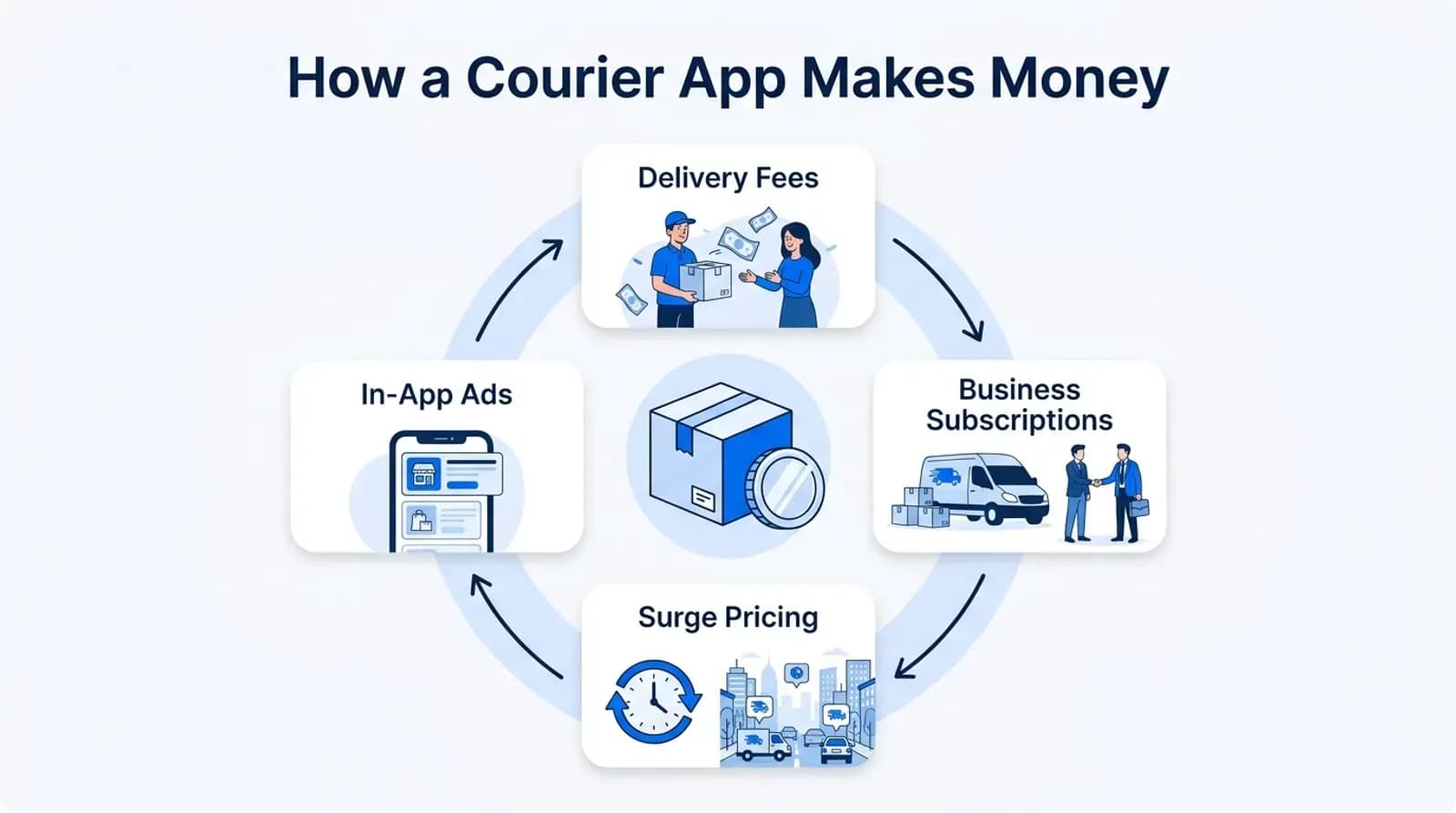
Monetization is key to sustainability. A courier business can make money through:
- Commission Based Charge a percentage per delivery, so you get a steady income with every order.
- Subscription Plans for Business Clients Offer business clients a subscription model with fixed pricing for bulk deliveries.
- Surge Pricing During Peak Hours Implement demand-based pricing to make more money during peak hours.
- Ad Revenue Inside the App Monetize by allowing third-party businesses to advertise in the courier app.
You can start a courier business with little investment by using technology, reducing infrastructure costs, and automating operations. A mobile app eliminates the need for big capital, while partnerships and third-party logistics help you scale without big expenses.
How Much Does a Courier App Cost and How Long Does It Take?
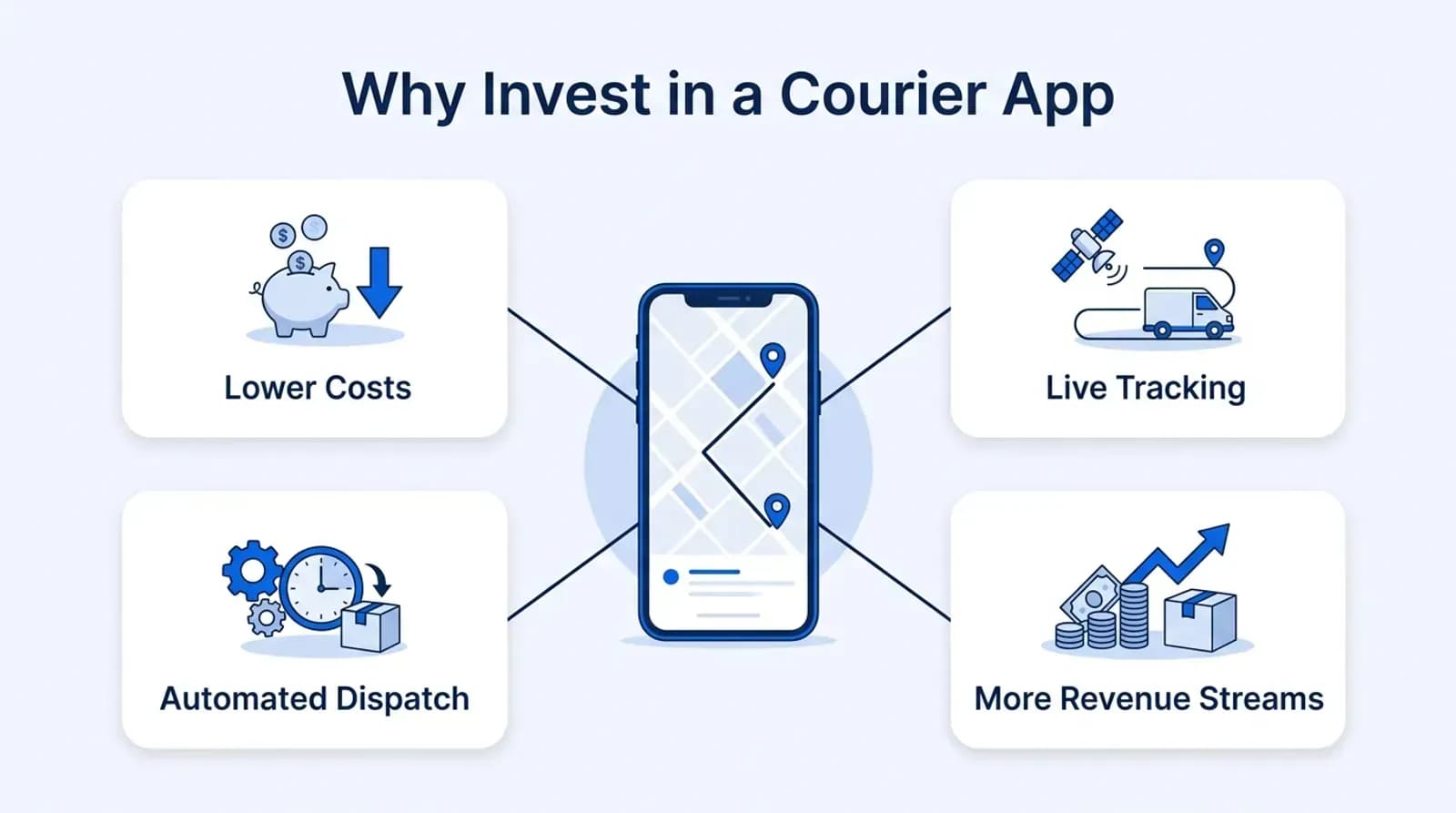
The cost of your courier app depends on the features, the apps you need (customer, driver and admin) and the integrations, such as payments and maps. A first release with booking, live tracking, digital payments and a driver app keeps it lean.
With Appkodes, the price and the launch date are agreed before any work starts, and most first releases go live in about 30 days. AI route planning, business subscriptions and surge pricing can follow in later releases.
How to Scale Your Courier Business and Maximize Profits?
Once your courier business is up and running, the next is to scale and maximize profits. Leveraging technology, expanding services, and optimizing marketing strategies will help you stay ahead and increase revenue.
Marketing & Customer Acquisition
Acquiring and retaining customers is key to long-term success. Implementing a well-planned marketing strategy will boost brand visibility and bring in a consistent flow of customers.
SEO & App Store Optimization for Visibility
Online presence is crucial to reach customers. Implementing SEO will ensure your website ranks higher on search engines and brings organic traffic to your business.
- Target keywords like “on-demand courier service near me” and “fast delivery services” to bring in local customers.
- Optimise website content with blog posts, landing pages, and FAQs to improve rankings.
- Invest in App Store Optimization (ASO) to get your courier app to rank higher in the Google Play Store and Apple App Store. Use relevant keywords, compelling descriptions, and high-quality screenshots to increase downloads.
Social Media & Referral Discounts
Social media is a powerful tool for customer engagement and brand awareness.
- Run targeted ad campaigns on Facebook, Instagram and LinkedIn to bring in customers looking for courier services.
- Use content such as customer testimonials, delivery success stories, and behind-the-scenes videos to build credibility.
- Implement a referral program where existing customers get discounts or free deliveries for referring new customers. This will encourage organic growth and customer loyalty.
Partnerships with Small Businesses Needing Delivery Solutions
Partnering with local businesses is cost-effective way to expand your customer base. Many small retailers, grocery stores, and pharmacies need delivery services but lack the resources to build their own logistics network.
- Offer customized subscription plans to businesses for bulk deliveries.
- Provide branded delivery services, where businesses offer your courier service under their own name.
- Negotiate long-term contracts to ensure steady revenue.
How to Upgrade Your Courier Business to Make More Money?
Expanding your services can give way to new revenue streams and get your business to a wider market.
International Courier Services
Going beyond domestic deliveries can increase profitability big time. Partner with international shipping providers to handle cross-border deliveries without investing in logistics infrastructure.
- Offer priority international shipping for higher prices.
- Leverage customs clearance automation to simplify cross-border shipping.
- Provide businesses with affordable bulk shipping options for international trade.
Warehousing & Fulfillment Integration
Include warehousing and fulfillment services to make your courier company a one-stop logistics provider. Businesses, especially eCommerce companies prefer end-to-end delivery partners.
- Give on-demand warehousing for businesses to store their inventory for faster dispatch.
- Provide same-day fulfillment services to process orders and deliver fast.
- Use AI-powered inventory management to optimize stock levels and reduce storage costs.
Invest in AI & Data Analytics
Artificial intelligence and data-driven insights can improve operational efficiency, reduce costs and customer experience.
Predictive Demand Analysis for Better Fleet Planning
AI-driven demand forecasting can help optimize delivery routes and reduce operational costs.
- Analyze customer order history and external factors (weather, traffic, holidays) to predict delivery demand.
- Allocate fleet resources dynamically based on peak usage times.
- Reduce idle time and fuel costs by optimizing vehicle routes.
AI-Driven Pricing Strategies
Dynamic pricing models can maximize profit while keeping rates competitive for customers.
- Implement surge pricing during high-demand periods to earn more.
- Offer customized pricing to businesses based on delivery volume and frequency.
- Use AI to adjust delivery charges in real-time based on distance, traffic, and urgency.
By implementing these growth strategies, your courier business can scale sustainably while keeping costs low. A well-optimized courier app backed by AI and data analytics will help you expand, attract more customers, and maximize profits.
How to Start Smart and Scale Fast in Your Courier Business?
To start a courier business, you need no more heavy investments in vehicles, warehouses, or manual operations. Go tech-first. This is how most successful entrepreneurs have reduced operational costs, automated their deliveries, and improved customer experience.
A feature-rich courier app powered by AI will have real-time tracking, optimized routing, digital payments, and seamless order management.
All of these are essential to run a profitable and scalable business. So, with the right approach, business owners can enter the logistics space with zero capital and high efficiency and customer satisfaction.
A focused first release can speed up your launch, and you add features as the orders grow.
Appkodes builds custom courier and delivery apps, with AI route planning and smart pricing as features inside them. You get a costed plan at a fixed price before any work starts. Start now and launch your logistics business with your own courier app.
Common questions
Can I start a courier business with zero investment?
You can start without a fleet, a warehouse or a big team by working with freelance drivers and local partners. Your one real investment is a courier app that handles bookings, tracking, dispatch and payments.
What is the most profitable courier business model?
Niche and B2B delivery usually earn the best margins: medical courier work, same-day delivery for local shops, and regular contracts with businesses. They bring steady volume and customers who pay for reliability.
What features does a courier app need?
Customer booking, real-time tracking, automated dispatch, digital payments and invoicing, a driver app, and an admin panel to manage orders, drivers and pricing. Route planning and demand forecasting can be added as you grow.
How do courier apps make money?
Through a commission or fee on every delivery, subscription plans for business clients, surge pricing during peak hours, and in-app advertising from local businesses.
How long does it take to build a courier app?
With Appkodes, most first releases go live in about 30 days, with booking, live tracking, payments and a driver app. The price and launch date are agreed before any work starts.

Arun Andiselvam
LinkedInI am a startup veteran who has built five brands. I sold the first, an SEO tool, for a six figure exit, and now lead Appkodes, building custom mobile and web apps for founders and businesses. I bootstrapped every one of them from day one.