
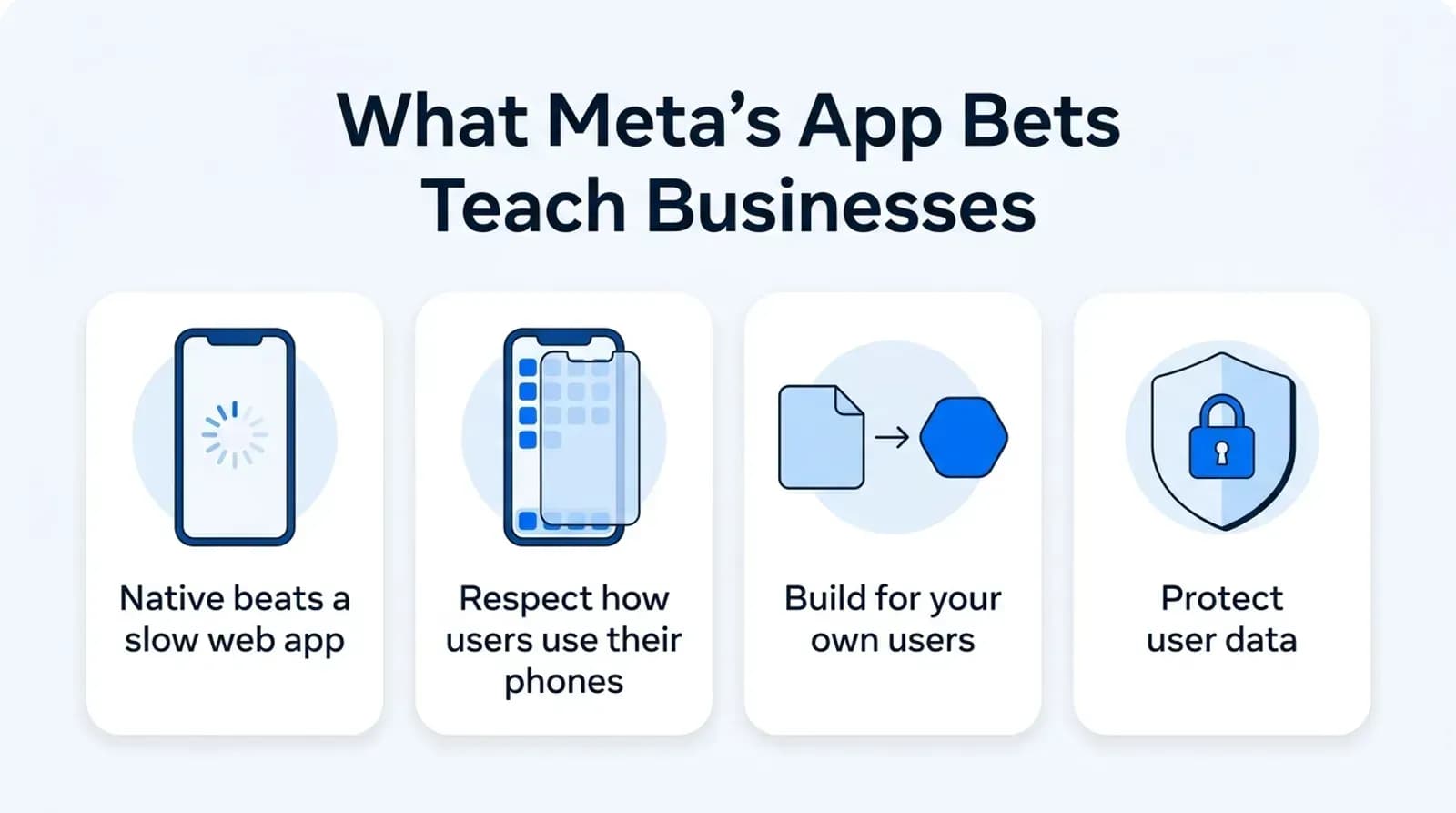
When was the last time you scrolled through Facebook? Even the biggest app company in the world gets things wrong. In 2012, Mark Zuckerberg told an audience that “the biggest mistake we’ve made as a company is betting on HTML5 over native”. Facebook’s early mobile app was slow, and it cost the company two years.
The list goes on. The standalone Facebook Gaming app shut down in 2022, and Facebook Watch was renamed Video in 2023. Facebook Dating is still running and got an AI dating assistant in 2025, but it never became the Tinder rival it was meant to be.
If you are about to create an app for your business, remember one thing: even the biggest players get it wrong when a product doesn’t fit what its users want.
Understanding the Rise and Stumble of Zuckerberg’s Formula
Facebook led the way in social networking, connecting people and growing businesses through mobile devices and websites. It changed how we share photos and videos through stories and reels, and how brands talk to customers.
Then WhatsApp made communication easy and secure, and it now has more than 3 billion users a month.
Not every bet paid off at first. Reels began as Instagram’s answer to TikTok and struggled early, but once it was shaped around Instagram’s own users it took off: Zuckerberg said in 2025 that Reels had an annual revenue run rate of over $50 billion. Threads, launched to attract Twitter users, saw engagement drop within weeks of its 2023 launch, then recovered to 500 million monthly users by June 2026. The Metaverse is still Meta’s most expensive bet: Reality Labs lost $6.02 billion in the fourth quarter of 2025 alone.
The same thing can happen to any business, from a startup to a market leader. The way to keep your business thriving is a tailored app strategy built around your own users.
Lessons for Businesses: Why You Need a Tailored App Strategy
Mark Zuckerberg’s approach to Facebook carries a valuable message: copying features or buying other companies can fuel growth, but it is risky if the product doesn’t fit its users.
Rather than simply copying successful ideas or buying competing companies, build something new that truly serves the needs of customers.
Bloomberg Opinion argued in February 2024 that Zuckerberg’s 20-year formula for success has expired. The lesson for your business: learn from a proven model, but build your own product around what your users need.
The success of an app in today’s marketplace depends on the right mix of learning from what works and building something your own users can’t get anywhere else.
12 Steps to Create a Mobile App for Your Business
Here are the 12 steps that are crucial to create a mobile app for your business and stand out from your competitors.
1. Define Objectives of Your App
It is very important to define the objectives before you create an app for your business, being a new start-up or just a business looking for innovation and transformation into new non-traditional forms of operations. First of all, start with sketching your ideas or creating a very easy and simple wireframe, something that can indeed be done using tools such as Canva or even freehand sketches.
This process will help you see your concept, give shape to your assumptions, and outline what the relationships are going to look like for the different modules of your application. From there, you’ll be able to better understand how different parts will interact with one another.
This is important to refine an idea. It’s a way of validating predevelopment by letting you know if some aspect of an idea is going to be a gap or an inefficiency early on. This saves much time and resources in the developmental phase, thereby ensuring the app matches your projection.
2. Validate Your App Idea
Validation comes next, whether you are a startup or a business going digital. This step makes sure your app idea resonates with your intended market and solves your target audience’s problems. The best way to do this is to build a Minimum Viable Product (MVP). It can be as simple as a clickable prototype or a basic web page that shows the core function of your app. It is not just a prototype but a way to gather early feedback from potential users.
The goal for this stage is to extract insightful feedback from your audience, for your early users are the most qualified validators of your app idea. Their feedback will further improve and define your app better.
Remember, it’s not the problem of getting your target audience to like your idea; it’s more of improving the concept based on their suggestions. Many successful businesses began that way.
3. Add AI Features Where Your Users Need Them
Advanced technologies, including but not limited to, Artificial Intelligence (AI), Large Language Models (LLMs), and Machine Learning (ML), can be your best friends only when they specifically match the market demand and your overall business goals.
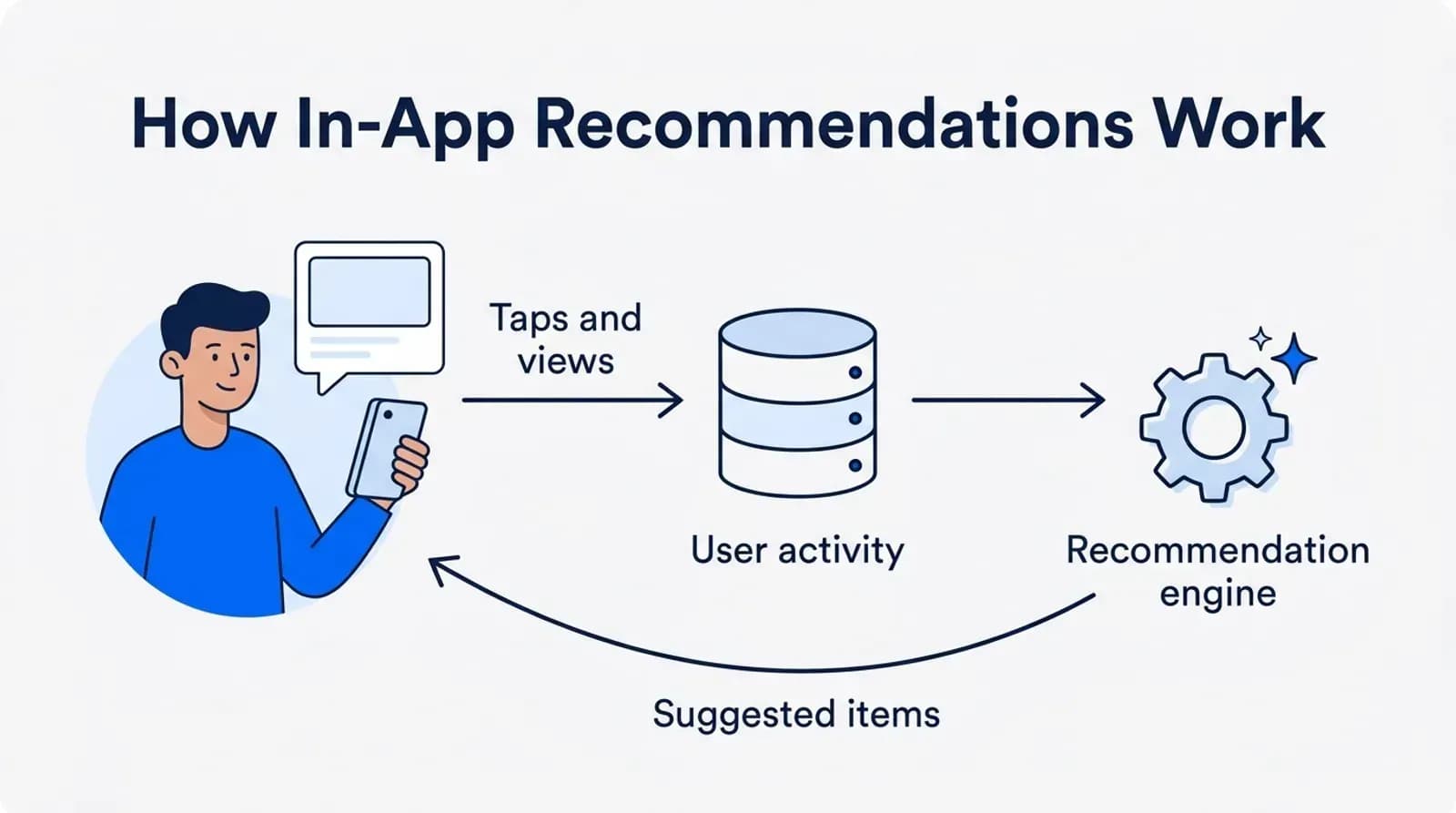
Used as features inside your app, they can recommend products or content based on what each user does, power smart search, and answer common questions through a support chat. These features help your app improve with use, but add them only where they solve a real problem for your users, since they also add cost.
4. Integrate Marketing Strategy from Day One
Marketing shouldn’t be an afterthought but rather something that is woven in and out of the development process. Determine the target audience from the get-go, and accordingly, design and determine features that best meet their desires.
Plan on developing growth-targeted features such as referral incentives, in-app social sharing, or user-generated content. Determine how you’re going to promote your application via SEO content, social media, partnerships, and influencers.
By bringing in marketing during development, your application can be much more easily marketed. There will be more pathways through which it can achieve organic growth.
5. Choose Between a Native App or a Cross-Platform App
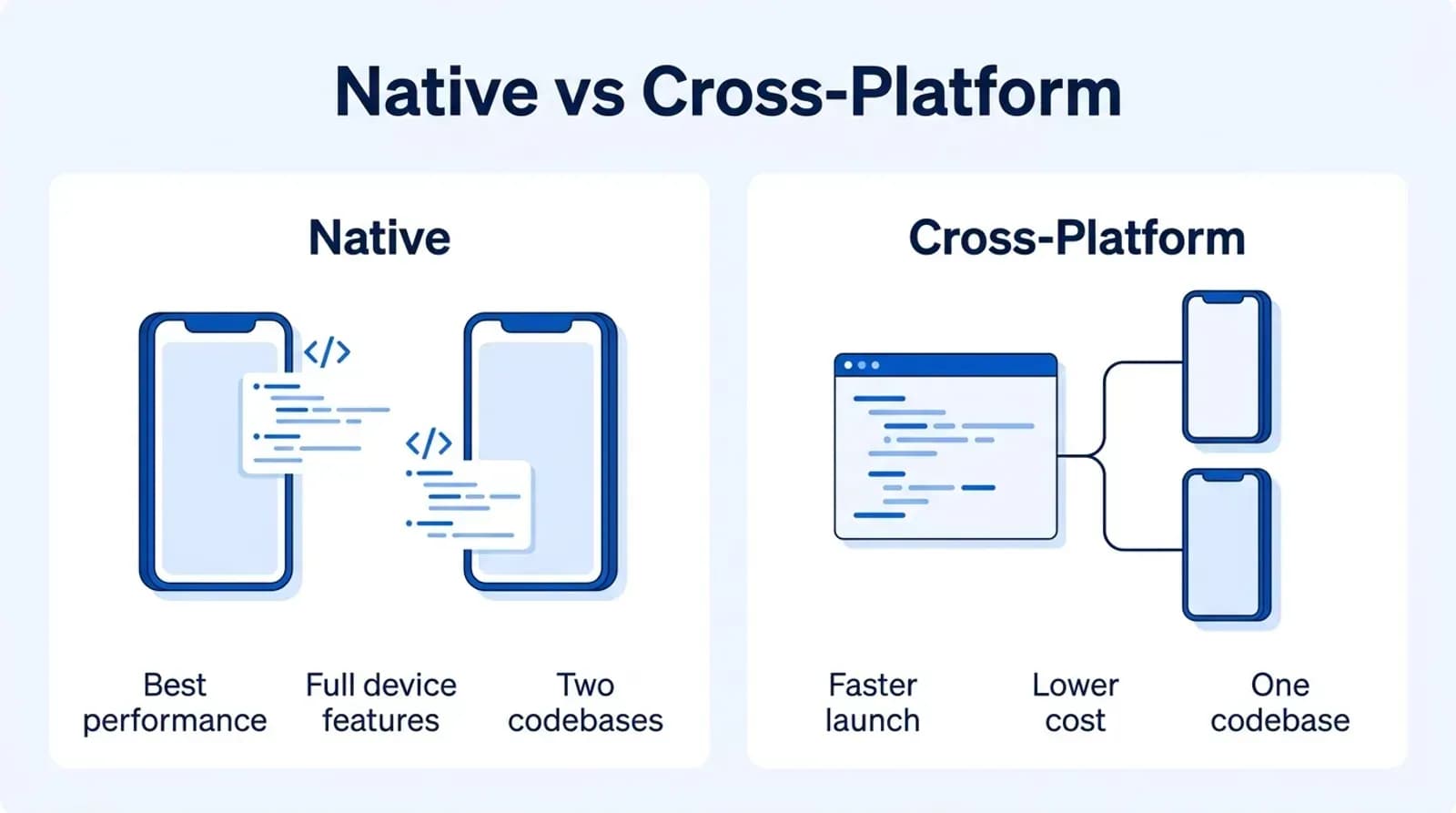
Another essential decision while you create an app for your business is whether it’s a native app or a hybrid, also known as a cross-platform app. The native apps will be built specifically to be most effective for a particular type of platform, like iOS app or Android app, and it uses the powers of the device for top performance. The native app provides a great user experience but comes at a greater price in terms of development and timelines since they need to design separate apps for each different platform.
Cross-platform apps use a single codebase that runs on both iOS and Android. They are quicker to launch and cost less to build, which suits startups and businesses that want both stores at once. Modern frameworks such as Flutter and React Native come close to native speed for most apps, but for heavy graphics or deep device features, native still wins. That is the real lesson of Facebook’s HTML5 mistake: choose the approach your app’s features need, not the one that looks cheapest.
After you have decided on the type of app, choose a development methodology. No two projects are the same: Agile, Waterfall, DevOps and others each suit different needs, objectives and resources.
Look closely at each one to decide which suits your project best. We have a separate blog on project management methodologies for startups to help you select the proper approach for a smooth and efficient development process.
6. Know When No-Code Is Enough
No-code app builders such as GoodBarber and BuildFire let people with limited technical skills or tight budgets launch simple apps.
They offer drag-and-drop editors and ready templates, which makes them fine for simple content apps, catalogs and event apps.
Their limits show when you need your own business logic, integrations with your systems, custom payments, or full ownership of your code and data. That is when a custom build pays off.
7. Leverage Product-Led Growth (PLG) for Scalable Marketing
Traditional marketing is all about external campaigns to drive awareness but Product-Led Growth (PLG) turns the product itself into the driver of user acquisition, conversion, and retention. Instead of pushing users through ads or promotions, PLG is about creating a frictionless experience where users can adopt, share, and advocate for the product naturally.
In PLG (Product Led Growth) the product becomes the primary touch point for the user and provides a frictionless experience from where users can get value and be motivated to share or advocate for the product organically. Since marketing strategy is infused into product development, then the application will be built to market itself.
By embedding growth features such as referrals and sharing into the product, PLG lowers customer acquisition costs and increases organic reach and retention. The result? A product that markets itself.
8. User-Centric UI/UX Development
For an app to be successful, whether it’s a start-up, a business that looks to innovate, or a transition from traditional approaches to digital, UI/UX development with a user-centric orientation is very important.
In the competitive market where first impression goes, that’s where the UI/UX comes in. A well-designed interface and user experience make all the difference between an app that thrives and one that doesn’t even gain traction.
Accordingly, UI/UX is one of the most critical things for startups and innovators. It leads directly to the engagement and retention of users. The intuitive interface attracts the user and keeps them coming back.
For traditional businesses going digital, bad UI/UX might create confusion and that will surely make potential customers run in the opposite direction. They won’t be checking out what your app is to offer. All validated app ideas, selected development methodologies, and marketing strategies will fail if the UI/UX does not meet expectations. Many businesses and even newbies prefer to opt for UI agencies to get their apps designed without any flaws. If you have the same thought then you should check our blog, how to choose a UI agency for startups.
Facebook learned this with Facebook Home, a layer that took over the home screen of Android phones in 2013. Users didn’t want Facebook to replace their home screen, and the HTC First phone built around it dropped from $99 to 99 cents about a month after launch. Home was later dropped.
A well-funded idea with strong technology failed because it did not match what users expected from their phones. It shows how a mismatch between what an app does and how people want to use it can undermine the whole strategy.
Therefore, UI/UX is the thing that holds the success of your app. It makes users comfortable and engaged while gaining trust and satisfaction. For any startup or enterprise looking to make an impact, such an investment in user-centric design is strictly a given. Otherwise, even the best ideas may go unnoticed.
9. Data Privacy & Security
It’s not only a technical requirement but a core of trust between your business and your users. This is most important for startups or businesses looking to innovate. Failing to do so might cause a loss of user trust and collapse your business model.
Authenticity and credibility are the key needs for start-ups. From day one, developing strong security encryption, safe authentication, and regular security audits decides your authenticity and helps keep users loyal to your app.
It does not matter how innovative or functional your application may be, if you ignore data security, it will mess up everything for you. Consider the case of Mark Zuckerberg and Meta. The company’s biggest trust failure was the Cambridge Analytica scandal in 2018.
In that case, data on up to 87 million users was improperly shared, and the FTC fined Facebook a record $5 billion in 2019. It showed how even a tech giant can lose users’ trust by being careless with data.
Integrating stringent security measures from day one, can protect your users and position your app as a trustworthy and reliable platform. This trust drives user loyalty and long-term growth.
10. Right Tech Stack & Optimization
Therefore, the right selection of tech stack and optimization is a must for startup businesses, the ones who are trying to innovate, and for companies switching over from the traditional model to the digital platform.
The tech stack forms the backbone of your app in terms of its performance, scalability, and user experience. Optimization ensures your application runs smoothly, fast, reliably, and engaging to users. Ignoring these aspects can lead to negative results, even if you’ve nailed your app idea and business strategy.
Startups are a fast-paced environment that depends on quick speed and performance. The issue here is the choice of an apt tech stack for business goals and future expansion plans. When it comes to digital transformation for businesses, it acts as a major challenge in terms of matching current technologies without disrupting established operations.
Here, again optimization becomes the need to bear the high traffic of users, and quick loading times, for a smooth experience across all devices.
Meta’s Metaverse push is an example. In 2022, a leaked memo from a Meta executive said “papercuts, stability issues, and bugs” made it too hard for people to enjoy Horizon Worlds.
Even the most ambitious ideas struggle if they are not built on a solid, well-optimized technical foundation.
Ensuring that your app is built on an advanced, scalable tech stack and keeping it continuously optimized for performance is in fact a survival strategy. So invest in the right technology from the start. This lets you innovate confidently, scale effectively, and provide users with an experience that keeps them coming back.
11. Test Your App on iOS and Android Devices
Testing the app on both iOS and Android devices is important while developing an application for startups, innovators, or businesses transitioning online. This is because success or failure is based on performance in a market.
This performance is dominated by various devices, screen sizes, and operating systems. Proper testing identifies bugs along with optimizing performance and guaranteeing compatibility. This works towards improving user satisfaction and retention.
Skipping this testing has a cost. A poorly tested app can crash, freeze, or give a bad experience, and potential users leave. Test on real devices, older phones and slow networks, not only on the latest models.
Once your app is fully developed and tested, submit it to the App Store and Google Play. Both have clear rules. On average, Apple reviews 90% of submissions in under 24 hours, and since April 28, 2026, apps must be built with Xcode 26 and the iOS 26 SDK. On Google Play, new apps and updates must target Android 16 (API level 36) from August 31, 2026, and new personal developer accounts must run a closed test with at least 12 testers for 14 days before release, so a company account saves time. Both stores also require an in-app way to delete accounts and a privacy declaration.
A detailed submission process can even make your application get approved as soon as possible so that you don’t have to jump over unnecessary hurdles to reach your target audience.
In short, testing and a proper submission are non-negotiables in the app development process. Getting them right avoids common pitfalls and sets your app up for long-term success.
What Costs Should You Plan For?
Before you build, plan for the full cost of owning an app, not only the build:
- The build itself: design, development, testing and launch.
- Hosting and third-party services such as maps, messaging and payments.
- Store fees: Apple takes 15% for small developers and 30% otherwise; Google Play’s new fee starts at 10% in the US, UK and EEA.
- Maintenance: updates for new iOS and Android versions, bug fixes and new features.
- Ownership: make sure you own the source code and the store accounts.
12. Improve and Update Your App Continuously
Launching your app is not the end. Continuous improvement and updates are needed. You may be a startup, innovator, or even transforming your traditional business. Your app must evolve to stay above the competition. Gather feedback and analyze user performance metrics.
This data is important for understanding user behavior and pain points. This lets you correct bugs, introduce new features, and improve user experience.
Having a normal app in such an ever-changing world is not the right strategy. Implement a cycle of constant updates and improvement to ensure retaining existing users of your app and also to draw in new ones and sustain growth over time.
Why Work with an App Development Company?
The lessons from Meta make one thing clear: the right development partner helps you avoid expensive mistakes.
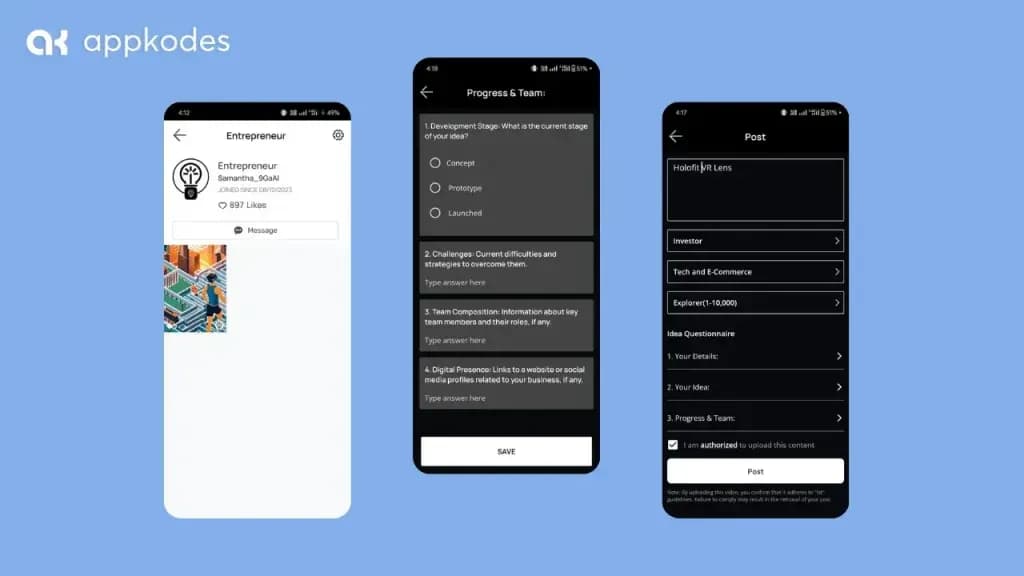
A client once came to Appkodes with an idea to connect entrepreneurs with investors. He first imagined a simple swipe-based app, like a dating app, where investors could swipe through startup pitches.
After understanding his goals, our team suggested a better format: short videos, so entrepreneurs could pitch their ideas and funding needs in a minute or two.
Short videos let entrepreneurs present their ideas in an engaging way, and investors can review each pitch quickly and get a clearer picture of every opportunity.
The result was a custom app, IST, where entrepreneurs show their vision and progress in video and investors make better-informed choices.
We also built in revenue features such as in-app purchases for the owner. Below you can see a few screens from IST.
Working with an experienced app development company helps you turn an idea into the right product, not just the first version you imagined.
Key Considerations When You Create a Mobile App for Your Business
However, an app idea alone is not enough to create an app for your business; some key factors need to be considered properly.
Scalability, Security, and User Experience: The Pillars of Successful App Development
A good application should always be built on at least three pillars: scalability, security, and UX. Scalability means your app can support the rising demand from users without interfering with the performance of the application.
Security secures user information and creates trust in the most data-sensitive world today. Lastly, well-crafted UX ensures that your app is intuitive, engaging, and retains the users over time.
Focus on Staying Ahead of the Curve
Another area in which a business should specialize is designing ahead of the curve. It will predict what the users would want and what could be their expectations in the future. Create a mobile app for your business with the vision of adaptability and innovation. An app built this way is more likely to thrive in a fast-changing market. Therefore, this is the main reason one needs the right app development company.
Why Collaborate with Appkodes Expert Development Team?
With a mobile app development company such as Appkodes, your idea is refined by people who have the technical skill to bring it to life, so your app meets today’s needs and can adapt to tomorrow’s. When you choose the right partner, you are not only building an iOS or Android app, but a scalable, secure platform for long-term growth.
At Appkodes, we design and build every app new for its client. Whether you are a startup or a business going digital, our startup mobile app development team can help you launch.
You get a costed plan at a fixed price before work starts, and most first releases go live in about 30 days.
Ready to create a business app that drives growth? Talk to us and let’s bring your idea to life.
Common questions
How do I create an app for my business?
Define your goals, validate the idea with an MVP, choose native or cross-platform, design around your users, build, test on real devices, then launch and keep improving.
Should I build a native or cross-platform app?
Cross-platform is quicker and cheaper for most business apps. Choose native for heavy graphics or deep device features. Facebook’s HTML5 mistake shows why this choice matters.
Can I use a no-code builder instead?
For simple content apps, yes. When you need your own business logic, integrations, custom payments or full ownership of your code, a custom build is the better choice.
How long does it take to create a business app?
With Appkodes, most first releases go live in about 30 days, with a costed plan at a fixed price agreed before work starts.
What do app stores require before launch?
Apple requires apps built with Xcode 26 since April 2026. Google Play requires Android 16 targeting from August 31, 2026. Both require in-app account deletion and privacy details.

Arun Andiselvam
LinkedInI am a startup veteran who has built five brands. I sold the first, an SEO tool, for a six figure exit, and now lead Appkodes, building custom mobile and web apps for founders and businesses. I bootstrapped every one of them from day one.