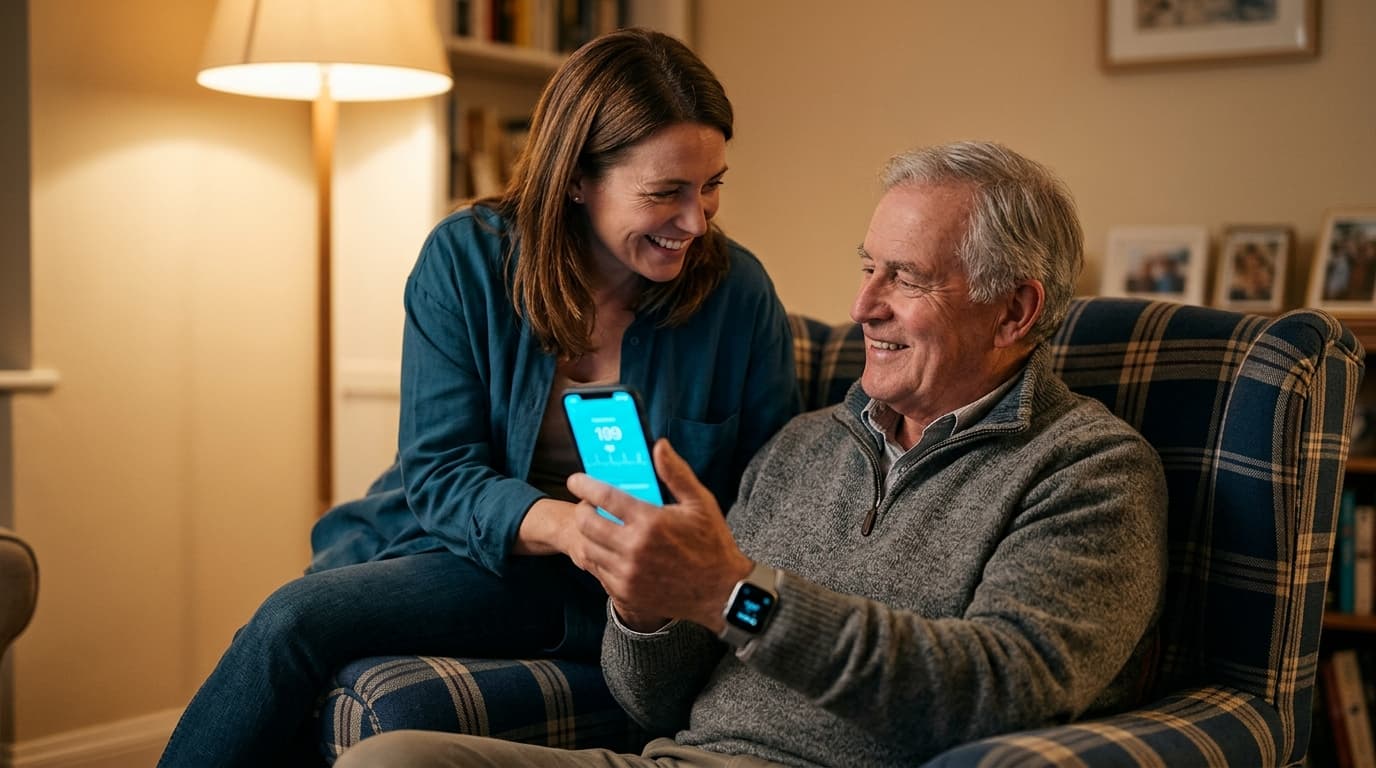

A real remote monitoring platform is not one app. It is a chain. A band on an elderly person's wrist, a path for that data to travel, a backend that decides what matters, a console where a caregiver on an eight-hour shift sees only the exceptions, and a phone in another country where an adult child needs to know their parent is fine. Break any link and the product fails, usually silently, which is worse.
We build these systems for clinics, care centers and health-tech ventures. This guide walks through the decisions that actually determine whether a build lands. How you integrate the wearable, how you ingest telemetry without losing it, how alerting escalates, what compliance costs you, and how to scope a first phase you can afford. Teams that make these calls early and deliberately tend to ship Health Monitoring App Development projects that hold together. It punishes teams who leave them to "we'll figure it out in sprint 6."
Start With the Service You're Running, Not the Features
Before architecture, settle what the product is. A 24x7 care center watching a hundred seniors who live alone is a wellness and safety service. It is not a diagnostic tool, and the language in your console should never suggest otherwise. Thresholds come from the client, they are configurable per patient, and the system raises a flag for a human to act on. That one decision cascades through your copy, your onboarding, your regulatory position and your liability.
The second framing question is who the product serves first. An internal tool for one care center has one tenant, one set of workflows and a forgiving user base you can train in a room. A commercial product sold to many centers needs multi-tenancy, per-tenant configuration and a support model from day one. Both are valid approaches. Choosing the wrong one wastes months. Teams build generic platform plumbing for a customer base that doesn't exist yet, or they hard-code a single center's rules into a product they later want to sell.
Our advice: build the internal tool properly, but with tenant separation in the data model from the first migration. Multi-tenancy retrofitted later is a rewrite. Everything else, billing, onboarding flows and white-labeling, can wait until a second center signs.
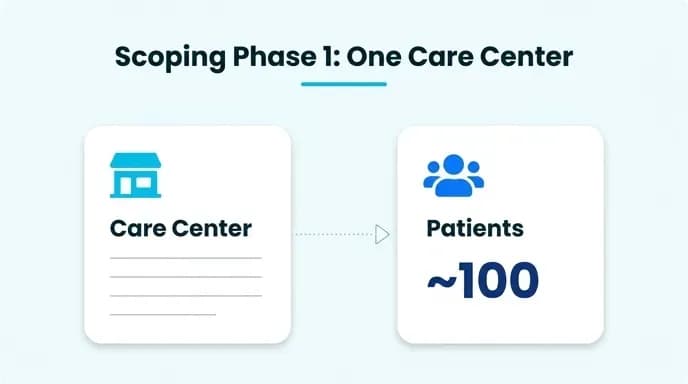
Scoping Phase 1: One Care Center, Roughly a Hundred Patients
A sensible first phase runs around sixteen weeks and covers one center, one band model, one language pair, Android only for family. That scope is not timid. It is enough to prove the hard parts. You will still have to solve ingestion reliability, the rules engine, the escalation matrix and consent, the four things that take longest and that no later phase can paper over.
What belongs in a second and third phase: additional care centers, iOS, a field app for staff who visit homes, WhatsApp notifications, reporting, a load test to multiple thousand devices, and deeper interoperability work.
Keeping the same team across phases matters more than people expect, since the knowledge of why a particular de-duplication rule exists lives in heads, not tickets. One component worth funding in Phase 1 even though it never ships to a patient: a device simulator capable of emulating thousands of bands. You need it for load testing, for UAT when real hardware is scarce, and for demos to investors and prospective centers. Teams that skip the simulator discover their scaling problems in production, with real seniors attached to the other end. We treat it as core infrastructure for any IoT health monitoring platform, not a nice-to-have.
Budget planning follows the same logic. First releases for remote patient monitoring software can start from around $8,000 with us, and that figure is a starting point tied to a defined scope, not a ceiling, and not a quote for everything described in this article. The honest version: cost scales with the number of integrations, the number of roles, the number of notification channels and the depth of audit you need. Nail the scope and the price holds. Leave the scope open and no one's estimate survives.
Wearable Integration: Build the Abstraction Layer First
Band makers give you an SDK or a cloud API. Neither will match the model you want. Fall events, SOS presses, wear-state and GPS usually arrive as vendor-shaped payloads with vendor-shaped semantics. The right move is to define a canonical schema for your system, covering observations, events and device states, then write a translation layer per vendor that maps into it. Your backend then speaks one language, forever.
This is the single highest-leverage decision in wearable health app integration. Bands get discontinued. Suppliers change pricing. A second center insists on the model they already own. With a translation layer, a new band is a new adapter and a test suite. Without one, it is a quarter of rework across the rules engine, console and family app.
Provisioning deserves the same rigor. Each device gets its own credentials or certificate, issued through a controlled process, revocable when a band is lost or retired. Shared keys across a fleet are a breach waiting for a news cycle.
Be explicit about what the band does versus what you do. If fall detection runs on the device, you consume the event. You do not re-derive it. That makes fall detection app development mostly a question of event handling, alert routing and false-positive management rather than signal processing. Geofencing, on the other hand, usually runs server-side on GPS fixes you receive. Document every hardware dependency in writing: battery reporting quirks, event latency, what happens when the band is charging, how wear-state is reported. These details are where production surprises come from.
Ingestion and Backend: Zero Silent Loss Is the Requirement
Device telemetry should arrive over MQTT where possible, with HTTPS as the fallback for networks or SDKs that can't do otherwise. Per-device authentication, rate limiting and TLS 1.2 or higher apply to both paths. Then the unglamorous work begins: validation, de-duplication, and handling readings that arrive out of order because a band buffered them while offline. A reading must be stored at its observation time, not its arrival time, or every trend chart you draw will lie.
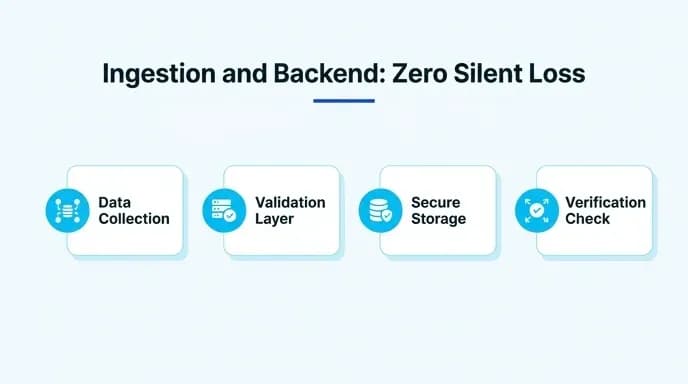
Store time-series data in something built for it, with roll-ups so a caregiver's trend view doesn't scan raw points. Build back-pressure and replay into the pipeline from the start. The standard to hold yourself to is zero silent loss. If the system can't process a message, it must say so loudly and keep the message.
On the backend itself, resist the urge to split into a dozen microservices. Modular and service-oriented with clear bounded contexts gets you most of the benefit. Split a service out only when scaling, team ownership or failure isolation justifies it. Document the API with OpenAPI 3.1 so the console, the family app and future integrators work from one contract.
The rules engine is the product's brain. It needs per-patient thresholds, sustained-breach windows so a single stray reading doesn't fire an alert, and composite conditions that combine signals. Crucially, thresholds must be editable by authorized staff without a deployment. If changing a number requires an engineer, caregivers will stop trusting the system and start ignoring it.
Finally, audit every access to patient data: who viewed which record, when, from where, written to an immutable log. You will need it for regulators, for internal investigations, and for the day a family asks who saw their parent's data.
Caregiver Console and the Alert System
The console is where the service lives or dies. Design it exception-first. A caregiver watching a hundred people cannot scan a hundred tiles. The default view shows what needs attention now, in severity order, with everything else collapsed into a calm summary.
Build for an eight-hour shift under fluorescent light. That means large hit targets, restrained color, no animation that pulls the eye for no reason, and alert sounds that distinguish severity without becoming wallpaper. Meet WCAG 2.1 AA. If your staff work in Malayalam and English, ship both from the first release. Bolted-on localization produces truncated labels and untranslated error states, and those are exactly the screens people read under pressure.
The caregiver alert system needs four severities and a configurable escalation matrix. An unacknowledged alert escalates on a timer to the next person in the chain. Notifications go out over SMS with DLT registration for India and push, each with delivery tracking, retry and failover to a second provider. De-duplicate aggressively so one fall doesn't generate six messages. Quiet hours apply to everything except Critical, which always breaks through.
A good caregiver alert system is judged on two numbers: how fast a Critical alert reaches the console, and how often it's wrong. Hold the first to a few seconds at p95. Manage the second by tuning sustained-breach windows and by giving caregivers a one-tap disposition on every alert, so the team can see which rules generate noise and fix them.
The alert worklist is the console's core screen: assign, acknowledge, escalate, close, with notes. Add a device fleet view showing battery, last-seen and wear-state, because an elderly monitoring app that quietly stops receiving data from a band on a charger is worse than no monitoring at all.
The Family App: Calm, Not Clinical
The family app serves a different human. An adult child overseas opens it at odd hours and wants one question answered: is my parent okay? The home screen answers that in plain words before anything else loads.
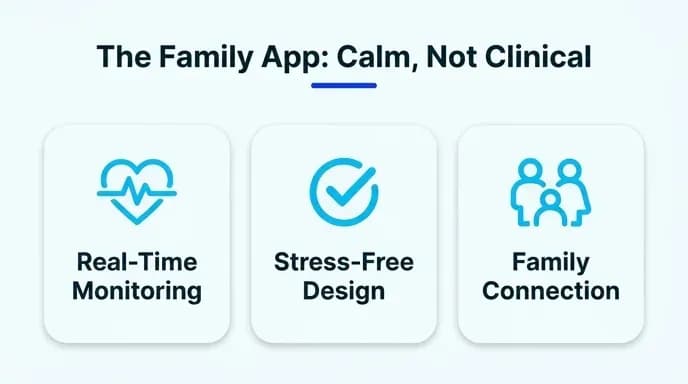
Sign-in is OTP, and it must handle international numbers properly, including country codes, delivery to foreign carriers, and a fallback when SMS doesn't arrive. Vitals shown are limited by what the patient consented to share. Alert history shows what happened and what the caregiver did about it, because the disposition is the reassurance. One-tap call reaches the care center directly.
Build for the phone people actually hold: Android 10, around 3 GB of RAM, and a 3G connection. That means a small APK, cached last-known state so the app opens instantly offline, and no video. Save iOS for a later phase unless your family base skews that way.
Consent control belongs in this app too. Families increasingly expect to see, and change, exactly what health information is shared and with whom, and giving them that control in the interface reduces support calls and builds trust faster than any marketing copy.
Healthcare App Compliance, DPDP and What It Costs
For an Indian deployment, the healthcare app compliance DPDP demands is not optional and not cosmetic. The DPDP Act 2023 requires real consent capture, a working withdrawal path, data-principal rights you can actually service, and retention rules the system enforces rather than documents. Production data stays in an India cloud region. Encryption in transit everywhere, AES-256 at rest, keys rotated on a schedule.
Build the data model so it maps to FHIR R4 and so consent is structured compatibly with national health infrastructure, even if you pursue no certification in the first phase. Retrofitting an interoperable model later means touching every table and every API. HIPAA and GDPR are useful benchmarks for engineering rigor. Outside their jurisdictions they are not your legal target, and we never promise guaranteed compliance with any of these regimes. That determination rests with your counsel and your auditor.
The costs founders underestimate: a paid discovery phase of two to three weeks to map data flows, run threat modeling, identify which vendor agreements you need signed, and freeze scope. Then security engineering across the build, covering SAST and dependency scanning in CI, vaulted secrets, OWASP Top 10 and API Top 10 coverage, MASVS L1 for mobile, and meaningful backend test coverage. Then a client-commissioned VAPT before go-live, with every Critical and High finding fixed. For US-facing products, Business Associate Agreements with every vendor touching patient data add legal review time to the schedule, not just paperwork. Our healthcare app development work builds these into the plan rather than discovering them in month four.
Healthcare projects run long for predictable reasons: consent flows have more states than anyone sketches, hardware behaves differently in homes than on desks, and security review is not a sprint you can compress. Add contingency to the compliance track specifically.
Avoiding the Oversights That Break These Builds in Production
The failures we see repeat. Time zones and clock drift on devices corrupt trends. Retry logic without de-duplication floods families with duplicate alerts at 3 a.m. No back-pressure means a provider outage silently drops readings. Notification providers fail without a configured fallback. Nobody load-tests the console with a realistic alert storm. Threshold changes require a deployment, so they never happen.
Prevention starts with research before code. Sit with caregivers during a real shift. Watch what they do when an alert fires, what they write down on paper because the software doesn't support it, and which screens they keep open. Talk to two or three families about what would reassure them versus alarm them. A week of this reshapes the backlog more than a month of internal debate.
Use third-party services where they're mature, for messaging and authentication among other things, and spend your custom development on the rules engine, the console and the integration layer, which are the parts no vendor sells you. Our notes on wearables in healthcare and digital transformation in healthcare go deeper on where that line sits, and our app development guides cover the planning steps in sequence.
One more constraint worth writing into your contract: a mainstream, hiring-friendly stack, with cloud accounts, repositories, CI/CD, signing keys and third-party credentials in your name from day one. If you intend to take maintenance in-house within two years, lock that in before the first commit.
Getting the Build Started
Our experience across many years and many clients has taught us that the projects which land are the ones where scope, price and launch date are agreed before anyone writes code. That's how we work: fixed price, fixed launch date, with the discovery phase producing the document both sides sign off on. Costs vary with scope, and we'll tell you where yours is heading before you commit.
If you're scoping an elderly monitoring app, a caregiver console or a wearable-driven platform, send us what you have, even if it's a one-page brief. We'll come back with an architecture, a phase plan and a fixed quote.
Common questions
What is the most important thing to decide before building a health monitoring app?
Start by settling what service you're running, not the features. Define whether you're building a wellness and safety service or a diagnostic tool, as this decision cascades through your copy, onboarding, regulatory position and liability. You should also decide early whether you're building an internal tool for one care center or a commercial multi-tenant product, as choosing wrong wastes months.
How should I integrate wearable devices into a health monitoring system?
Define a canonical schema for your system covering observations, events and device states, then write a translation layer per vendor that maps vendor payloads into it. This makes adding new bands a simple matter of creating a new adapter and test suite, rather than reworking your entire rules engine and apps when bands get discontinued or suppliers change.
What should I build in the first phase of a health monitoring app?
A sensible first phase runs around sixteen weeks and covers one care center, one band model, one language pair, and Android only for family. This scope is enough to prove the hard parts: ingestion reliability, the rules engine, the escalation matrix, and consent. A device simulator capable of emulating thousands of bands is worth funding in Phase 1 even though it never ships, since you need it for load testing, UAT, and demos.
Arun Andiselvam
LinkedInI am a startup veteran who has built five brands. I sold the first, an SEO tool, for a six figure exit, and now lead Appkodes, building custom mobile and web apps for founders and businesses. I bootstrapped every one of them from day one.