
If you're planning a rental or booking business, the first number you need isn't revenue. It's build cost. The honest answer is that rental app development cost sits on a wide scale. A lean first release can start from $8,000. A polished cross-platform MVP commonly lands near $20,000, and a two-sided marketplace with payments, messaging and dispatch realistically runs $30,000 to $40,000 at minimum. Heavily customized versions with bespoke design, deep integrations and scale-ready infrastructure can climb into the $100,000 to $200,000 range.
Those gaps aren't random. They map to decisions you make in the first two weeks. How many features go in release one, whether you build native or cross-platform, how much backend logic you need, and who writes the code all play a part. This guide walks through each of those decisions and what it does to your budget.
What the Cost to Build a Rental App Looks Like by Stage
Think in three tiers rather than one number.
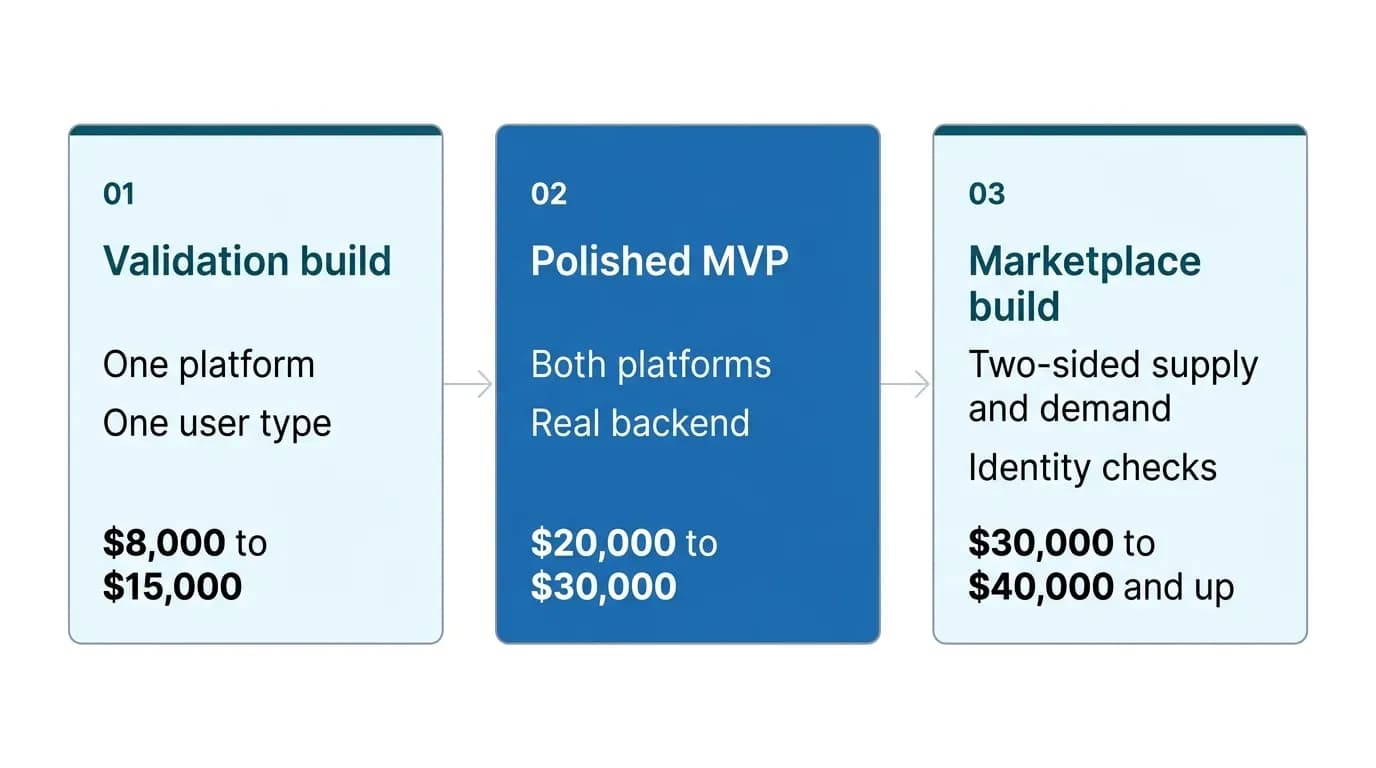
Tier one: the validation build ($8,000 to $15,000). One platform or a responsive web app, one user type doing one job well, covers this tier. Browse items, check availability, request a booking, pay. Admin handles the rest manually through a simple dashboard. We've shipped first releases in this band for delivery apps, team messaging tools and remote patient monitoring software, and the pattern holds for rentals. You're buying proof that people will book, not a finished product.
Tier two: the polished MVP ($20,000 to $30,000). Both platforms via a cross-platform framework, real backend, user accounts, payment capture and release, a calendar that prevents double-booking, notifications, and an owner-side app or portal. This is where most rental founders should aim their MVP rental app budget if they already have demand signals.
Tier three: the marketplace build ($30,000 to $40,000 and up). Two-sided supply and demand, in-app messaging, identity checks, deposits, damage claims, ratings, payouts, multi-location or multi-currency. Every feature has to work for two audiences with different incentives, and the rules between them get complicated fast, which is exactly why rental marketplace app cost rises here.
A quick sanity check applies across all three tiers. If a quote for a two-sided rental marketplace comes in under the validation tier, something has been left out of scope, usually payments, admin tooling, or testing.
Why Backend Complexity Drives Most of Your Rental App Development Cost
Founders tend to price the screens. Developers price the logic behind them. That gap is where budgets break.
An uncomplicated app with no accounts, no stored data and no payments is genuinely cheap to build. Think $3,000 to $10,000 of work. Add authentication, a real database, messaging and payment processing and the same app can push past $15,000 without a single extra screen appearing. Rentals make this worse than most categories, because availability is a hard problem. You need to hold inventory while a booking is pending, release it when payment fails, block out maintenance windows, handle overlapping date ranges, and prevent two people from booking the same unit at the same second. None of that is visible in a design file, and all of it costs money.
Here's roughly what individual features add once the foundation exists:
- Authentication and user profiles: modest on their own, but social login, phone verification and role-based permissions (renter, owner, admin) each add work.
- Payments: the biggest single swing. Charging a card is straightforward. Holding a security deposit, splitting a payout between platform and owner, refunding partial amounts and handling failed captures is a project of its own.
- In-app messaging: real-time infrastructure, push notifications, read states and moderation. Easy to underestimate, expensive to retrofit.
- Availability and calendar logic: the core of any booking product, and the part worth paying properly for.
- Admin and operations tools: the screens you'll live in daily. Skip them and you'll pay for them later in staff hours.
When we scope a project, we price the backend first and the interface second. It produces a less exciting proposal and a far more accurate one.
Native, Cross-Platform or Web: The Decision That Moves Your Budget Most
Building native iOS and Android apps in parallel means two codebases and two sets of developers. It's roughly double the platform work. Cross-platform frameworks like Flutter and React Native give you one codebase for both stores, which is why a polished cross-platform MVP commonly lands around $20,000 while the native equivalent runs considerably higher.
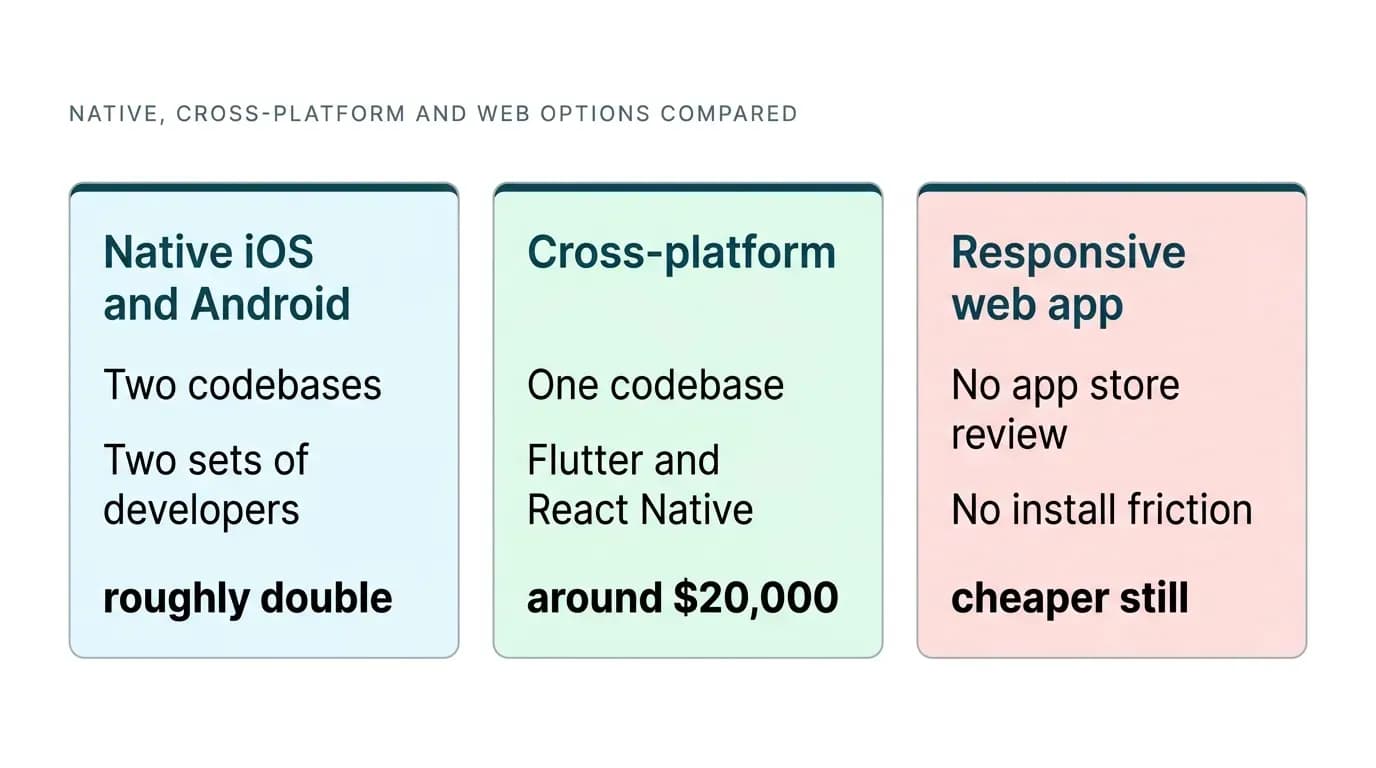
A responsive web app is cheaper still to start with, and for a lot of rental businesses it's the smarter first move. There's no app store review and no install friction, so you can put it in front of real renters in a fraction of the time. If your customers find you through search or local ads and book once or twice a year, think equipment or venues or party supplies, the web is often enough. Apps become necessary when repeat usage, push notifications, camera-based check-in or offline access matter.
The cost to build a booking app also depends on how much of the interface is truly custom. Standard components styled to your brand are fast. Bespoke animations, custom map interactions and one-off layouts for every screen are not. Cross-platform gets you most of the way for most rental products, and you can always add a native module later for the one thing that needs it.
If you're weighing a ready-made script against a custom build, our comparison of open source rental software covers where each option genuinely saves money and where the savings disappear.
How to Write Requirements That Stop Cost Overruns
Vague briefs are the single most reliable cause of budget surprises. "Users can book items" could mean five days of work or five weeks. Every developer who quotes on that sentence is guessing at a different version of your product.
Before you ask anyone for a price, write a feature list that answers these questions for each item:
- Who does it? Renter, owner, admin, or more than one.
- What happens on success? The exact outcome, including what gets emailed, charged or notified.
- What happens when it fails? Payment declined, item unavailable, booking cancelled late, renter is a no-show. Edge cases are most of the code.
- What does admin need to see or override? Every manual intervention you'll want on day one.
- Is it release one, or release two? Be ruthless. Most lists are twice as long as they need to be.
Send that document to everyone you're quoting with, and you'll get estimates you can actually compare, plus you'll spot the vendors who read it. This is also what makes fixed price app development possible. We agree a fixed price and a fixed launch date before work starts, and that only works when both sides know precisely what's being built. Custom rental software pricing becomes predictable the moment scope stops moving.
What Cheap Developers Really Cost
The temptation is obvious. An experienced agency quotes $25,000, a freelancer quotes $6,000, and the features list looks the same. Sometimes that works out, but often it doesn't, and the failure mode is consistent. The app launches, works for the first hundred bookings, then becomes impossible to change. Poor data structure, no tests, logic tangled into screens, no documentation. The second developer looks at it and recommends a rebuild, and you've paid twice.
A capable distinct freelancer building a cross-platform MVP realistically charges $15,000 to $30,000. Below that range for a real rental product with payments and a backend, you're usually buying either an incomplete build or inexperience. The difference experience buys isn't speed on day one. It's the architecture decisions made in week one that determine whether adding deposits in month six takes two days or two months.
Check these things before you hire, whoever you hire. Ask to see a shipped app with payments in it, and ask who owns the code and where it will live. Ask what happens after launch, and ask for a written scope with a date against it. Years of experience across many businesses have taught us that founders who ask those four questions rarely get burned.
Validating Before You Spend: The MVP Rental App Budget That Works
Build the smallest thing that proves someone will pay to rent from you, then spend the real money.

In practice that means picking one category, one city and one user type. Launch with manual operations behind a simple interface, you approving bookings, you confirming availability, you handling handover. Run it for a few months. You'll learn which features renters actually ask for, which ones you assumed mattered and nobody used, and what your real cost per booking is. Every one of those lessons makes the next build cheaper, because you stop paying for guesses.
The rental app development timeline follows the same logic. A focused first release can be in users' hands in weeks, not quarters. We've taken a medicine delivery app from kickoff to launch in about 30 days, and a tightly scoped rental product moves at a similar pace. A broad build with every feature negotiated as you go will take multiple months and cost more than the original quote, because the scope never stopped moving.
If you're still shaping the business model behind the app, start with our guide on how to start a rental business. The operational decisions there determine half of what you'll end up building.
Get a Fixed Price Before You Commit
Costs vary by scope, and anyone who gives you a number before understanding your feature list is guessing. But you shouldn't have to accept an open-ended estimate either.
Send us your feature list and we'll come back with a fixed price and a fixed launch date, agreed before any work begins. The budget you approve is the budget you pay.
Common questions
How much does it cost to build a rental app?
Rental app development cost ranges widely depending on scope. A lean validation build starts from $8,000, a polished cross-platform MVP commonly lands near $20,000 to $30,000, and a two-sided marketplace realistically runs $30,000 to $40,000 at minimum, with heavily customized versions climbing into the $100,000 to $200,000 range.
Should I build a native app or cross-platform for my rental business?
Cross-platform frameworks like Flutter and React Native give you one codebase for both iOS and Android stores, making a polished cross-platform MVP commonly land around $20,000, while the native equivalent runs considerably higher. A responsive web app is cheaper still to start with and is often the smarter first move if your customers book once or twice a year.
What features add the most cost to a rental app?
Backend complexity drives most of your rental app development cost. Payments are the biggest single swing, as holding a security deposit, splitting payouts between platform and owner, and handling failed captures is a project of its own. Availability and calendar logic is also core to any booking product and worth paying properly for.
What should I include in my rental app requirements to avoid cost overruns?
Before asking for a price, write a feature list that answers who does each feature, what happens on success and failure, what admin needs to see, and whether it's release one or two. Be ruthless about scope, as most lists are twice as long as they need to be.
How long does it take to build a rental app MVP?
A focused first release can be in users' hands in weeks, not quarters. A tightly scoped rental product can move at a similar pace to a medicine delivery app that went from kickoff to launch in about 30 days.

Arun Andiselvam
LinkedInI am a startup veteran who has built five brands. I sold the first, an SEO tool, for a six figure exit, and now lead Appkodes, building custom mobile and web apps for founders and businesses. I bootstrapped every one of them from day one.