
Short answer: yes, a mobile shop can be profitable, but almost never on one revenue line alone. The shops that make money in 2026 run handset sales, accessories, repairs, and at least one service line side by side. They also track stock and margins closely enough to know which of those four is actually paying the rent.
If you are asking is mobile shop business profitable before you sign a lease, here is the honest framing. The demand is still there, and margins on new phones are thin. The real money sits in the attached revenue around the phone rather than the phone itself. This guide walks through what each line actually earns, what it costs to start, where new owners lose money, and how software changes the numbers.
Where the Money Actually Comes From in a Mobile Shop
New handset sales are the lowest-margin thing most shops sell. Distributors set the price, and customers compare prices online while standing in the store. The mobile shop profit margin on a flagship device can be slim enough that a single return wipes out the gain. That is normal, and it is not a reason to skip handsets, because foot traffic from phone buyers is what feeds everything else.
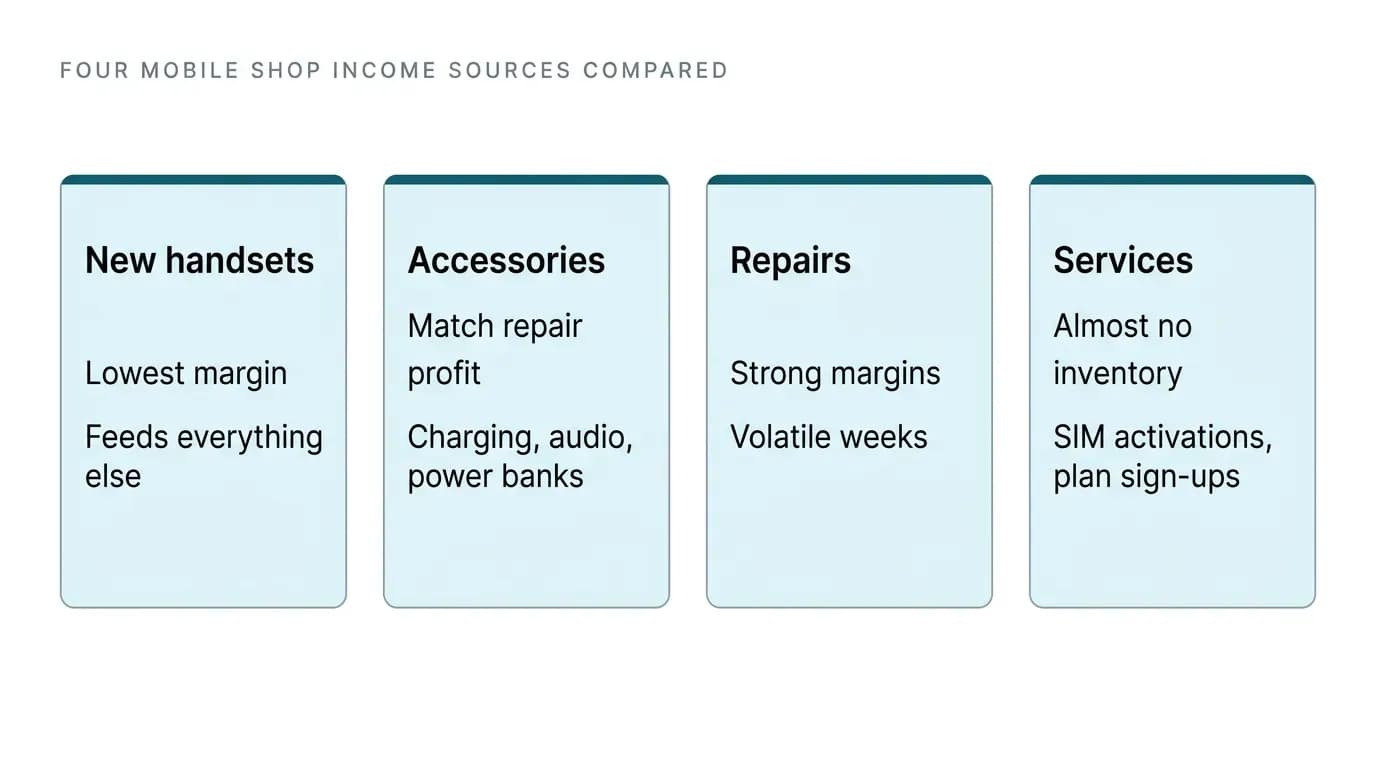
Accessories are where the picture changes. Structured properly, accessories and gadgets can match the monthly profit of core repair services. The catch is that most shops stop at screen protectors and cases, which are commodity items with heavy online competition. The shops doing well have pushed into trending and genuinely useful products, things like charging gear, audio, or power banks, so a customer has a reason to walk back in every few weeks rather than once every three years.
Repairs carry strong margins on parts and labor, but they are volatile. Solo repair operations commonly see strong weeks followed by completely dead ones. That makes repairs a poor foundation for fixed costs like rent and salaries. They work best as a second or third stream, not a first one.
Then there are services: SIM activations, plan sign-ups with carrier commissions, device trade-ins, data transfer, insurance, and bill payments. These take almost no inventory and convert the traffic you already have. A sensible read on the profitability of mobile phone retail in 2026 is that handsets buy you the footfall, and everything attached to them buys you the profit.
Build Four Revenue Streams, One at a Time
Here is the most valuable rule from shops that survive their first few years: aim for at least four revenue streams, each capable of covering your full operating costs on its own. That sounds aggressive, and it is meant to. If any single line can carry the shop, then losing one to a carrier policy change, a parts shortage, or a new competitor down the road becomes a bad quarter rather than a closure.
The sequencing matters as much as the count. A single operator should build these revenue streams one at a time, letting each one mature before adding the next. That way they grow together, and none of them is half-built when you need it. Launching handsets, accessories, repairs, and trade-ins all in month one usually produces four weak lines and an owner who cannot keep up with any of them.
Here is a practical order for most new shops. Start with accessories and SIM or plan services, since they need little capital and no technical skill. Add handset sales once you have supplier terms and know what your local customers actually buy. Bring in repairs third, when you have either the skill yourself or a technician you trust, then add trade-ins and refurbished devices last, because they tie up cash and need real grading discipline.
Any serious mobile phone shop business plan should name these four lines explicitly, with a target monthly contribution for each. Avoid lumping everything into one revenue forecast. When you review the month, you want to see which line carried it, not a single number that tells you nothing about what to do next.
How to Start a Mobile Shop Business Without Burning Your Capital
The question of how to start a mobile shop business usually comes down to how much goes in before the first sale. Shop fit-out, display counters, security, signage, a point-of-sale setup, opening stock, and a deposit on the lease make up the bulk of it. Repairs add a second layer, since you will need soldering and rework gear, a microscope, screen separation tools, diagnostic equipment, and a working parts inventory.
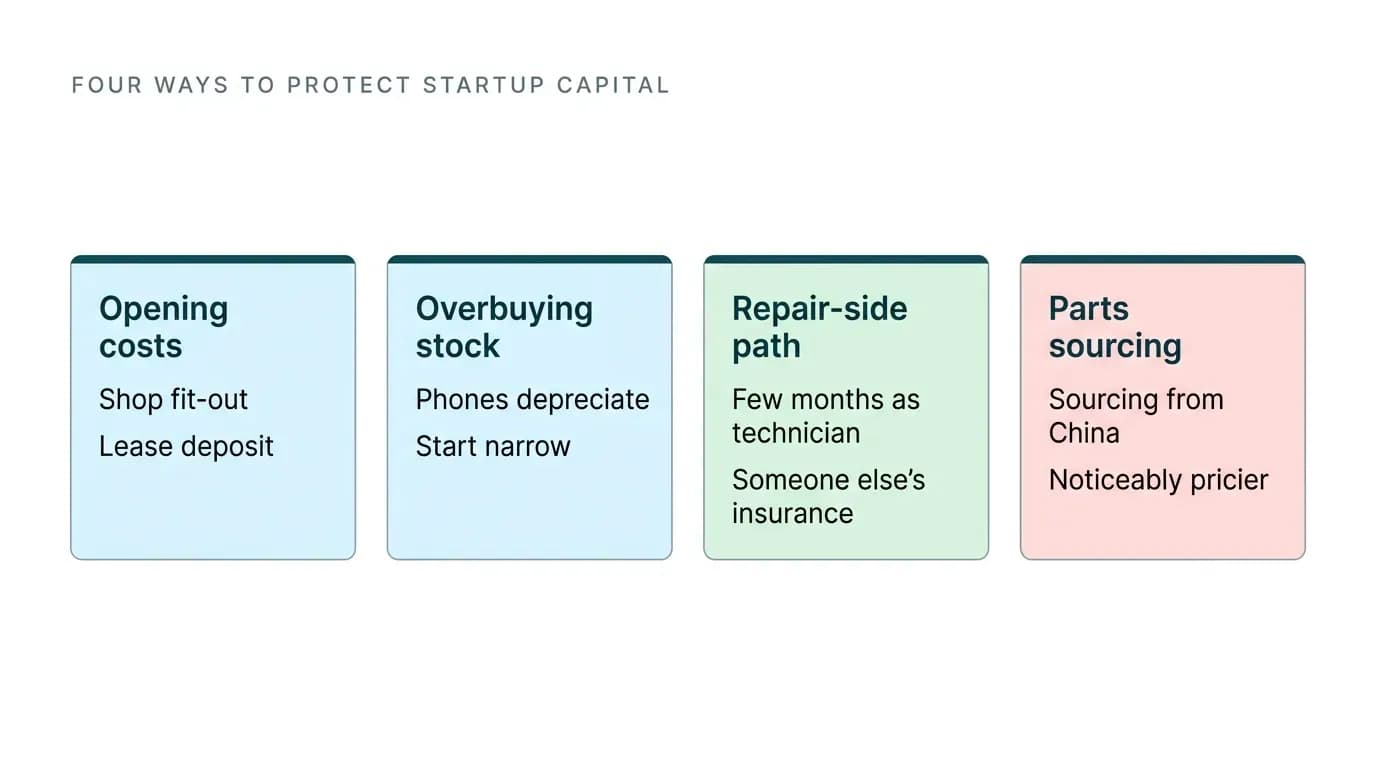
The most common capital mistake is overbuying handset stock in the first month. Phones depreciate while they sit on your shelf, and the models you guess will sell are rarely the ones your area wants. Start narrow, restock fast, and let the first ninety days of actual sales data tell you what to deepen.
On the repair side, there is a cheaper path than most people take. Work under an established shop before starting your own. Spending a few months as someone else's technician means your costly early mistakes are covered by someone else's insurance and someone else's reputation. Hands-on experience at an existing repair shop is what stops you damaging a customer's device in your first week and collecting the kind of reviews a new business does not recover from.
Parts sourcing deserves early attention too. Sourcing from China has become noticeably pricier than it used to be, so the old assumption of cheap screens and batteries underwriting your repair margin no longer holds automatically. Price your repairs against current parts costs, not the ones you heard about a couple of years ago. Re-check supplier quotes regularly rather than annually.
Mobile Phone Repair Shop Profitability in 2026
A fair concern is whether repair demand holds up given the volume of new phones sold every year. It does, for a simple reason: devices are more expensive than they used to be, and people keep them longer. A customer weighing a screen repair against a new flagship usually picks the repair.
Mobile phone repair shop profitability turns on specialization more than volume. Screen and battery swaps are the entry level, and every shop in town does them at roughly the same price. Chip-level work, things like board repair or data recovery from damaged boards, carries far better margins because very few operators can do it. It also opens a side line in sourcing older handsets for PCB and component harvesting.
It takes time to get there. Fundamentals take a while to learn properly with consistent hands-on practice, and chip-level skill takes considerably longer. A contracted repair technician working for a traditional shop earns a modest but steady monthly income during that period, which is a reasonable way to fund the learning.
Where repair businesses break down is cash flow consistency, not margin. A good screen job earns well, but a dead week earns nothing while rent stays the same. That is exactly why repairs belong inside a shop that also sells accessories and plans, and why we keep pointing owners back to the four-stream model. If you are planning the software side of a repair operation specifically, our breakdown of mobile phone repair shop software covers ticketing, parts tracking, and technician workflow in more detail.
Mobile Shop Inventory Management Is the Margin
Most shops that look busy but make no money have an inventory problem. Capital sits in slow SKUs, and fast sellers go out of stock on the weekend. Repair parts get used without being logged, and nobody knows the true mobile shop profit margin by product line until the accountant says so months later.
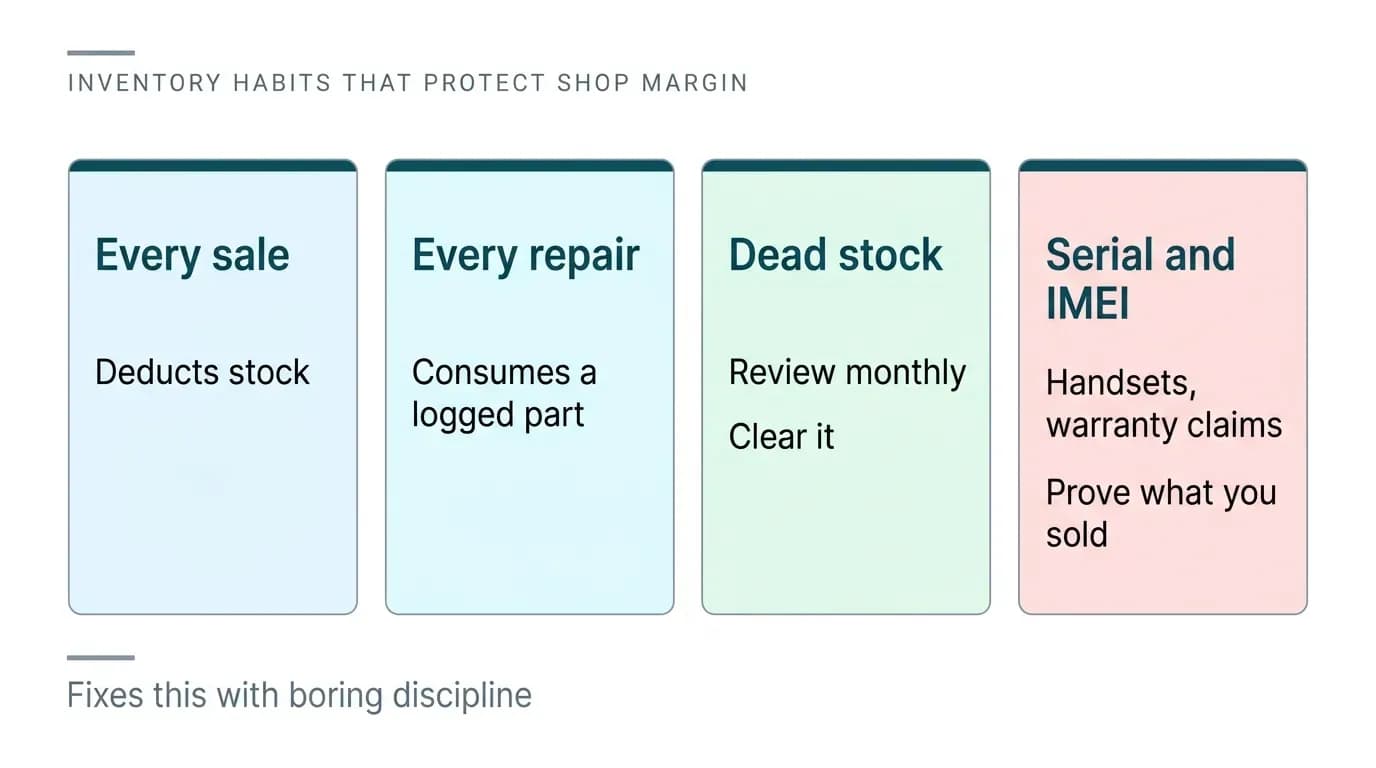
Proper mobile shop inventory management fixes this with boring discipline. Every item has a SKU. Every sale deducts stock, and every repair consumes a logged part. You review dead stock monthly and clear it rather than hoping.
Serial and IMEI tracking matters for handsets, warranty claims, and trade-ins, and it is the only way to prove what you sold when a dispute arises. Software is what makes that discipline survivable for a small team. The point is not features, but knowing, on any Tuesday, which lines are earning, what needs reordering, and which repair tickets are sitting unclaimed. Our guide to mobile shop software walks through what to build or buy and in what order.
Turning the Shop Into Something Customers Reach From Home
The strongest mobile shop business ideas in 2026 extend the shop beyond its four walls. A branded app or online store lets regulars reorder accessories, book a repair slot, and check trade-in values or track a repair without calling you. That alone smooths the dead weeks that make repair income unpredictable.
If you already sell online, a mobile app for your Shopify store is the fastest route. Your catalog, pricing, and stock stay where they are, and the app becomes a repeat-purchase channel with push notifications instead of another system to maintain. For shops with repairs, trade-ins, and multiple locations, a custom build usually makes more sense than stitching plugins together.
We have spent years building this kind of software and have worked with businesses across the retail and repair space. The way we price it is deliberately unambiguous: fixed price, fixed launch date, both agreed before any work starts. First releases start from $8,000 depending on scope. If you want a number for your own setup, tell us what your shop needs and we will quote it before we begin.

Arun Andiselvam
LinkedInI am a startup veteran who has built five brands. I sold the first, an SEO tool, for a six figure exit, and now lead Appkodes, building custom mobile and web apps for founders and businesses. I bootstrapped every one of them from day one.