
Prediction markets have moved from a niche academic curiosity to one of the most talked-about product categories in consumer fintech. People want to put money behind a view on an election, a cabinet appointment, a referendum or a policy decision. They want the price to move in real time while results come in.
If you're reading this, you probably want to build something in that space. This guide walks through what goes into a political betting and prediction app. We'll cover the features, the architecture, the settlement logic, the wallet work, the regulatory questions most agencies skip, and what it realistically costs to get a first release live.
We've been building apps for 18 years, and we've served more than 1,000 businesses. We'll be direct about which parts of this build are straightforward and which parts will eat your budget if you don't plan for them.
What a Political Betting and Prediction App Actually Is
At its core, you're building a marketplace for opinions about future events. A user opens the app and browses political event categories: presidential elections, parliamentary races, leadership contests. They pick an event, select an outcome, stake an amount, and wait for the result to be officially confirmed. If they're right, they get paid out.
There are two structural models, and the one you pick shapes everything downstream.
Fixed-odds (bookmaker) model. You set the odds. Users bet against the house. Your platform carries the risk and your margin sits inside the odds spread. It's simpler to build and simpler to explain, but you need capital reserves and real odds-setting expertise.
Market-based (exchange) model. Users trade shares in outcomes against each other, with each share priced between zero and one dollar representing the implied probability. You take a fee on trades or settlements rather than carrying position risk. This is how the better-known platforms work, and it's what most founders mean when they say they want to build a betting app like Polymarket.
The market model is harder to engineer. You need an order book or an automated market maker, real-time price propagation, and liquidity bootstrapping. It scales better, though, and it removes the risk of a single large losing book wiping you out.
Before you commit to either, map your event types. Elections with a fixed resolution date are the simple case. Political appointments, cabinet reshuffles and "will X happen before Y date" markets need carefully worded resolution criteria, because ambiguity in the market question is the single biggest source of user disputes.
Legal Status and Regulatory Uncertainty Across US States
This is the section most development agencies won't write. It's also the one that will decide whether your product has a business behind it.
The legal status of election betting in the United States is genuinely unsettled. It varies by state, it's been the subject of active litigation and enforcement actions, and the picture has kept shifting through recent election cycles. Some platforms operate under federal commodities frameworks. Others have been challenged by state gaming regulators who view event contracts on elections as gambling under their jurisdiction. Both positions have had days in court.
What that means practically for you as a founder:
- Get a regulatory opinion before you write a line of code. Not after the MVP. Not after launch. A licensed attorney who works in gaming or derivatives law needs to tell you which structure you're operating under and in which jurisdictions you can accept users.
- Build geofencing in from day one. State-level and country-level access control needs to sit in your architecture, not be bolted on. You'll want IP checks, device location checks, and address verification at the KYC stage, with an admin-controlled list of permitted jurisdictions you can update without a code release.
- Assume the rules will change mid-build. Design your market creation tools so you can restrict categories by jurisdiction. If a regulator decides a particular class of political market can't be offered in a given state, you want that to be a configuration change.
- Separate your political markets from everything else. Many platforms hedge by also running non-political markets. Keep the architecture modular so the political category can be switched off regionally without breaking the rest of the app.
We build the technology. We do not give legal advice, and you should treat any agency that tells you your political prediction market app is "definitely legal" as a red flag. What we can do is build a platform whose permissions, geofencing and market controls are flexible enough to survive a regulatory shift without a rewrite.
Core Prediction Market App Features Your MVP Needs
Here's the honest feature breakdown. We've grouped these the way we'd scope them in a build.
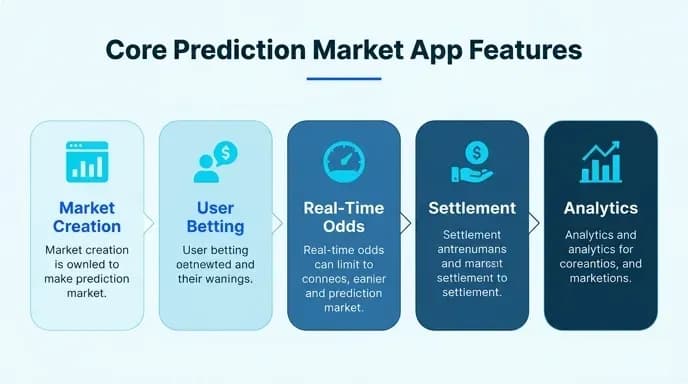
User Accounts and Verification
Registration with email and phone, secure login with two-factor authentication, and a profile layer that holds identity verification status. KYC is not optional in this category. You need identity documents, address confirmation and age checks before a user can deposit or withdraw.
Build a verification queue into the admin side so a human can review edge cases. The personal dashboard is where users live, and it should show wallet balance, open positions with current market value, realized profit and loss, and a full prediction and transaction history that's exportable. Users in this category are more financially literate than typical app audiences, and they expect records they can reconcile.
Political Markets and Categories
Your market structure needs a category (presidential, parliamentary, appointments, referendums, legislation), an event, and multiple outcomes per event. A single election might have eight candidate outcomes, each priced independently, with prices summing to roughly one dollar across the set.
Every market needs a clearly written resolution source stated on the market page itself. This is the official body or publication whose declaration settles it, and every market needs a close time, after which no new positions can be taken, plus a resolution window.
The Prediction Engine
This is the heart of the build. A user selects an outcome, enters a stake, and sees potential returns calculated and displayed before they confirm. Then the engine has to handle order matching or AMM pricing, position tracking, and automatic settlement once a verified result is entered.
A well-built prediction engine for betting apps has to do three things under load. It must price accurately, match fast, and never double-spend a user's balance. That last point sounds obvious and it's where cheap builds fall over. Every stake placement needs to be an atomic transaction against the wallet ledger.
Wallet and Payments
Deposits, withdrawals, balance management, and a transaction ledger that is the single source of truth. Payment gateway integration for cards, bank transfers, and regional rails like M-Pesa where you're serving African markets. If you're going crypto-native, stablecoin deposits and on-chain settlement are a different architecture again.
Admin Dashboard
User management, market creation and editing, settlement controls, transaction monitoring, payout approval, and analytics. Admins also need a suspension control for distinct markets. If a news event makes a price obviously stale, you pause trading before the informed money arrives.
Notifications
Market updates, prediction confirmations, closing alerts, result announcements and payout notifications, delivered by push, email and in-app. Closing alerts matter more than founders expect. A user who misses a market close because nobody told them is a user who churns.
Web, Android and iOS
A responsive web app, a native or cross-platform Android app, and an iOS app. App store policies around real-money betting apps are strict and vary by region. Plan for a review process that takes longer than a normal submission, and for the possibility that web stays your primary channel in some markets.
Market Manipulation, Whales and Why Your Order Book Design Matters
One of the uncomfortable truths about this category is that prediction markets can be moved by a single large bettor. When liquidity is thin, a whale placing a big position can push a price well away from where the crowd actually sits, and casual users reading that price as a forecast get a distorted picture.
This matters to you commercially, not just ethically. If your prices are visibly manipulable, your platform loses the one thing that makes prediction markets interesting: the claim that the price means something.
Design choices that reduce manipulation risk:
- Position limits per user per market, scaled to market liquidity. A thin new market gets tight caps. A deep election market can take size.
- Slippage protection and depth display. Show users the order book depth, not just the top price. A price backed by shallow liquidity should look different in the UI from a price backed by deep liquidity.
- Time-weighted price displays. Showing a short-term average alongside the last traded price makes a single large print look like what it is, a single large print.
- Cooling-off and circuit breakers. If a price moves beyond a threshold you set in a short window, pause the market briefly and let the admin review.
- Wash trading detection. Flag accounts trading against themselves across linked wallets or devices.
Building these controls into the first release signals that you take price integrity seriously. It also gives your admin team the levers they need when something looks wrong.
How Accurate Are Election Odds, Really?
Founders often pitch prediction markets as being more accurate than polling. Be careful with that claim, because the evidence is more complicated.
Research into prediction market accuracy has produced encouraging headline figures, though the published numbers vary widely depending on methodology, and there's a real question about what any given figure is actually measuring. Accuracy over what time horizon? Against what baseline? A market that correctly favors a heavy favorite months out isn't demonstrating much.
What we've observed across election cycles is more useful to your product design. Accuracy tends to degrade as you approach primaries and key voting dates. Exactly when the stakes are highest and volume is heaviest, the pricing gets noisier. That's partly because late-breaking news arrives faster than the market can absorb it, partly because speculative money crowds in, and partly because a lot of the price signal near a deadline comes from people trading on sentiment rather than information.
Three implications for your build:
Adjust your pricing model for event proximity. If you're running an AMM, widening spreads or increasing the liquidity parameter as a market nears resolution reduces the impact of late volatility. If you're running an order book, tighter position limits near close serve a similar function.
Don't market your odds as forecasts. Label them clearly as trading prices shaped by whoever happens to be active on your platform, not as predictions of what will happen, and keep that framing in your marketing copy as well as your UI.
Show users the uncertainty. Display a confidence or volume indicator alongside every price so a thinly traded market showing ninety percent doesn't read the same as a deep, heavily traded market showing the same number.
Demographic Bias: Why Your Market Isn't a Poll
There's a sampling problem underneath every political prediction market app, and it's worth understanding because it affects how you should position the product.
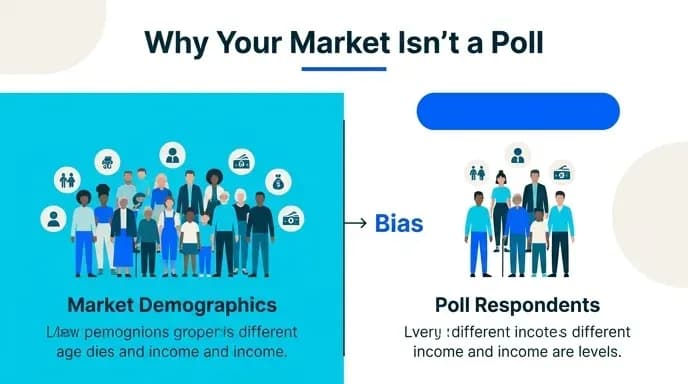
The people who trade political markets are not a representative slice of the electorate. The demographic skews young, skews male, and skews heavily toward people already comfortable with crypto and speculative trading. That's a very particular worldview, and when it sets prices, the prices reflect that group's beliefs about what will happen, not the broader population's voting intention.
Traditional polling has its own serious problems, but polling at least attempts a representative sample.
What to do about it in the product:
- Be transparent in your market pages about what the price represents. A short explainer, "this price reflects what traders on this platform are willing to pay, not a poll of voters", costs you nothing and protects you later.
- Consider publishing anonymized, aggregate trader composition data. Platforms that show who's trading build more trust than platforms that hide it.
- Resist the temptation to have media pick up your prices as election forecasts. It's great marketing until the market is wrong in public, and then it's the story.
Insider Trading, Conflicts of Interest and Fair Play Controls
If you're running markets on political appointments and government decisions, you are running markets where some participants genuinely know the answer before the public does. A campaign staffer who knows the endorsement is coming. A party official who knows the candidate is dropping out before it's announced. A government insider who knows the policy decision.
This is the hardest integrity problem in election betting app development, and there's no technical fix that fully solves it. What you can do is make it harder, make it detectable, and make your position clear.
Policy layer. Write explicit terms prohibiting participation by candidates, campaign staff, party officials and government employees in markets they can influence or have non-public information about. Require users to attest to this at account creation and again when entering certain market categories. It won't stop a determined bad actor, but it gives you grounds to void positions and freeze payouts.
Detection layer. Build surveillance into the admin dashboard from the start:
- Flag unusually large positions taken shortly before a decisive price move.
- Flag accounts with abnormally high win rates in specific categories.
- Cluster accounts by device fingerprint, IP range, funding source and withdrawal destination to catch coordinated groups.
- Log every trade with precise timestamps so you can reconstruct the sequence around any suspicious resolution.
Response layer. Give admins the ability to freeze an account, void specific positions, hold a payout pending review, and annotate a market as under investigation. Publish what you'll do when you find something.
The same infrastructure handles conflict-of-interest safeguards more broadly. If a market concerns a specific appointment, you might want to restrict or flag accounts linked to the relevant organization. That requires nothing more exotic than a good KYC record and a rules engine in the admin panel, but it has to be designed in, not retrofitted.
Protecting Retail Users From Themselves
There's a real asymmetry in these markets. Professional traders and well-funded speculators have better information, better models and more capital than the retail user who saw a headline and wants to bet a hundred dollars on it. Over time, that asymmetry transfers money in one direction.
You can't remove it, but you can design around it, and platforms that do tend to retain users longer because fewer of them blow up and leave.
Build these in:
- Deposit limits users set for themselves, adjustable downward instantly and upward only after a delay.
- Loss limits and session reminders showing cumulative position and time in app.
- Self-exclusion, with a hard account lock for a chosen period that support cannot override on request.
- Clear risk disclosure at the point of stake, showing maximum loss in plain currency terms alongside potential return.
- No credit-funded deposits. Cards tied to credit lines are a known escalation path.
There's also the question of perverse incentives, and it deserves a straight answer. Markets on political outcomes can shade into markets where someone profits from a bad event, a resignation, a crisis, an institutional failure. Some platforms have run markets that were defensible on paper and indefensible in a news headline.
Set editorial policy on market creation before your first market goes live. Write down which categories you will not list, who signs off on new markets, and what happens when a listed market becomes distasteful as events develop.
Wallet Integration, Payouts and Withdrawal Speed
Wallet integration for betting apps is where user trust is won or lost, and it's the area founders consistently underestimate.
The ledger is the foundation. Every deposit, stake, settlement, fee and withdrawal is an immutable double-entry record, and the user-visible balance is derived from the ledger, never stored as a mutable field someone can update. This sounds like over-engineering until your first reconciliation dispute, at which point it's the only thing that saves you.
On top of the ledger sits the payment layer:
- Deposits via card, bank transfer, and regional rails. M-Pesa integration matters enormously for East African markets and the flows are well documented. Card processing for betting categories often requires a specialist acquirer. Standard processors frequently decline the merchant category.
- Withdrawals with configurable approval rules. Small withdrawals to a verified, previously used destination can auto-approve. Large ones or new destinations go to manual review.
- Reconciliation jobs that match gateway settlement reports against your ledger daily and flag mismatches.
Withdrawal speed is a competitive weapon.
Niche Coverage and Multi-Platform Switching
Here's a product insight worth more than most feature lists. Traders routinely run several prediction market apps side by side, because the big platforms have thin coverage outside their headline categories. Someone who wants esports markets, or regional legislative markets, or a particular country's local elections, often can't find depth anywhere and ends up juggling apps.
That fragmentation is your opening. A political prediction market app that goes genuinely deep in one underserved vertical, a specific region's elections or a particular class of government decisions, can win a dedicated audience that the large general platforms aren't serving.
The practical requirement is that your market creation tooling has to be fast. If listing a new market takes an engineer, you'll never cover a long tail. Build a market template system where an operations person can clone a structure, set outcomes, set the close time, name the resolution source, and publish, all in minutes, without a deploy.
Depth beats breadth at launch. Pick your vertical, make it the best place to trade that vertical, and expand from a position of strength.
Tech Stack and Architecture for Prediction Market Platform Development
Here's how we'd structure prediction market platform development for a first release.
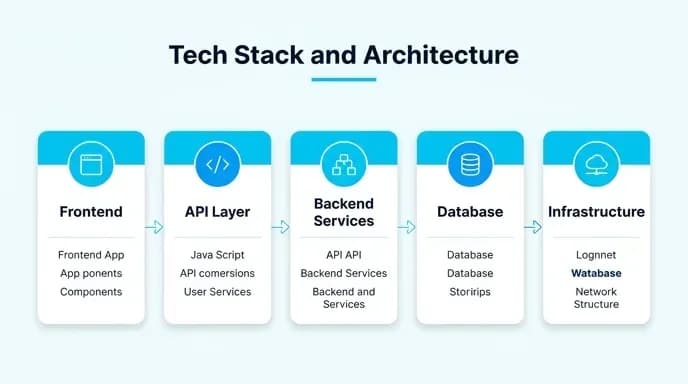
Backend. A strongly typed service layer, Node.js with TypeScript or Go, handling accounts, markets, orders and settlement as individual services. PostgreSQL as the system of record for the ledger and positions, because you need transactional guarantees. Redis for order book state and price caching.
Matching and pricing. If you're running an order book, the matching engine runs in memory with an append-only log for durability and replay. If you're running an AMM, the pricing function lives in a single service that every price read goes through. Either way, this component gets the most testing attention in the build.
Real-time layer. WebSockets pushing price updates, order fills and market status changes. Users watching an election night expect the number to move as it happens.
Frontend. React for web, React Native or Flutter for Android and iOS, sharing types and business logic with the backend where possible. Shared code is what keeps three-platform builds affordable.
Infrastructure. Containerized services behind a load balancer, with autoscaling sized for election-night spikes rather than average load. Traffic in this category is extraordinarily peaky, with months of quiet, then an order-of-magnitude surge for a few hours.
Security. Encryption at rest and in transit, secrets in a managed vault, rate limiting on every endpoint, audit logging on every admin action, and penetration testing before you take real money.
The architecture lesson from other high-concurrency consumer products applies directly here. The moments that define your platform are the ones where everybody shows up at once. We've written before about why PK Battles are the highest-grossing feature in social apps, and the underlying reason is the same: live, time-boxed, high-stakes moments concentrate engagement and revenue. Build for the peak.
What It Costs and How Long It Takes
Scope drives cost, so let's be concrete about what moves the number.
A first release covering accounts and KYC, a working prediction engine for betting apps with one market model, wallet and a single payment rail, admin market creation and settlement, notifications, and a responsive web app is the realistic MVP. Our first releases start from $8,000. That figure covers a build of this scope and complexity, and it moves up from there once you add a second market model, additional payment rails, or native mobile apps on top of the web release.
Your Build Roadmap and Next Step
A sensible sequence for prediction market platform development:
- Legal first. Jurisdictions, structure, permitted market types. Two to four weeks with counsel.
- Scope and fix. Define the first release precisely. Agree price and date.
- Core build. Accounts, KYC, ledger, prediction engine, admin tools, web app.
- Payments and testing. Gateway integration, reconciliation, penetration testing, and a closed beta with play money.
- Launch on web. Get a real market cycle through the system before you add platforms.
- Mobile and expansion. Android and iOS, then additional verticals and payment rails.
Prove the loop works end to end: market created, positions taken, result verified, payouts settled, withdrawals cleared. Expand from there.
If you want a clear number and a date for your political betting and prediction app, get in touch for a quote. We'll scope it with you, tell you honestly which features belong in release one and which can wait, and agree the price and launch date before any work begins.
Common questions
What are the two structural models for building a political betting app?
The fixed-odds (bookmaker) model, where you set the odds and users bet against the house, and the market-based (exchange) model, where users trade shares in outcomes against each other with prices between zero and one dollar. The market model is harder to engineer but scales better and removes the risk of a single large losing book wiping you out.
Is election betting legal in the United States?
The legal status of election betting in the United States is genuinely unsettled and varies by state, having been subject to active litigation and enforcement actions. You should get a regulatory opinion from a licensed attorney before writing code, and design your platform with geofencing and jurisdiction controls from day one to adapt to changing rules.
What core features does a prediction market app MVP need?
An MVP needs user accounts with KYC verification, political markets with clearly stated resolution sources, a prediction engine that prices accurately and matches orders atomically, wallet and payment integration, an admin dashboard for market management and settlement, notifications for market updates and closings, and web, Android and iOS apps.
How can you prevent market manipulation in a prediction app?
Design controls including position limits scaled to market liquidity, slippage protection and order book depth display, time-weighted price averages, cooling-off periods and circuit breakers for large price moves, and wash trading detection to flag accounts trading against themselves.
Are prediction market odds more accurate than polling?
The evidence is more complicated than the common claim that prediction markets are more accurate than polling. Accuracy tends to degrade as you approach voting dates, and near deadlines the pricing gets noisier due to late-breaking news, speculative money, and trading based on sentiment rather than information.

Arun Andiselvam
LinkedInI am a startup veteran who has built five brands. I sold the first, an SEO tool, for a six figure exit, and now lead Appkodes, building custom mobile and web apps for founders and businesses. I bootstrapped every one of them from day one.