

Most founders who come to us wanting a last-minute hotel booking platform have the same mental model. Build a booking site, sign up hotels, charge commission. That model is not wrong, but it misses what actually makes this category work. A website like Hotel Tonight is not a cheaper version of a standard booking site. It runs on a different kind of inventory, with different incentives for the hotel and a different risk profile for the traveler.
Here is the short answer before we go deep. To build a platform like this, you need four things. A supply engine that gets hotels to release unsold rooms at a discount, and a pricing and inventory layer that surfaces only what is genuinely available right now. A booking flow fast enough to finish on a phone in under a minute, and a clear policy framework around cancellations so travelers know what they are trading away for the lower rate. Everything else, the design and the filters, sits on top of those four.
Why Last-Minute Platforms Can Offer Rates Standard Channels Cannot
This is the mechanic everyone searches for and almost nobody explains properly, so we will start here.
A hotel room is perishable inventory. A room unsold at 11pm earns the hotel nothing, and the cost of that empty room was already paid in staff, financing and utilities. A room sold at a steep discount at 8pm still contributes something. That gap between "nothing" and "something" is the entire economic basis of the category.
But hotels cannot simply advertise that discount publicly. Most of them have rate parity obligations with the large online travel agencies and with their own brand channels. If a hotel posts a dramatically lower public rate, it undercuts its own distribution agreements, and it also trains its regular customers to wait. The whole point of a last-minute platform is that it provides an opaque or semi-opaque channel where the hotel can discount without the discount becoming its new public price.
So the deal a last-minute platform offers a hotel is roughly this. You release rooms you are not going to sell, and the rate stays unpublished until late in the booking window. The traveler cannot use it to anchor future expectations, and the platform takes a commission on revenue the hotel would otherwise never have seen.
When you build the product, this means your system needs:
- Time-gated rate release. Rates that unlock at a defined hour, or at a defined number of hours before check-in, rather than being live all day.
- Rate masking. The ability to show a discounted price without exposing it to price-scraping comparison engines, which often means requiring a sign-in, an app install, or a membership tier to see the final number.
Founders who skip this layer end up with a booking site that lists the same rates everyone else lists. That is the single most common reason a website like Hotel Tonight fails to differentiate. The supply agreement was never built to support genuine discounting in the first place.
Cancellation Policies and the Refundability Trade-Off
Travelers have gotten sharp about this. The discount is real, and so is the catch. Deeply discounted last-minute rooms are usually non-refundable, or carry a cancellation window so short it is effectively non-refundable.
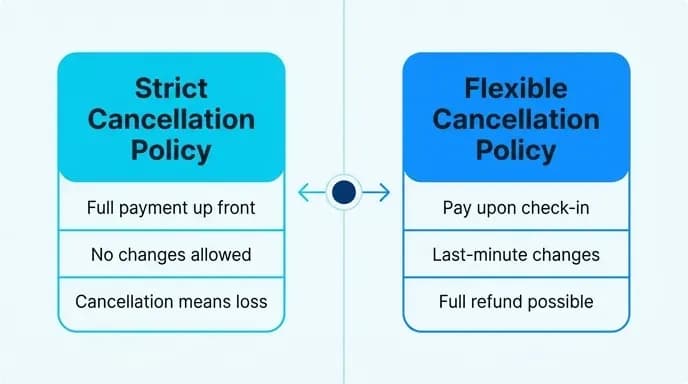
This is not a flaw in the model. It is the other half of the trade. The hotel accepts a lower rate in exchange for certainty, and certainty means the booking does not evaporate an hour later. Let travelers cancel freely on a deep-discount rate, and hotels will stop releasing inventory, because they are now carrying all the risk for less pay.
What you control is how honestly you present it. Practical design decisions worth making early include showing the cancellation status as a visible attribute on the listing card, not only on the checkout screen, and using three straightforward tiers rather than free text: fully refundable, refundable until a stated time, and non-refundable.
When we scope booking platforms, we treat the cancellation policy engine as core infrastructure, not a settings screen. It touches payments, notifications, refunds, accounting and support workflows all at once.
How Inventory and Day-of-Week Timing Shapes Last-Minute Pricing
The discount a traveler finds on any given night is not a fixed property of the platform. It is a function of how much unsold inventory exists in that city on that date.
Booking later in the day genuinely does improve the odds of a lower rate. The hotel's chance of filling that room at full price keeps shrinking by the hour. But the effect swings wildly with context, since a Tuesday in a business district behaves nothing like a Saturday in a beach town.
This matters enormously for product design. Travelers who open your app on a sold-out weekend and find nothing worth booking often do not come back. A few things help:
Set expectations inside the product. If inventory in a city is tight tonight, say so, and offer alternatives such as a nearby neighborhood or tomorrow night. Silence reads as a broken product.
Make availability the primary filter, not price. Travelers in this category switch between platforms freely. They stay on whichever one has real open rooms for their dates and location. A beautiful interface with nothing bookable loses to a plain one with five available properties.
Track fill patterns per market. Over time your own booking data tells you which cities, which days and which seasons produce soft inventory. That data is what lets you tell hotels when to release rooms and tell travelers when to look.
Never show stale availability. Nothing kills a booking platform's reputation faster than a listed room that cannot actually be booked. Real-time inventory syncing with property management systems and channel managers is not a nice-to-have.
Should Travelers Call the Hotel Directly? Yes, and Build for It
Calling rarely guarantees a lower price. But it often turns up free parking, a room upgrade, a later checkout or a waived resort fee that the platform rate does not include.
Pretending this does not happen is a mistake. Design around it instead.
The strongest counter is to make the platform booking better than the phone call, not just cheaper. That means negotiating perks into your rate agreements, not only price. Bundle the parking. Lock the upgrade. Include the late checkout as a platform benefit the traveler would otherwise have to argue for on the phone. When the perks are already in the booking, the call stops being worth making.
The second counter is speed and certainty. A phone call at 10pm means waiting on hold, talking to a front desk agent who might not have authority to discount, and ending up without a confirmation number. A booking that completes in forty seconds on a phone with instant confirmation has real value, and travelers pay for it.
The third is loyalty mechanics. Credits, tiers and repeat-booking rewards accumulate on the platform and do not transfer to a phone call. Hotel Tonight built exactly this, which is one of the reasons the category can hold users who would otherwise shop around every single night.
Quality Degradation After Acquisition: The Risk Every Founder Should Study
This category has a pattern worth understanding before you build in it. A last-minute booking platform builds an audience on genuinely deep discounts, gets acquired by a larger travel company, and then the discounts thin out. Prices drift upward, the standout deals become rare, and the product starts to look like every other booking site with a different logo on it.
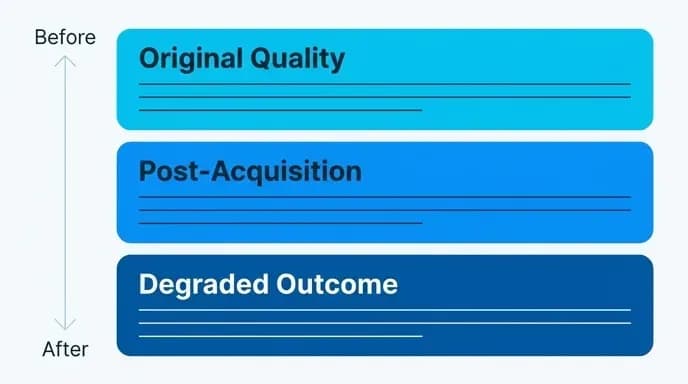
The reason is structural, not malicious. Inside a large travel group, the last-minute brand stops being an independent business fighting for its own supply. It becomes one channel among many. The parent company has rate parity concerns across its whole portfolio, and deep discounting in one brand cannibalizes margin in another. The incentive to offer a genuinely lower price weakens every quarter.
There is a second version of the same drift that does not require an acquisition at all. Platforms that started as last-minute-only gradually open up advance booking, because advance booking has higher volume and better planning economics.
What this means for you as a founder:
- Protect the discount as the product. If the average saving on your platform drifts toward zero, you no longer have a business, you have a worse version of a crowded one.
- If you add advance booking, keep it separate. A distinct surface, an individual rate class, and a last-minute section that is still genuinely last-minute.
- Measure deal quality, not only GMV. Track the gap between your rate and the public rate for the same room on the same night, per market, and treat a narrowing gap as an alarm.
The travelers who love this category are loyal for years when the deals are real, and they leave quietly when the deals stop.
Mystery Hotels and Risk: How Much Should You Hide?
Opaque booking, where the traveler sees the star rating, the neighborhood and the price but not the hotel name until after payment, is the deepest discount mechanism available. It solves the hotel's rate parity problem completely, because the rate can never be attached to the brand publicly.
It also asks the traveler to accept real risk. Whether they accept it depends entirely on how well you manage the information you do give them.
If you build a mystery inventory feature, give travelers enough to assess the risk honestly:
- A tight, accurate neighborhood boundary on a map, not a vague city-wide circle.
- The star rating and the guest score range.
- The amenities that are guaranteed regardless of which property it turns out to be: parking, breakfast, pool, accessible rooms, pet policy.
The platforms that handle mystery inventory badly are the ones where the reveal feels like a bait-and-switch. The ones that handle it well make the reveal feel like a win. The traveler knew the floor they were guaranteed, and the actual property comfortably beat it.
Mystery inventory also needs its own support playbook. When something goes wrong with an opaque booking, the traveler feels doubly wronged, since the room was not what they hoped and they did not choose it. Staff your support accordingly, and give your agents authority to make it right quickly.
Telling Authentic Discounts Apart from Budget-Only Listings
Travelers compare these platforms constantly, and the comparison they actually care about is not which has the prettiest app. It is which one delivers a real saving on a hotel they would have been willing to book anyway.
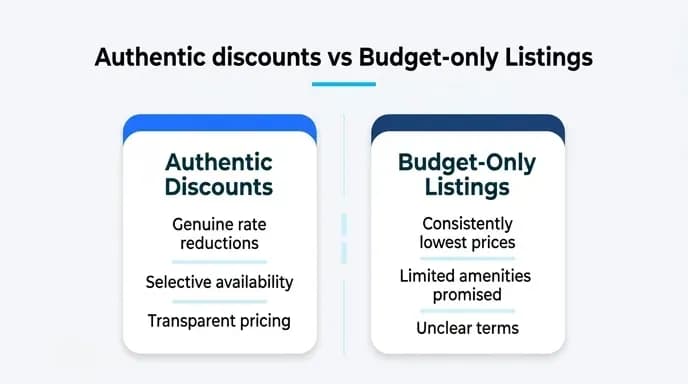
There is a shortcut some platforms take that erodes trust fast. They fill the catalog with properties that are simply cheap, rather than good properties offered cheaply. A listing at a low nightly rate for a hotel nobody wanted at any price is not a deal. Travelers see through it within two or three bookings.
Build your credibility deliberately:
Show the comparison honestly. Display the standard rate alongside yours where your agreements allow it, and make sure the comparison rate is real and current. Padding reference prices before marking them down ruins credibility with a market faster than almost anything else.
Curate supply. A smaller catalog of properties that meet a quality bar beats a huge catalog of everything available. Curation was central to how this category earned its reputation in the first place.
Segment clearly. Travelers looking for a cheap bed near the airport are a legitimate segment. They just should not be mixed in with discounted four-star rooms downtown.
Publish your own quality signals. The booking sites that hold users long-term are the ones where what you see is what you get.
The Technical Build: What a Platform Like This Actually Requires
Here is what sits under the surface when we scope a rental or booking marketplace of this type.
Supply side. A property onboarding flow, a hotel-facing dashboard for managing room types and rate rules, channel manager and property management system integrations so availability stays accurate, and an inventory release mechanism tied to time windows.
Pricing engine. Rate rules per property, discount floors and ceilings, time-based unlock logic, market-level overrides for high-demand dates, and taxes and fees calculated correctly per jurisdiction.
Traveler apps. Native iOS and Android plus a responsive web app. Location detection, map and list views, a booking flow short enough to finish standing on a sidewalk, saved payment methods, and instant confirmation.
Payments. Card processing, wallets, authorization and capture logic, refunds tied to your cancellation tiers, and payouts to hotels on an agreed cycle.
Operations. An admin portal for your team covering disputes, refunds, fraud review, property approvals, content moderation on reviews, and reporting.
Messaging and notifications. Booking confirmations, check-in instructions, and the nudges that bring travelers back when soft inventory appears in a city they visit often.
That is a real build, and it is close in structure to the rental marketplace work we do across other categories. If you want to see how we approach the broader pattern, our rental marketplace software solutions page covers the shared architecture.
Defining the MVP: deciding which features come first and which get dropped
You do not need all of that to launch. The first release needs to prove one thing: hotels in a single city will release discounted inventory to you, and travelers will book it.
A sensible first version:
- One city, or two neighborhoods in one city.
- Twenty to fifty curated properties onboarded manually if needed.
- Time-gated rates with a simple unlock rule.
- Mobile apps and a web booking flow.
- Two cancellation tiers, clearly labeled.
- A basic hotel dashboard, or even a manual process with your operations team in the middle.
- Payments, confirmations and a working support channel.
Cut the loyalty program, the mystery inventory, the multi-city expansion, the recommendation engine and the advance booking surface. Each of those is a good idea later, but a distraction now.
A focused marketplace MVP of this shape is typically a matter of weeks rather than quarters.
For a non-technical founder, the honest answer to "can I really do this" is yes, on one condition. You own the supply relationships. The engineering can be bought, but the hotel agreements cannot.
Template Script or Custom Build?
A lot of founders in this space start by pricing a ready-made booking script. That's a reasonable thing to ask, and the answer hinges on what exactly you're putting to the test.
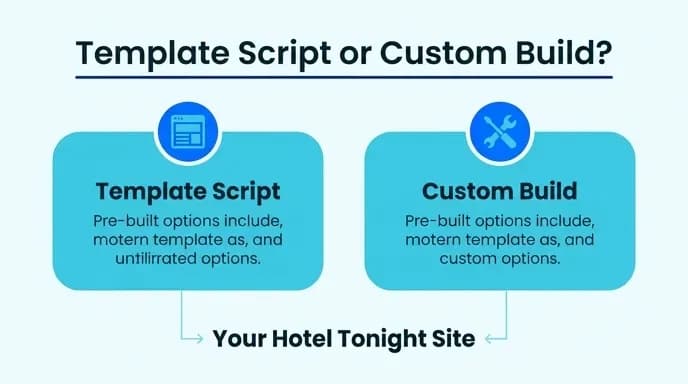
A template can get a booking site running by the weekend, enough to show a potential hotel partner what you mean. What a template cannot do is the thing that makes this business work. Time-gated rate release, opaque inventory, per-property discount rules, channel manager syncing and a cancellation engine your hotels will actually sign off on are not configuration options. They are the product.
A cheap license will not save you from the months of rework that follow when the template cannot support real discounting.
In a last-minute booking platform, the underlying agreements and infrastructure are the business, not the storefront on top of them.
Get a Fixed Price Before Anyone Writes Code
If you are serious about launching a website like Hotel Tonight, the next step is not a wireframe.
Tell us that, and we will come back with a fixed price and a fixed launch date, agreed before work starts, so you know what you are spending and when you are live. Get a quote from our team and we will scope it with you.
Common questions
Why can last-minute hotel booking platforms offer lower rates than standard booking sites?
Hotel rooms are perishable inventory that earn nothing if unsold, so hotels are willing to offer steep discounts late in the day. However, hotels cannot advertise these discounts publicly due to rate parity obligations with other channels, so last-minute platforms provide an opaque channel where the discount remains unpublished until late in the booking window.
What are the four key things needed to build a hotel booking platform like Hotel Tonight?
You need a supply engine that gets hotels to release unsold rooms at a discount, a pricing and inventory layer that surfaces only what is genuinely available right now, a booking flow fast enough to finish on a phone in under a minute, and a clear policy framework around cancellations so travelers understand what they're trading for the lower rate.
Why are last-minute hotel bookings usually non-refundable or hard to cancel?
Hotels accept lower rates in exchange for certainty of payment. If travelers could cancel freely on deeply discounted rates, hotels would carry all the risk for less pay, so they would stop releasing inventory. The non-refundable or short cancellation window is the other half of the discount trade.

Arun Andiselvam
LinkedInI am a startup veteran who has built five brands. I sold the first, an SEO tool, for a six figure exit, and now lead Appkodes, building custom mobile and web apps for founders and businesses. I bootstrapped every one of them from day one.