Most restaurant owners asking this question are really asking two things at once. Which app should my customers order through? Which one leaves me with money at the end of the month? Those are different questions, and the answer to the second one has changed.
Here is the short version. If you want volume fast and can live with commissions, the big marketplaces still deliver eyeballs. If you want margin, repeat customers and control over the guest experience, the best food ordering app is the one that carries your name. That means your own branded ordering app, backed by a QR code ordering system on the table. We build those at Appkodes, so treat the rest of this article as a comparison written by someone with a side. We will still give you the honest case for the alternatives, because picking wrong costs you a year.
Which Is the Best Food Ordering App for Restaurants Right Now?
Let's deal with the marketplaces first, since that is where most owners start.
Third-party delivery apps work. They put you in front of people who have never heard of you, and they handle the driver network and payment. That is a real service, but the pattern we have seen in late 2026 is consistent enough that you should price it in before signing.
Menu prices on these platforms run noticeably above what the same dish costs in the restaurant. On some items the gap is wide enough that a guest comparing a receipt against your printed menu feels misled, and they blame you, not the app. On top of that, service fees and delivery fees stack at checkout, which is why subscription programs that promise free delivery often save diners very little once the final total loads. Guests notice this pattern. Ordering direct from a restaurant's own site or app avoids most of that markup, and a growing number of regulars have worked this out on their own.
Reliability is the other weak spot. Drivers get routed to the wrong address or told to drop at some random point, so orders land hours late or never arrive. Large catering-sized orders get assigned to a cyclist who physically cannot carry them, and the guest receives half a meal. Refunds are where goodwill dies. A partial credit of a few dollars against a forty-dollar order that never showed up is not a resolution. Long-time customers are quietly moving between platforms looking for one that handles this better.
There is also a slower-burning issue around sourcing. Diners increasingly want to know where food came from, and an aggregator listing tells them nothing. So which is the best food ordering app for you depends on what you are optimizing. For raw discovery, a marketplace. For everything after the first order, your own.
What Is the Cheapest Food Ordering App? And What Does Cheap Actually Cost?
When owners ask what is the cheapest food ordering app, they usually mean "free to join." Marketplaces are free to join and expensive to stay on, because the cost arrives as a percentage of every order, forever. Run the math on a year of commissions and compare it to a one-time build. For a busy kitchen the build often wins before the second year starts.
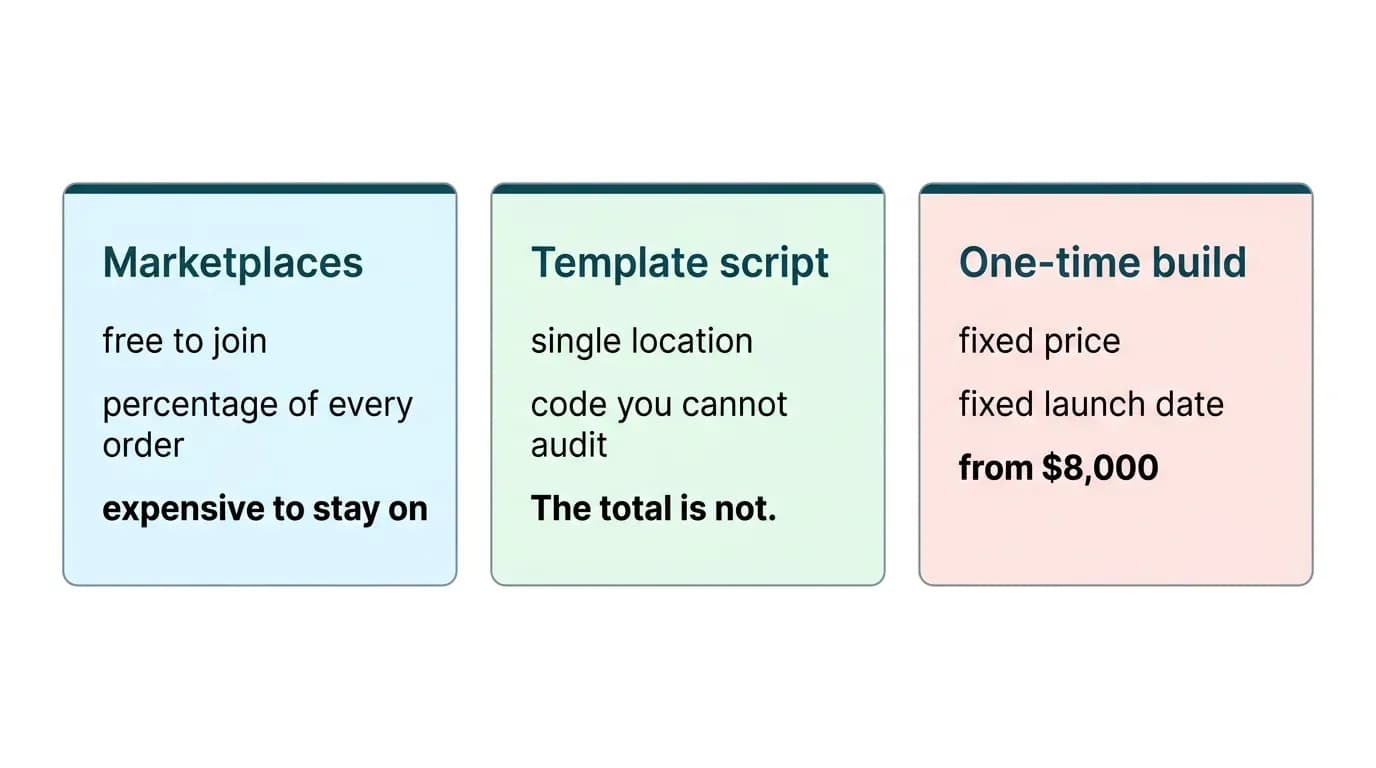
The genuinely cheap route is a template script from a marketplace like CodeCanyon. We will be straight with you: some of these work for a single location with a simple menu. The problems show up later. You inherit code you did not write and cannot audit, and updates arrive on someone else's schedule. Payment gateways and tax rules differ by market. The moment you need something the template did not anticipate, whether that's scheduled catering orders or a second location or a loyalty tier, you are paying a developer to reverse-engineer unfamiliar code. The sticker price is low. The total is not.
Our own position sits between those. We work on fixed price, fixed launch date, agreed before anything starts, and a first release can begin from $8,000. That number moves with scope. A single-location ordering app with QR table service is a different build from a multi-city delivery operation with rider dispatch, so treat it as a starting point, not a quote. The reason we price this way is that unpredictable development budgets are the single most common thing founders tell us went wrong last time.
If your budget is genuinely tight, start smaller rather than cheaper. A QR code ordering system for dine-in, with online ordering for pickup, is a narrow build that earns from day one, and delivery can come later.
How QR Code Ordering Changes the Comparison
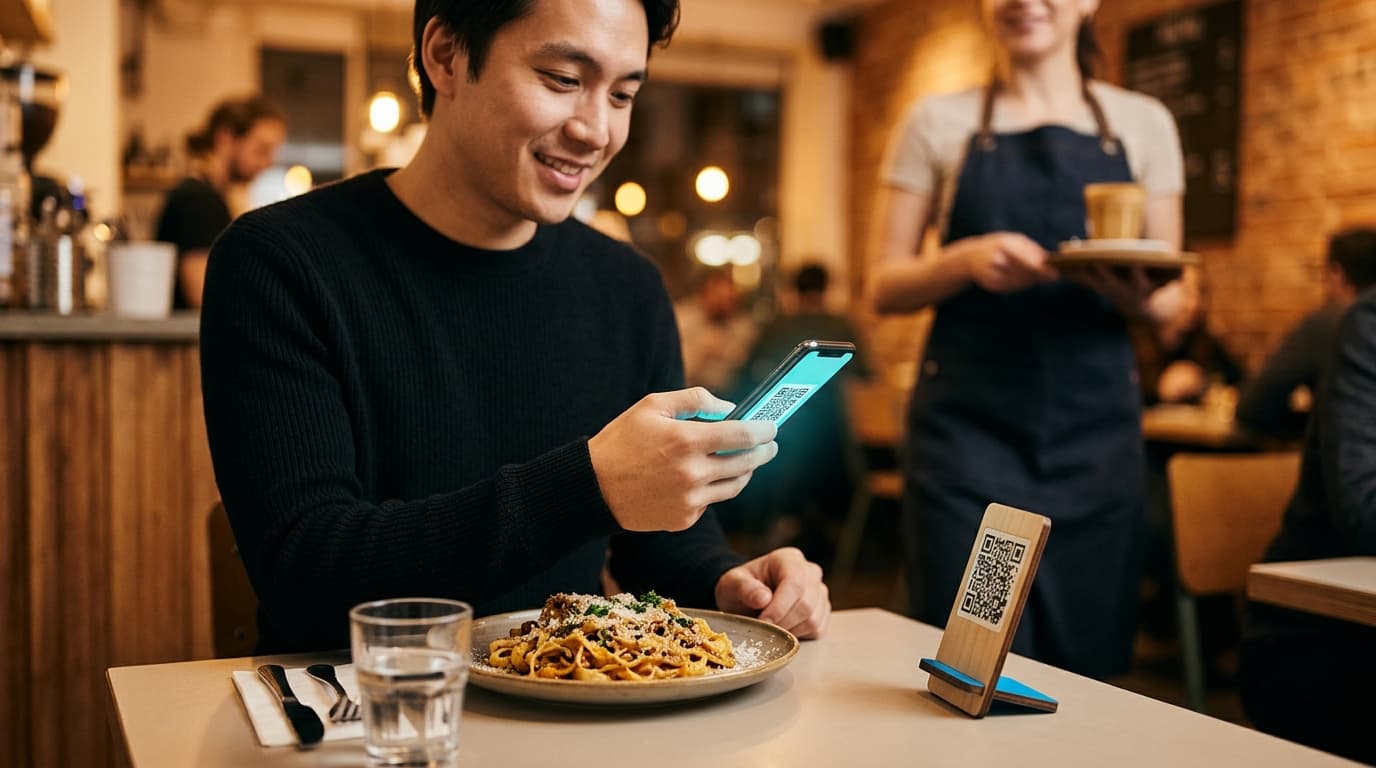
QR code ordering is where owned systems pull clearly ahead, because it covers the part of service marketplaces never touch. That part is the table.
Done well, a guest scans, browses the live menu, orders and pays without waiting for anyone. Staff spend their time on hospitality instead of tapping tickets into a terminal. You own the data, meaning what sells, what gets abandoned and who comes back, and you can email those guests without paying an intermediary for the privilege.
Done badly, QR code ordering creates a mess we see often enough to warn about. If the system does not group orders from the same table, dishes fire the moment each person taps submit, and food arrives at wildly different times. One guest is on dessert while another waits on a starter, and multi-course service becomes impossible to run. The fix is not complicated, but it has to be built in deliberately: orders from a table are held and coursed together, with the kitchen controlling the fire sequence rather than the guest's thumb. If you are evaluating any QR product, ask that question first.
For the mechanics of how the whole flow works end to end, we wrote a full breakdown of how a restaurant QR code ordering system works. The same logic applies to reservations, waitlists and table management, which is why we usually build them together rather than bolting them on afterwards. You can see how that fits in our restaurant reservation system.
Making the Call Without Betting the Restaurant
Here is how we would decide in your position.
Stay on the marketplaces for discovery, and treat them as paid advertising rather than infrastructure. Build your own ordering channel for the guests who already know you, and give them a reason to use it. That means better prices than the app charges, loyalty that actually counts, and a kitchen that gets the order right. Most restaurants we work with run both for the first year, then watch the direct share climb as regulars migrate.
This is still doable if you are non-technical. We build apps for restaurants of all sizes, from single-location dine-in setups to multi-city delivery operations. The pattern that works is the same every time: define a tight first release, agree the price and the launch date in writing, ship it, then expand based on what guests actually do. Our food delivery app development work follows exactly that shape: customer app, restaurant app, rider app and admin portal. You do not need all four on day one.
Tell us what your restaurant needs and we will give you a fixed price and a fixed launch date before any work begins.
Common questions
What is the best food ordering app for restaurants?
The best food ordering app depends on your goals. If you want volume quickly, third-party marketplaces deliver visibility, but if you want margin, repeat customers, and control over the guest experience, a branded ordering app backed by QR code ordering is superior.
How much does a food ordering app cost?
Third-party marketplaces are free to join but charge a percentage commission on every order indefinitely. Building your own branded app starts at around $8,000 for a single-location setup with QR table service, though the final price depends on scope and features.
What are the problems with third-party delivery apps?
Third-party delivery apps suffer from menu price markups that mislead customers, stacked service and delivery fees at checkout, unreliable drivers who get routed incorrectly or arrive late, inadequate refunds for missing orders, and lack of sourcing information that customers increasingly want.
How does QR code ordering work in restaurants?
With QR code ordering, a guest scans a code, browses the live menu, orders and pays without waiting for staff. The key to doing it well is grouping orders from the same table and holding them together so the kitchen controls the firing sequence rather than each guest ordering individually, which prevents food from arriving at different times.
Should restaurants use both marketplace apps and their own ordering system?
Yes, most restaurants should use marketplaces for discovery while treating them as paid advertising, and build their own ordering channel for existing customers with better prices and loyalty rewards. The pattern that works is running both for the first year, then watching direct orders increase as regulars migrate.

Arun Andiselvam
LinkedInI am a startup veteran who has built five brands. I sold the first, an SEO tool, for a six figure exit, and now lead Appkodes, building custom mobile and web apps for founders and businesses. I bootstrapped every one of them from day one.