Most founders ask the question before they have a spec. That's fair, you need a number to plan around. So here is the honest version. A simple single-purpose app takes two to four weeks. A real MVP with accounts, a backend and payments takes eight to sixteen weeks. A multi-sided platform, with customers, providers, riders and admin, takes three to six months before the first public release. How long does it take to build an app comes down less to the idea than to how many user types it serves and how much of it has already been built before.
That range is wide because the word "app" is doing too much work. A calculator and a food delivery marketplace are both apps. Below, we break the timeline down by app type, by stage, and by the decisions that quietly add weeks to a schedule. We work on a fixed price, fixed launch date basis. These are the numbers we commit to in writing, not optimistic guesses we revise later.
How long does an app take to make, by type?
Here is the shape of it, based on builds we've shipped and what we see across the market.
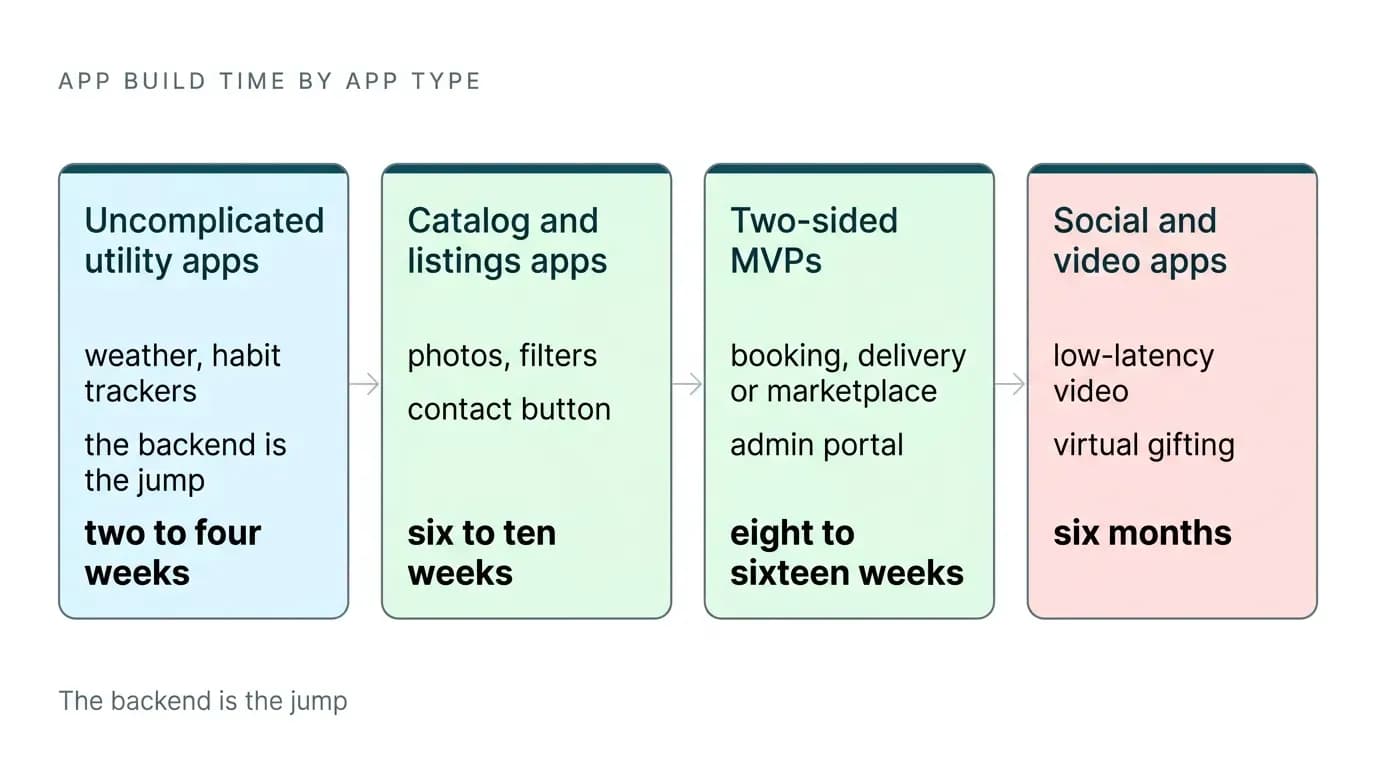
Uncomplicated utility apps, calculators, weather, habit trackers, flashcards without a server, land at two to four weeks. Add a backend so data syncs across devices and sign-up works, and that same flashcard app stretches to four or five weeks. The backend is the jump, not the screens.
Catalog and listings apps, a property app with photos, filters and a contact button, run six to ten weeks. We see this pattern consistently across real estate, rental directories and similar listing-driven products. Add agent dashboards and lead routing and you're into MVP territory, which takes longer still. Our real estate app development work usually starts at the catalog layer and grows from there.
Two-sided MVPs, booking, delivery or marketplace, take eight to sixteen weeks for a first release. You're building two or three apps plus an admin portal, and each one needs its own flows.
Social, live streaming and short video apps are the longest to build from nothing. Feeds, moderation, low-latency video, PK Battles and virtual gifting are each substantial pieces of engineering. Built from scratch, six months is realistic. Built on a proven base, far less, which is the whole argument for a clone app approach.
So how long does an app take to make in the real world? Faster than most founders fear, slower than the two-week prototype demo suggested.
How long does it take to build an iOS app versus an Android app?
This question comes up constantly and the answer surprises people. Roughly the same as Android, since the engineering effort is comparable. The difference is at the edges. Apple's review process is slower and stricter, so you budget extra days before launch day and design for that review rather than hoping to slip past it.
How long does it take to build an Android app? Similar build time, quicker to get live, but more device and screen-size testing because the hardware range is enormous. A layout that's clean on one flagship can break on a three-year-old budget phone. That QA tail is real work.
The important point is this: building both separately roughly doubles your timeline and your budget. We build cross-platform, so one codebase ships to both stores. This is the single biggest lever an early-stage founder has over the schedule. It's why the gap between "iOS first" and "both platforms" is now days of store admin rather than months of parallel development.
How long does it take to build an app prototype? And should you?
Clickable designs, real screens, real tap-through, no working backend, take one to two weeks for a focused product. That's enough to put in front of ten potential users, watch where they hesitate, and cut the features nobody reaches for.

Before you pay anyone, there's a cheaper step worth taking. Build a rough version on a no-code platform yourself. It won't scale, it won't handle your real security needs, and you'll outgrow it. But it will tell you in a weekend whether people want the thing. Founders who do this arrive at the first development conversation with a far sharper spec, and a sharper spec is weeks saved.
Be clear about what a prototype is not. It is not a head start on the build, because the code behind a prototype is throwaway by design. Its value is the decisions it forces you to make early, while changing your mind is still free.
Real builds, real timelines: what solo and small-team projects actually look like
The internet is full of "I built this in a weekend" stories, and some of them are true. Stories like this circulate often, and they are worth understanding properly before you plan around them.
That developer already knew the stack cold.
For a non-technical founder, the path looks different. Learning a framework like Flutter to the point where you can ship something production-grade takes four to six months of daily work, minimum. This isn't a reflection of your ability. It's the honest cost of learning design, frontend and backend work, plus QA, infrastructure and release management, all at once, because a marketable product needs all six.
A developer working with AI assistance can produce a solid standard app in about a month. That is a genuine shift in what a small team can do. But the gap between a working app and a sellable one is still the unglamorous part, things like error handling, edge cases, store compliance, and payments that don't lose money.
Two things we watch during builds that founders rarely think about. First, file size creep, apps tend to grow steadily heavier as features land, and on slower connections that affects install rates directly. Second, performance under real use. Even polished products ship with noticeable jank in animations and view switching, and that gap is an opening for anyone building in the same space. Smoothness is a feature people feel before they can name it.
The AI-assisted development question: speed versus trust
AI coding tools have compressed timelines, and we use them. The honest caveat is that generated code carries risk a founder can't easily see. It copies patterns without understanding your context, authentication that looks right but leaks, dependencies pulled in without review, data handling that would never survive a security audit.
This matters most in regulated work. For healthcare apps, mental health tools and anything touching patient records, we treat AI output as a draft that a human reviews line by line. We build HIPAA and GDPR-ready systems. Readiness comes from reviewed architecture and documented data handling, not from whatever a model generated at speed. Your own compliance obligations still depend on how you operate the product, and that's a conversation worth having with counsel in your market.
The practical rule is easy: let AI speed up the parts where a mistake is visible, and slow down where a mistake is invisible until it's expensive. That discipline costs a few days and saves you a breach.
What actually delays apps: feature creep, perfectionism and the cost of changing your mind
Across years of shipping these projects, we have almost never seen a timeline blow up because the engineering was hard. It blows up because the scope moved.
Feature creep is the main culprit, and it rarely arrives as one big request. It arrives as "could we also," repeated weekly. Every addition touches design, build, testing and the admin panel, four places, not one. The fix is dull and effective: agree the release scope up front, write it down, and move everything else to a version two list. We lock down that scope before work starts, which is what makes a fixed price and fixed launch date possible at all.
Perfectionism is the quieter delay. Founders hold the launch waiting for one more feature, and every week of waiting is a week of learning nothing. Ship the version that solves one problem properly. Real users will tell you what to build next, and they'll be more right than your roadmap.
Budget matters here too. A freelancer might build a simple app cheaply, but you're buying their availability, not a team. Our first releases start from $8,000, think a delivery app like Swiggy, a Slack-like workspace tool, or remote patient monitoring software. For a medicine delivery app we work to roughly a 30-day launch, with the caveat that scope and integrations move that number. Payment structure matters as much as price, and milestone payments tied to deliverables keep both sides honest.
Deciding between building from scratch and initial from a proven base changes the timeline more than anything else on this list. Our custom app vs template script comparison lays out the trade-offs, and our guide to how to build an app walks the full process end to end.
Post-launch: the timeline that never ends
Launch day is not the finish line, and planning as if it is will hurt you. Budget the first four to six weeks after release for fixes, crashes on devices you never tested, flows users take that you never imagined, performance under load that staging never showed.
After that, settle into a rhythm. Small releases every few weeks, each one driven by what your data and your users tell you. Add the ongoing costs of OS updates, store policy changes, server bills and security patches. An app is a product you operate, not a project you complete.
Tell us what you're building and we'll come back with a scope, a fixed price and a fixed launch date before any work begins, get a quote here.
Common questions
How long does it take to build a simple app?
A simple single-purpose app takes two to four weeks. Add a backend so data syncs across devices, and that same app stretches to four or five weeks.
How long does it take to build an MVP with payments?
A real MVP with accounts, a backend and payments takes eight to sixteen weeks.
How long does it take to build an iOS app versus Android?
The engineering effort for iOS and Android is roughly the same. The main difference is that Apple's review process is slower and stricter, while Android requires more device and screen-size testing.
What causes app development timelines to get delayed?
Timelines rarely blow up because the engineering is hard—they blow up because the scope moved. Feature creep, arriving as repeated weekly requests for "could we also," and perfectionism holding up launch are the main culprits.
How long should you budget after launching an app?
Budget the first four to six weeks after release for fixes, crashes on devices you never tested, and flows users take that you never imagined. After that, settle into a rhythm of small releases every few weeks.

Arun Andiselvam
LinkedInI am a startup veteran who has built five brands. I sold the first, an SEO tool, for a six figure exit, and now lead Appkodes, building custom mobile and web apps for founders and businesses. I bootstrapped every one of them from day one.