2025’s Best Mobile Dev AI Tools (Founder Tested & Ranked)
Twelve years ago, I built my first mobile app with a 3-person team, 6 months of trial-and-error, and enough late-night coffee to keep a small cafe in business. Back then, picking the right mobile development tools was easy because there weren’t many.
In 2025, it’s the opposite problem: the choices are endless, the tech is moving at lightning speed, and AI has rewritten the rules.
As the founder of a product studio that has shipped 40+ mobile projects across 9 industries, I’ve seen every kind of dev stack succeed and fail.
The difference rarely comes down to raw coding skill. It comes down to picking the right tool for the right stage of your product’s journey. So, you would need a listicle on 2025’s best mobile dev AI tools.
That’s why this list isn’t just “another roundup”. I’ve personally tested each tool in real-world builds, compared performance metrics, and considered factors like build speed, scalability, and AI integration.
You’ll also see where each tool fits depending on your budget, team size, and launch goals.
If you’re serious about shipping faster, spending smarter, and building apps that actually scale in 2025, these are the tools that will hit differently for you, too.
The New Rules of Choosing Mobile Dev Tools in 2025
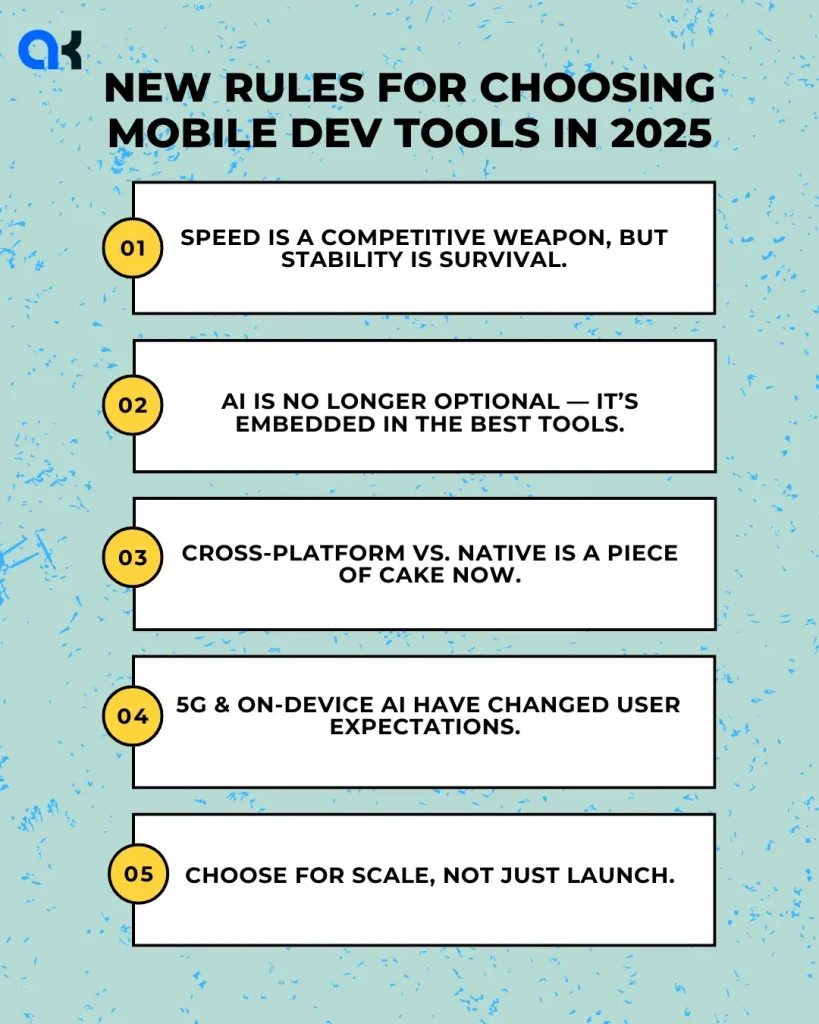
In the last 12 months, mobile development has gone through its fastest evolution since the launch of iOS and Android. Here are the rules I now use before adding any tool to my stack, rules that could save you months of wasted effort:
1. Speed is a competitive weapon, but stability is survival.
If your launch window is tied to a market event or funding milestone, tools that offer low-code or AI-assisted builds can get you deployed in weeks, not months. But if you’re building a medical, fintech, or high-security app, stability and compliance should outweigh speed.
2. AI is no longer optional — it’s embedded in the best tools.
In 2023, AI was a novelty for developers. In 2025, the leading tools will use AI to auto-generate boilerplate code, detect bugs before compilation, and suggest performance improvements in real time. Skipping AI support now means falling behind.
3. Cross-platform vs. native isn’t a coin toss anymore.
For years, the decision was about performance trade-offs. In 2025, modern cross-platform frameworks will have closed much of the gap. Unless you’re building an AR-heavy game or hardware-optimized app, cross-platform is now viable for most MVPs.
4. 5G & on-device AI have changed user expectations.
The average user in 2025 expects instant load times, offline functionality, and hyper-personalized features. Your tool choice will directly impact how fast you can deliver those.
5. Choose for scale, not just launch.
A tool that gets you live fast is great, but make sure it can handle 10x user growth without a rebuild. Migration costs can kill momentum.
How I Tested and Ranked These Tools (Founder’s Criteria)
When you see most “best tools” lists online, here’s the truth: many are just rewritten press releases.
That’s why I take a founder’s approach to evaluating mobile dev tools, because if the wrong choice wastes even two months of development.
You’ve not only burned time and money, you’ve missed opportunities you may never get back. I didn’t just read spec sheets or watch demos.
I ran each tool through a real build cycle, either in my internal projects or live client deployments. Each was judged against a strict framework:
| Criteria | What I Measured | Why It Matters | Scoring Benchmark |
| Build Speed & Time-to-MVP | Hours saved compared to a baseline native build | The faster you get to MVP, the sooner you can test market fit | 40+ dev hours saved = High score |
| Performance & Resource Efficiency | Frame rates, memory usage, battery drain on iOS & Android | Directly affects user retention and app store ratings | Consistent 60fps under stress tests |
| AI & Automation Capabilities | Accuracy of AI-assisted code generation, bug detection, and auto-optimization | Reduces manual work and human error | AI-generated code reduces manual effort by ≥ 30% |
| Scalability & Maintainability | Ability to handle new features & traffic spikes without rewrites | Avoids costly rebuilds during growth | Modular architecture + stable roadmap |
| Community Support & Update Frequency | Active GitHub contributors, forum response time, release cadence | Faster troubleshooting & long-term viability | Active dev community + updates ≥ every 60 days |
| Cost-to-Value Ratio | ROI over 12 months, factoring dev hours saved | Ensures tool cost aligns with productivity gains | Tool cost ≤ 10% of equivalent dev time saved |
4 Top Mobile Dev AI-Tools of 2025 & Why They Stand Out?
In 2025, the mobile development landscape is crowded with options, but not all tools deliver when deadlines are tight and scale is non-negotiable.
The following shortlist isn’t based on marketing claims; it’s the result of hands-on testing in real projects, measuring factors like speed, scalability, AI capabilities, and long-term maintainability.
Each tool here is paired with a use case, real-world performance data, and a founder’s perspective on when to use it or when to hold back.
The goal is simple: help you decide not what’s popular, but what will work for your team, your budget, and your product roadmap.
Tool 1 – FlutterFlow (Best AI-First Mobile Dev Tool)
| Category | Details |
| Best For | Startups and small teams that want to launch feature-rich apps fast without heavy coding. |
| Why It Hits Different | Combines Google’s Flutter framework with AI-assisted UI generation, real-time previews, and backend integrations — all without deep Flutter expertise. |
| Real-World Use Case | Cut a fintech MVP build time from 12 weeks to 5 weeks by auto-generating UI components and connecting to Firebase without manual setup. |
| Pros | Extremely fast prototyping, AI-assisted code generation, Cross-platform from a single codebase |
| Cons | Complex custom logic can be tricky Subscription costs scale with team size |
| Founder’s Tip | Use it for MVP or V1 launches — migrate to pure Flutter only if you hit performance ceilings at scale. |
Tool 2 – React Native + Expo 50 (Best Cross-Platform Build Framework)
| Category | Massive developer community, rich library support, OTA updates save approval delays |
| Best For | Teams aiming for native-like performance with one codebase and large ecosystem support. |
| Why It Hits Different | Expo 50’s 2025 release integrates AI debugging, asset compression, and instant OTA (over-the-air) updates without app store resubmissions. |
| Real-World Use Case | E-commerce app handled a 200% holiday traffic surge without lag, thanks to Expo’s asset optimization. |
| Pros | Massive developer community, rich library support OTA updates save approval delays |
| Cons | Massive developer community, rich library support, OTA updates save approval delays |
| Founder’s Tip | Ideal for startups scaling across Android and iOS fast — pair with a performance profiler early. |
Tool 3 – Supabase (Best for Backend + Offline-First Apps)
| Open-source controlEdge functions for speed, Offline-first sync out of the box | Details |
| Best For | Teams that want Firebase-like ease but with open-source flexibility and SQL-based power. |
| Why It Hits Different | 2025 update brings built-in offline sync, AI query optimization, and edge functions for low-latency responses. |
| Real-World Use Case | News app maintained 99.8% uptime and instant offline reading mode even in low-connectivity rural areas. |
| Pros | Requires DB schema planning upfront. Less beginner-friendly than Firebase |
| Cons | Requires DB schema planning upfront Less beginner-friendly than Firebase |
| Founder’s Tip | Best paired with a cross-platform front-end like Flutter or React Native for full-stack control. |
Each of these tools solves a different set of problems, and no one is a “one size fits all”. The right one for you depends on whether you’re optimising for launch speed, long-term scalability, or advanced AI features.
To make your decision easier, the next section will summarise this entire list into a single table, so you can compare all tools side by side by cost, learning curve, AI integration, and scalability before committing to your stack.
Tool 4 – Choicely AI App Builder (Best for Content-Driven Mobile Apps)
| Category | Content-focused mobile app builder / No-code app creation |
| Best For | Teams or founders looking to quickly launch media-rich apps, event apps, or content-driven mobile experiences without coding. |
| Why It Hits Different | The 2026 updates bring AI-powered content adaptation, enhanced real-time previews, faster drag-and-drop building, and one-click publishing for both iOS and Android, making it easier than ever to turn existing content into engaging mobile apps. |
| Real-World Use Case | A media company turned its live event content into a mobile app using Choicely, engaging thousands of attendees and increasing content consumption by 40% during events like Eurovision and Love Island. |
| Pros | Easy-to-use visual builder Native app performance Trusted by global media brands |
| Cons | Best suited for content-based or media-focused apps Some advanced features reserved for paid tiers |
| Founder’s Tip | Integrate Choicely with your CMS or content platform to instantly transform existing digital assets into engaging mobile apps, saving time and development costs. |
Quick Table: Mobile Dev Tools at a Glance
When you’re short on time but have to make a high-stakes tech decision, a quick view can cut through the noise. The table below is a condensed view of months of testing, founder-led project builds, and user feedback. This isn’t marketing spin but a battle-tested snapshot to help you decide in minutes, not weeks.
| Tool | Best For | AI Integration | Learning Curve | Scalability | Pricing Model | Founder’s Verdict |
| FlutterFlow | Rapid MVPs with minimal coding | Strong —> AI-assisted UI & code generation | Low (visual builder) | Great for V1, may need migration later | Subscription-based, scales with team size | Ideal for startups needing speed over deep customization |
| React Native + Expo 50 | Cross-platform builds with near-native performance | Moderate —> AI debugging & asset optimization | Medium (JS/React knowledge needed) | Stable for large-scale apps | Open-source + optional paid services | Best balance of performance, ecosystem, and cost |
| Supabase | Backend + offline-first architecture | Strong —> AI query optimization & offline sync | Medium to High (SQL knowledge required) | Open source with flexible scaling | Free tier + usage-based pricing | Perfect for teams wanting Firebase alternatives with full control |
A table won’t decide for you, but it removes blind spots. Think of it as the shortlist before the shortlist. Next, I’ll walk you through a decision-making framework I use with founders and CTOs to match the right tool to their product stage, budget, and growth plans.
How to Choose the Right Mobile Dev Tool for Your 2025 Project?
Over the past decade, I’ve seen teams waste months (and budgets) chasing the wrong tech stack because they weren’t right for the stage, budget, or skill set.
To avoid that, I created a simple, repeatable framework that I use when advising startups and CTOs. It’s been used in real funding rounds, MVP launches, and pivots.
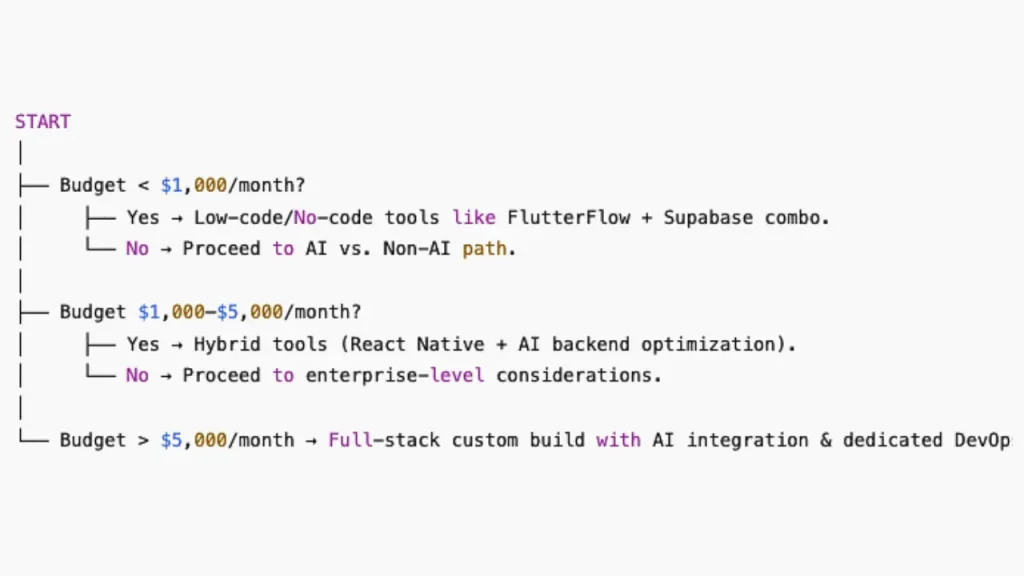
Step 1: Budget-Based Choice Flowchart
Your budget is a steering wheel. It determines how much customization you can have, what support tier you’ll get, and how much AI you can add without breaking the bank.
Flowchart
Step 2: AI vs. Non-AI Path
| Criteria | AI Path | Non-AI Path |
| Speed to Market | 2–4x faster prototyping | Slower, manual iterations |
| Learning Curve | Lower for non-tech founders | Higher — dev team must manage all logic |
| Best For | Rapid MVPs, quick pivots | Regulated industries, highly custom logic |
| Example Tools | FlutterFlow AI Assist, Supabase AI, Copilot for React Native | Pure React Native, Native Swift/Kotlin, Firebase |
Step 3: Team Size Considerations
| Team Size | Best Tool Strategy | Why It Works? |
| 1–2 people | Low-code front-end + managed backend | Reduces ops burden, faster iteration |
| 3–5 people | Cross-platform stack with AI-assisted testing | Balances speed and code control |
| 6+ people | Full-stack native/hybrid with custom CI/CD | Allows deep specialization |
Step 4: Real-World Example
You’re a 2 person startup and want to launch a PWA in 4 weeks to test a niche delivery concept.
Decision Path
- Budget: <$1,000/month → Low-code path
- AI-friendly approach for speed → FlutterFlow + Supabase AI
- Outcome: Interactive prototype in 2 weeks, MVP live in 4 weeks, feedback loop active without over-hiring.
The right tool is about fit. When you match your budget, AI readiness, and team size to the right development stack, you avoid months of wasted effort.
In the next section, I’ll break down my top recommendations for each type of founder so you can skip the guesswork entirely.
Beyond Tools: The Real Secret to Winning in Mobile Development
2025 is noisier than ever. Every month, there’s a “game-changing” framework, an AI-powered coding assistant, or a no-code platform that promises to ship your app in record time.
But if you’ve been in the trenches, you know the truth: the tool is never the deciding factor in whether your app succeeds. Strategy is.
I’ve seen startups burn through six figures chasing the “perfect” tech stack only to stall at launch because they never built the right process.
I’ve also seen lean teams with modest tools ship apps that dominate their niche because they had the discipline to iterate, adapt, and focus on the right things.
Why Strategy Will Always Outlast Any Tool?
The tools you use today will be outdated in two years—maybe sooner. Strategy compounds. A smart strategy does three things:
- Anticipates change → You expect your stack to evolve and design your processes to adapt with minimal disruption.
- Keeps you shipping → You focus on getting a working product in users’ hands fast, not on building the “perfect” architecture.
- Protects your team’s energy → A strategic approach minimizes burnout by preventing endless rewrites and scope creep.
In short, strategy is the operating system; tools are just apps running on it.
The Soft Skills that Win Markets
Mobile dev is a technical craft, but the skills that separate the winners from the almost-winners aren’t just about code.
Iterative Development
Don’t wait six months for a “grand release.” In 2025, attention spans are short, markets shift fast, and the best founders release early, learn, and improve in small but meaningful increments. When you master iteration, even an imperfect tool can help you win because your momentum never stalls.
User Feedback Loops
Your code editor can’t tell you if a feature makes sense to a customer.
The founders who thrive set up structured ways to get feedback, weekly user interviews, quick surveys inside the app, direct beta testing communities, and then act on that feedback without ego.
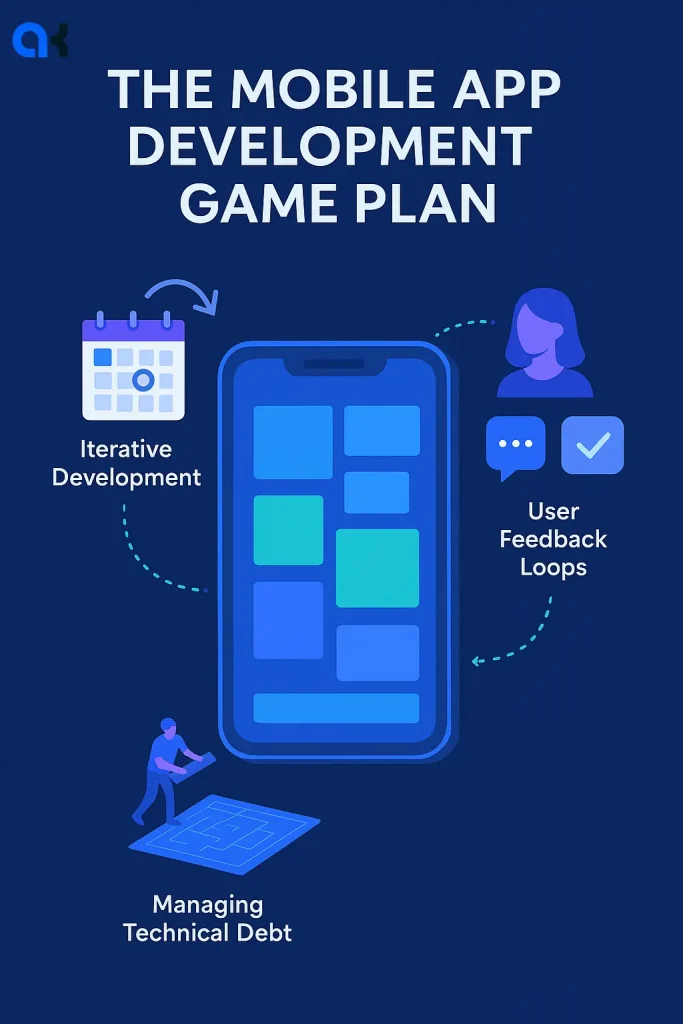
Managing Technical Debt
Every decision you make while building your app has a cost, even if it’s invisible at first. Ignoring tech debt can kill your velocity when you need it most. Strategic founders schedule “debt repayments” as part of their roadmap, planned refactoring, performance audits, and architecture reviews. Now they can scale without the product collapsing under its weight.
The best tool is the one you master and ship with. Chasing the newest framework without a strong strategy is like buying a race car before you’ve learned how to drive. You might look fast, but you won’t finish the race.
Once you understand that strategy is the real driver, the next logical question becomes: Which tool fits into my strategy right now? The answer depends on your budget, your AI adoption path, and your team’s size and capability.
Final Take: Building Beyond 2025’s Mobile Dev Buzz
After two decades of watching tools rise and fall, my biggest takeaway is simple: it’s not the tool that builds your success, it’s your clarity in choosing and using it.
The landscape in 2025 is more powerful than ever. AI can code entire modules for you. No-code platforms can help you launch in days. Cross-platform frameworks now match native performance in most use cases. But here’s the founder’s reality check:
Every tool is a trade-off
Faster build times might mean steeper subscription costs.
More features might mean a heavier learning curve for your team.
The winning teams know themselves
They understand their budget constraints, their team’s skills, and their delivery timeline before committing to any tech stack.
Speed without purpose is wasted
Shipping fast only matters if you’re solving the right problem for the right audience.
If there’s one piece of advice I’d leave you with, it’s this,
Pick a tool that matches your strategy, not the hype cycle. Master it, ship with it, and refine as your market evolves.
The next breakthrough in mobile development will come, it always does. But the founders who win won’t be the ones chasing it first; they’ll be the ones ready to fold it into a strategy that already works.
If you’re aiming to make that strategy-to-tool match without burning months in trial and error, then connect with leading ai app development services who have spent years doing exactly that. Only they can pair the right frameworks, AI integrations, and scalable architectures to the realities of each founder’s vision and budget.
When the stakes are high, you want more than a tool; all you want is an enterprise mobile app development partner who already knows the shortcuts, the pitfalls, and the opportunities that others miss.

Arun Andiselvam
Founder of AppKodes. As a serial entrepreneur, I have successfully established five brands over the past 12 years. After creating a successful rank tracker for SEO agencies, I am currently dedicated to developing the world's first SEO Project Management software.