The Scalability Ceiling: Why Manual Month-End Processes Stifle Mid-Market Growth
As mid-market organizations grow, they typically have to deal with operational anxiety. As the number of transactions increases, it becomes tougher to keep track of financial processes that used to work for smaller teams, like spreadsheets, email approvals, and accounting workflows that don’t connect.
Finance teams are especially affected during the month-end close. As the number of transactions and the level of detail in reporting increase, the process becomes slower due to traditional methods. Organizations are increasingly adopting modern technologies, like financial close software, to improve the efficiency of the process, particularly in the area of reconciliation and tracking of closing activities.
More than 60% of mid-market businesses still rely on manual reconciliation and spreadsheet-based workflows, which often slow the closing process. Companies that use automatic financial systems can finish the month-end close 30–40% faster. This shows how important it is to have up-to-date financial close solutions.
What is the Month-End Close Process
As part of the month-end close process, financial transactions are checked, accounts are balanced, journal notes are looked over, and reports are made for leadership teams. It makes sure that the company’s financial records properly show how it did during a certain time period.
This process might be pretty easy for small businesses. However, as businesses grow, they quickly have more deals, departments, and financial data. Financial reporting is getting harder to understand because of this growth.
Finance teams are required to collaborate with numerous departments, gather data from various systems, and verify the accuracy of all entries prior to the completion of reports. Delays are inevitable when these duties are contingent upon manual workflows.
How Manual Financial Workflows Slow Finance Teams Down
Spreadsheets and pieces of different systems are often used in manual financial processes. These tools are easy to use and adaptable, but they aren’t made to handle large-scale financial tasks well.
When companies stick to manual workflows, a number of problems appear.
1. Delayed Financial Reporting
It takes a lot of time and work to do manual reconciliation. Before closing the books, finance personnel need to check transactions, find any mistakes, and make sure that approvals are in order.
This means that making financial reports might take days or even weeks. It’s harder for leadership teams to make choices on time when reports are late.
2. Increased Risk of Errors
People can make mistakes when they enter data by hand. Financial reports can be off because of even small mistakes in spreadsheets or journal notes.
When mistakes happen, finance teams have to spend more time looking into them and fixing them. It takes even longer to close now because of this.
3. Limited Visibility Across Departments
Multiple spreadsheets and disconnected tools are often used in manual processes. This makes it hard for finance teams to keep a reliable representation of what’s going on with money in other areas. It’s harder to find financial problems or trends when data isn’t organized.
The Impact on Mid-Market Companies
When it comes to financial processes, mid-market companies are especially at risk of inefficiencies. They deal with more transactions and more complicated financial arrangements than small businesses. But it’s possible that they haven’t put in place smart financial automation systems yet.
As a result, finance teams often struggle with-
- Managing large volumes of financial data
- Coordinating closing activities across departments
- Ensuring compliance with reporting standards
- Meeting tight reporting deadlines
When manual processes dominate the financial close cycle, finance teams spend more time managing administrative tasks than analyzing financial performance.
What Does Financial Close Automation Do?
Automation reduces the need for manual intervention, which enables businesses to manage their financial activities more efficiently. Financial management systems are helpful for businesses today because they can track closing activities.
Manually gathering and checking information isn’t needed because automated systems do it all and instantly point out any problems. This lets the finance teams work on making decisions and analyzing money more.
For better coordination between sections, automation also organizes financial tasks on a single platform.
Automation improves financial operations by helping teams.
- Centralize financial data in one system.
- Automate reconciliation and repetitive tasks
- Track month-end closing activities in real time
- Detect errors or discrepancies more quickly
- Improve collaboration between finance and other departments
These improvements help finance teams complete financial processes faster and with greater accuracy.
What Finance Teams Gain from Automating the Closing Process
- Automation helps in reducing the time taken for completing the closing process. The tasks that are performed manually can be completed in less time through automation.
- Automated reconciliation helps in reducing errors by checking the financial data.
- Having centralized financial systems helps in gaining real-time visibility into the financial performance of an organization. The progress can be monitored, and problems can be identified.
- Automated systems help in creating an audit trail, thus enabling an organization to be compliant with financial regulations and reporting requirements.
Preparing Finance Teams for Future Growth
As businesses grow, so should their financial processes. The financial processes that worked so well in the early stages of the business can be barriers to growth.
Finance teams of today demand systems that offer speed, precision, and transparency. With the use of automation technologies, organizations can overcome the limitations of their operations and achieve financial efficiency. Automation enables finance professionals to move away from financial planning and into other areas.
How Automation Improves Collaboration Across Finance Teams
For many mid-market companies, the process of month-end close involves the coordination of various teams, such as the accounting, finance, and operations teams. When the process of performing these tasks is manual, using tools such as emails and spreadsheets, it becomes hard to keep track of the process and the people involved.
The process of automation helps to arrange these activities into a workflow, where tasks can be easily monitored and coordinated for the finance teams.
Automation improves collaboration across finance teams by helping them-
- Clearly assign responsibilities for each closing task
- Track progress of reconciliations and approvals in real time
- Maintain a single source of financial data across departments
- Reduce confusion caused by multiple spreadsheets or email threads
- Ensure that updates are visible to everyone involved in the closing process
With better coordination and clearer visibility, finance professionals can spend more time reviewing financial insights and less time searching for missing information.
Why Real-Time Financial Visibility Matters
For business choices, it’s important to have current and accurate financial information. When businesses use manual methods, they usually don’t get their financial information until after the accounting cycle is over. This makes it take longer for leaders to react to changes in sales, costs, or performance.
By putting together data from many sources, automation helps finance teams get to accurate financial data more quickly. With real-time visibility, businesses can keep track of their finances all the time, instead of just waiting for data every so often.
Businesses can plan better, manage their resources more efficiently, and confidently take advantage of growth possibilities when they can get financial information faster.
Financial Close and Automation Trends
Recent industry research shows that finance teams are increasingly adopting automation to improve efficiency and accuracy in financial operations.
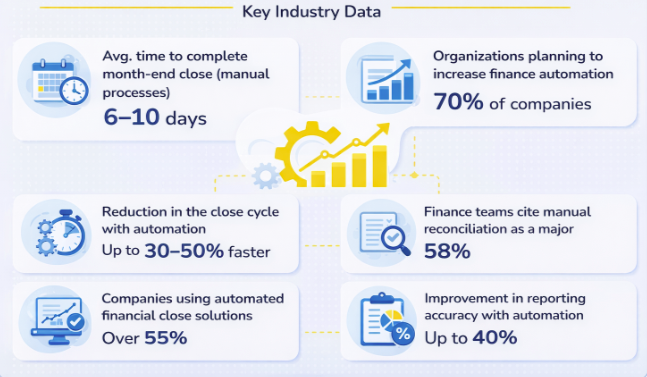
These details highlight the growing shift toward automated financial processes. As transaction volumes increase and financial structures become more complex, organizations are adopting automation to accelerate reporting cycles, improve data accuracy, and gain faster visibility into financial performance.
How Finance Automation Supports Scalable Growth
As mid-market organizations continue to expand, financial operations must keep pace with increasing transaction volumes and reporting expectations.
Manual processes that rely on spreadsheets and fragmented data sources often struggle to support growing business needs. Automation helps address this challenge by creating structured financial workflows that can scale along with the organization.
Automated financial close processes allow finance teams to manage tasks more efficiently by standardizing key activities such as-
- Reconciliation of financial records
- Approval workflows for closing tasks
- Data consolidation from multiple systems
- Generation of financial reports
Instead of spending time collecting data from multiple systems, finance professionals can access consolidated financial information in a centralized environment. This improves both speed and accuracy during the closing cycle.
Financial processes are also more consistent when they are automated. It makes sure that the same steps are taken every time a report is due, which helps keep everyone in line and saves on reporting mistakes.
As a company grows, it needs more and more accurate financial information to plan and make decisions. Finance teams can get timely information that helps with planning, forecasting, and performance analysis due to automation.
Final words
Manual month-end closing processes can limit a company’s growth as financial complexity increases. If you do account reconciliation manually or on a chart, you might make mistakes and waste time. Companies in the middle market can make better choices when they use automated financial solutions to get more accurate data, speed up reporting, and see things more clearly. Appkodes can help build solutions for clients according to their needs. Get ready to have your automated system up and running.

Thangamanikandan Bharathan
Starting as an iOS developer and moving up to lead a mobile team at a startup, I've expanded my expertise into Project Management, DevOps and eventually becoming a COO & Chief Service Officer in the IT sector. As a CSO, I excel in team leadership, technical advice, and managing complex business functions, focusing on combining technology and operations to drive growth. I'm keen to connect for collaborations or to exchange insights in the tech world!