Will AI SaaS Development Transform Your Business or Just Generate Ideas?

What if your product wasn’t just a tool, but something that could observe, learn, and improve itself without being told? Not just responding to users but anticipating them.
Imagine a SaaS platform that notices changing patterns, predicts demand shifts before they happen, and even suggests new features based on silent behavior trends. What if your software could evolve the same way your customers do?
This isn’t a distant future scenario. It’s already unfolding. In fact, global AI adoption in business is expected to reach $1.8 trillion by 2030, with ai SaaS development companies leading the charge in driving innovation and automation.
Look at what’s happening inside India’s e-commerce ecosystem. As the festive season approaches, Flipkart has quietly reshaped how sellers grow on the platform. Over just the past six months, there’s been a 25–30% increase in active sellers, and the marketplace now holds over 90 million product listings. But the fascinating part lies beneath the surface.
AI-driven personalization is now helping Flipkart increase customer engagement by 25% and reduce supply chain inefficiencies by nearly 30%. The system studies browsing patterns, cultural buying habits, and seasonal rhythms and adjusts everything from recommendations to inventory placement automatically.
No manual dashboards. No guessed decisions. Just systems that learn.
So here’s the question: If one marketplace can learn and adjust at this scale… what could your product do if it learned from every user touchpoint too? Because the real shift is happening in how software is built.
According to Bain & Company’s 2025 Technology Report, companies that only use generative AI for coding see productivity gains of 10–15%. Useful, but expected.
However, businesses that weave AI into the entire development lifecycle requirements, design, testing, and feedback loops see 30%+ performance improvements and drastically faster release cycles. Some are even automating testing and quality checks, accelerating launches by up to 40%.
Meanwhile, 34% of SaaS companies adopting AI in daily operations report:
- Clearer product decisions
- Stronger customer retention
- Faster market adaptation
- More predictable growth
Not because AI replaced work but because it reduced guesswork. This is where AI SaaS becomes more than a feature; it becomes a strategy. A strategy for:
- Spotting market shifts before they become trends
- Understanding users beyond clicks and forms
- Reducing repetitive bottlenecks so teams focus on innovation
- Designing products that never stop evolving
Businesses that make this shift are already seeing 30–50% more stable, scalable growth. Not by doing more but by doing smarter. So the real question isn’t: “Should we adopt AI saas?”
It’s something far more interesting: What would happen if your ai saas development software learned faster than your competitors? What would your product become if it didn’t just serve users but grew with them?
The companies willing to explore that question now will be the ones everyone else studies later. Before diving deeply, you should know what ai saas development is.
What is AI SaaS Development?
AI SaaS development is all about building cloud-based software that’s smarter, faster, and more capable than traditional applications. Instead of installing programs on your computer, users access AI-powered features through a subscription, often right in their web browser.
These solutions combine SaaS architecture, scalable cloud infrastructure, data engineering, and machine learning models to automate tasks, provide actionable insights, and deliver personalized experiences.
What makes AI SaaS especially appealing for businesses is its ability to reduce operational costs, boost efficiency, and speed up digital transformation. Why now?
Why AI is Crucial for SaaS and Today’s Business Market
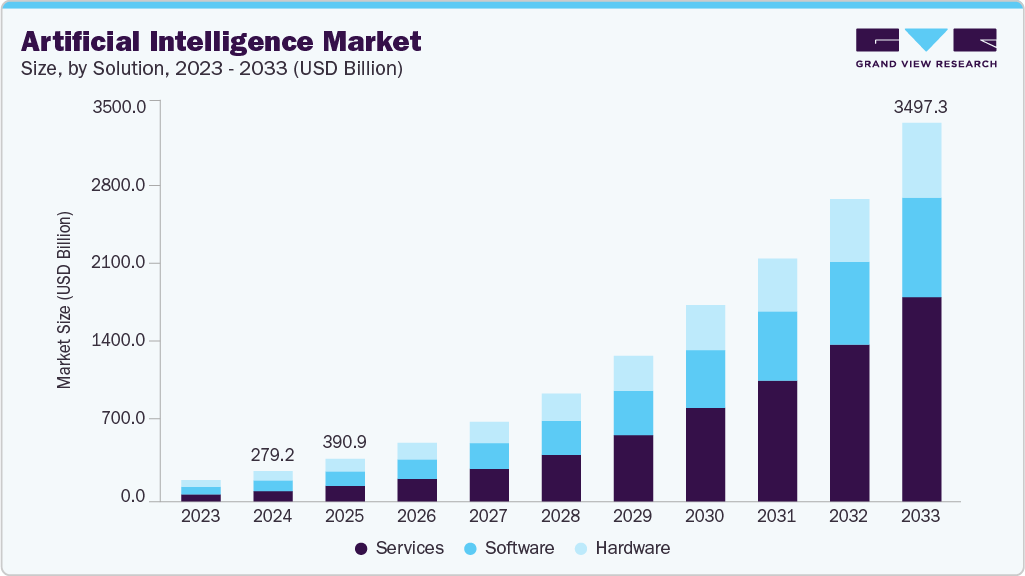
AI adoption has entered a new phase. What was once experimental has now become a strategic requirement. In 2024, the AI market hit $279 billion and is expected to grow at a 36% CAGR through 2030. This growth reflects a fundamental shift in how software is designed, improved, and delivered.
Source: https://www.grandviewresearch.com/
Intelligence is moving from being a feature to becoming a structural element of product design.
McKinsey estimates that generative AI could create between $2.6 and $4.4 trillion in economic value each year across industries. Yet, most organizations never realize that promise.
Research from BCG, IBM, and MIT Sloan suggests that almost 80% of AI initiatives stall at the pilot stage. Not because the models don’t work but because AI is still often treated as something bolted on after the product is built, rather than something that shapes how the product works from the ground up. For early-stage teams and small businesses, choosing the right AI use cases matters even more. ZenBusiness’s AI guide highlights how narrowing focus to a few high-impact workflows prevents wasted spend and keeps projects from stalling at the pilot phase.
The companies that are breaking through are the ones that build intelligence into their product’s foundation.
In these products, AI isn’t a widget in a toolbar; it is part of how decisions are made, how workflows adapt, and how user interactions evolve. The software can see where friction occurs, understand behavior as it happens, and adjust itself continuously rather than waiting for the next major release cycle.
This pattern is consistently reflected in research from Bain & Company, Accenture, and Salesforce. SaaS product development with shadcn AI into their core workflow logic see smoother onboarding, more intuitive user experiences, and features that feel relevant rather than excessive.
Not because the product simply “has AI,” but because learning has become a native function of the system. And this changes how growth happens.
Instead of relying on larger support teams, more marketing spend, or faster release schedules, progress comes from the product’s own ability to improve itself. It becomes more accurate, more contextual, more aligned with the way people actually use it, and it does so automatically.
For founders and product teams, this marks a subtle but profound shift. Growth stops being a matter of effort alone. It becomes something the system participates in. This is where the value compounds not by doing more, but by designing smarter. How to make it work?
How AI SaaS Development Works?
1. Identify the Core Problem
Everything starts with a clear problem. You need to know who your users are, what challenges they face, and how AI can make their lives easier. For instance, many professionals spend hours sorting emails manually. An AI tool that automatically categorizes and prioritizes messages doesn’t just save time; it addresses a real, everyday frustration, making the product immediately useful.
2. Research Users and the Market
Understanding your audience is crucial. You want to know if there’s genuine demand, what users are willing to pay, and how your solution fits within industry standards. For example, if you’re creating a financial dashboard, it’s not enough to visualize numbers; you also need to consider banking regulations, privacy concerns, and how competitors price similar tools. This research ensures your idea is both feasible and valuable.
3. Define AI Functionality
Once you know the problem, decide what kind of AI can solve it. Some products rely on natural language processing to understand text, others use predictive analytics to forecast trends, while some require computer vision to recognize images.
A customer support platform, for example, could use NLP to interpret questions and provide automated answers, small businesses even use this to power the best ai answering service for handling inbound calls automatically. while predictive analytics helps forecast which users might churn, allowing proactive engagement. Choosing the right functionality early guides the rest of the development process.
4. Collect and Prepare Data
AI learns from data, so collecting high-quality, clean, and ethical data is essential. If you’re building a chatbot, you’ll gather actual user queries and pair them with correct responses. Cleaning and labeling this data ensures that the AI provides accurate, helpful answers instead of generating irrelevant or incorrect responses, which could frustrate users.
5. Train and Evaluate AI Models
Training is where your AI starts learning from the data. But it’s not enough to train a model once you need to evaluate it for accuracy, bias, speed, and explainability. Imagine a medical imaging tool: it must detect anomalies correctly and explain its reasoning so doctors can trust it.
Similarly, an AI grammar checker needs to provide suggestions that make sense in context, not just follow rigid rules.
6. Build SaaS Architecture
The software backbone has to support multiple users, AI features, and future updates. A modular, API-driven architecture allows different components to be updated or replaced without breaking the entire system. For example, a project management tool might swap in a new AI model for predicting task completion times, improving accuracy without rewriting the app.
7. Integrate AI into Real Workflows
AI is valuable only when it helps users accomplish tasks seamlessly. It’s not enough to have the AI work behind the scenes; you need to embed it where it interacts with real user workflows. A marketing platform, for instance, can do more than analyze data: it can suggest, draft, and schedule social media posts automatically, turning insights into action in the users’ daily routine.
Building on this idea, conversational interfaces powered by an ai voice bot can extend that same workflow-driven experience into hands-free interactions that support users in real time.
Looking ahead, these automated workflows could extend to AI voice assistants that execute tasks or deliver insights through simple spoken commands, making interaction even more seamless.
8. Deploy Cloud Infrastructure
Cloud platforms like AWS, Google Cloud, or Azure provide the flexibility and scalability needed for AI SaaS. If your product suddenly attracts thousands of users uploading videos or generating reports, cloud auto-scaling ensures smooth operation without downtime. Planning cloud resources properly keeps performance consistent as your user base grows.
9. Implement MLOps
Managing AI is like managing software. You need version control, automated training and deployment, continuous monitoring, and feedback loops. For example, if your AI-driven email assistant starts categorizing messages incorrectly after an update, MLOps processes can retrain and redeploy the improved model automatically, keeping the user experience intact.
10. Measure, Optimize, and Iterate
Launching your product is only the beginning. Continuous improvement is key. Track how users interact with your AI, refine its performance, and update workflows accordingly. A sales forecasting tool, for instance, may initially struggle with new product categories. Regular retraining ensures the AI remains reliable, providing accurate predictions that users can trust. How can you do that? With the right ai saas development company, get to know their types.
Types of AI SaaS Development Companies
The AI SaaS development industry is growing fast, and companies in this space often specialize in different areas depending on their expertise. Understanding these categories can help you choose the right partner for your AI project, whether you’re a startup or a large enterprise.
#1 Product Engineering–Driven Firms
These companies build full SaaS platforms from scratch, handling everything from planning and design to development and deployment. They ensure the underlying architecture is robust and the system can scale as users grow.
For beginners, think of a startup with an idea for a smart project management tool. A product engineering-driven firm can turn that concept into a fully working AI application, ready for real users.
#2 Generative AI & LLM Specialists
Companies specializing in generative AI and large language models (LLMs) create tools like AI copilots, chatbots, and content generation platforms. Their focus is on making applications understand natural language and produce intelligent outputs. Many of these companies offer generative AI consulting services to help businesses integrate AI-powered solutions, customize models for specific use cases, and accelerate intelligent automation across workflows.
For example, a business launching an AI writing assistant relies on these specialists to generate accurate, human-like text, answer customer questions, or even assist with coding tasks.
#3 Enterprise AI SaaS Builders
These firms tackle complex, compliance-heavy platforms for industries like finance, healthcare, and government. They design AI SaaS products that meet strict security standards and regulatory requirements, ensuring reliability at scale.
A practical example: a bank using an enterprise AI SaaS platform to analyze transactions safely while staying compliant with financial regulations.
#4 Automation-Focused Developers
Automation-focused developers use AI for RPA (Robotic Process Automation), workflow orchestration, and building AI agents. Their solutions streamline repetitive tasks, freeing employees to focus on higher-value work.
For instance, a finance team can automate invoice approvals or expense tracking, reducing errors and saving hours of manual effort every week.
#5 Data & Predictive Intelligence Studios
These companies specialize in turning raw data into analytics, forecasting, and actionable insights. By identifying patterns and predicting trends—much like spend analysis software does for financial and operational data—businesses can make smarter, data-driven decisions.
A beginner-friendly example: a retailer predicting which products will be most popular during a holiday season, helping optimize inventory and marketing campaigns.
#6 Cloud-Native AI SaaS Consultants
Cloud-native AI SaaS consultants focus on architecture, scaling, and modernization. They make sure AI platforms are resilient, efficient, and ready to grow with user demand.
For example, if your AI tool suddenly attracts thousands of users uploading data or generating reports, these consultants ensure the system remains fast, reliable, and cost-effective.
Source: https://www.houseware.io/
Hyper-Personalization and Behavioral Insights with AI SaaS Solutions
Imagine opening an app that seems to know exactly what you need, sometimes even before you do! That’s the magic of AI-driven hyper-personalization.
Gone are one-size-fits-all experiences. Artificial Intelligent systems now adapt onboarding flows, tweak interfaces in real time, and offer timely prompts that guide each user naturally through their journey. Every interaction feels deliberate, tailored, and meaningful. Some platforms even use anti AI detector technology to ensure that AI-generated messages and suggestions read naturally, maintaining a human-like touch that builds user trust.
At the heart of this personalization are behavioral insights. AI doesn’t just track what users do; it studies how and why they do it. Actions, language, and even sentiment are analyzed continuously.
For example, if a user’s engagement drops, the system might serve a personalized tutorial to bring them back on track. Conversely, positive behavior could trigger context-aware suggestions to keep them engaged. This turns marketing, support, and UX decisions from guesswork into data-driven precision.
But ai in saas development goes further: it understands cultural and regional nuances. It can detect language subtleties, local preferences, and behavioral patterns, automatically adjusting content and features to fit each market.
A feature that excites users in one region may need subtle changes in another, and AI can make those tweaks in real time without manual intervention.
The result is a living, learning product. Users feel genuinely understood and guided, while teams gain actionable insights that inform design, content strategy, and even roadmap decisions. AI strengthens the bond between product and user. Here’s the best case for that.
Use Case: How Spotify Uses AI to Drive Growth
Think about the last time you opened Spotify. You didn’t search for long. The app already knew what might fit the moment, maybe a calm playlist for the morning, something focused while working, or upbeat tracks for the evening. It feels natural, almost effortless. But behind that simplicity is a complex AI system shaping the experience in real time.
Every interaction leaves a trace: a song skipped halfway, a track replayed three times, a playlist saved but never returned to. These aren’t just actions they are signals. Spotify’s AI reads them, compares them, and places them into patterns of behavior. It doesn’t just learn what users like it tries to understand when and why they like it.
This is where features like Discover Weekly come from. It is less about guessing “you like pop” and more about noticing your Monday mornings sound different from your Friday nights. Retention isn’t accidental it’s learned, reinforced, and continuously refined.
But Spotify doesn’t stop at recommendations. It uses similar intelligence to understand when a listener might be ready for something more. Instead of a generic “Go Premium,” the offer appears at a moment when it feels relevant aligned to the listener’s habits and needs.

Source: https://www.techi.com/
Inside Spotify, product teams don’t wait months to see results. They run experiments and watch AI dashboards show what changes: Did a new playlist layout increase listening time? Did a recommendation tweak reduce churn? Did a UI adjustment improve engagement? Decisions move from guessing to observing and adapting.
This approach scales globally. Listening habits in Tokyo differ from those in São Paulo, and AI learns those differences automatically. A feature stays the same, but the experience shifts to fit the context.
What makes Spotify special isn’t just its music library, but how AI and generative UI constantly personalize the experience and help the company make smart decisions in real time. Here are some other real-world applications.
Real-World Applications of AI SaaS Development
Is AI good for small SaaS startups? SaaS is expected to reach $700 billion by 2030. Remember, AI is already reshaping how both startups and established companies grow.
1. Personalized E-Commerce Recommendations
AI-powered SaaS platforms analyze customer behavior, browsing patterns, and past purchases to deliver highly personalized product recommendations. This goes beyond simple “related products” and can adapt in real time as customers interact with the platform.
For beginners, think of it as a system that “learns” what each shopper likes and suggests items they’re most likely to buy.
For online retailers, this not only improves user experience but also boosts sales and engagement, turning casual browsers into repeat customers.
2. AI-Powered SaaS CRM Platforms
Customer Relationship Management (CRM) platforms enhanced with AI can track interactions across email, chat, and social media, predict customer behavior, and generate actionable insights.
For instance, a sales team can know which leads are most likely to convert or when to follow up with a client. This helps businesses make smarter decisions, improve customer engagement, and increase revenue. Beginners can see it as an intelligent assistant that helps a company understand and serve its customers better.
3. Automated Financial Risk Assessment Tools
In the financial sector, AI SaaS platforms can automatically assess credit risk, detect potential fraud, and forecast market trends. These tools analyze huge datasets much faster than humans, flagging anomalies and predicting outcomes.
For example, a bank can quickly evaluate loan applications or detect suspicious transactions in real time. This reduces errors, increases efficiency, and allows financial institutions to make decisions with confidence.
4. Healthcare Diagnostics & Triage Assistants
AI SaaS in healthcare helps analyze patient data, recommend diagnoses, and prioritize treatment based on urgency. Triage assistants can identify patients who need immediate attention while flagging less urgent cases.
For beginners, it’s like having an intelligent assistant for doctors and nurses that helps them work faster and more accurately. This improves patient outcomes, reduces diagnostic errors, and supports doctors in making informed decisions.
5. AI Knowledge Management and Search SaaS
Businesses often struggle with managing large volumes of data. AI knowledge management systems organize, categorize, and search information efficiently, surfacing relevant insights when needed.
For instance, employees can quickly find the latest research, policy updates, or internal documentation without wasting hours searching. This improves productivity, reduces mistakes, and ensures teams make decisions based on accurate information.
6. HR Recruitment and Talent-Matching SaaS
AI in HR streamlines recruitment by automatically screening resumes, matching candidates to job descriptions, and even predicting future performance.
Many companies now rely on AI interview platforms to conduct structured interviews, evaluate candidate responses, and reduce manual screening efforts in the hiring process.
Recruiting software for small business reduces bias in hiring, speeds up the process, and ensures a better fit between candidates and roles. Beginners can think of it as a system that helps HR teams find the right talent faster and more objectively.
7. Predictive Maintenance for Industrial Companies
Industrial AI SaaS is used to monitor equipment health and predict failures before they occur. Sensors feed real-time data into AI models that detect anomalies and schedule maintenance proactively. This minimizes downtime, reduces repair costs, and extends the lifespan of machinery. For teams working in challenging environments, deploying rugged computers ensures reliable data collection and analysis even in extreme conditions.
For example, a factory can prevent expensive production halts by knowing in advance when a critical machine is likely to fail.
8. Generative AI Creative Tools for Marketing Teams
Generative AI tools assist marketers in creating content, visuals, social media posts, and even ad copy. By understanding brand guidelines and audience preferences, these AI systems can generate multiple creative options quickly.
For beginners, it’s like having a virtual creative assistant that speeds up campaigns, encourages experimentation, and allows marketing teams to focus on strategy instead of repetitive content creation. Now learn how you can unlock global markets for your business.
How AI Saas Marketing Helps Unlock Global Markets
Think global expansion is just about translating your app and running ads? Think again! In today’s ai saas development world, growth is a race, and AI is the radar that tells you where the finish lines are before anyone else even sees them.
Instead of waiting months for consultants and endless research reports, AI gives entrepreneurs real-time clarity. Working alongside a SaaS geo agency can make this even more effective by translating those AI insights into region-specific go-to-market decisions. It scans search patterns, social conversations, spending data, and even infrastructure maturity across regions. The result?
You don’t just guess where demand is rising, you see it as it happens. Imagine knowing which cities are hungry for your product before your competitors even show up!
And the proof is in the real-world stories.
1. Anthropic didn’t just stumble into enterprise markets; they used AI-driven insights to scale fast, hitting nearly $3 billion in annualized revenue.
2. Alta supercharged its international B2B sales with AI-powered agents, adapting pitches across cultures and winning adoption in markets most startups struggle to crack.
3. Even Ferrari, yes Ferrari, worked with IBM to analyze millions of real-time fan interactions worldwide, turning global passion into loyalty.
Source: https://www.gminsights.com/
If these players can do it, why not your cloud-based saas applications? But here’s where it gets exciting: AI doesn’t just say where to expand; it tells you how!
#1 Maybe freemium takes off in Southeast Asia while feature-based pricing works better in Germany.
#2 Maybe customers in emerging economies prefer mobile-first bundles while North America responds to usage-based billing.
AI reads the signals, tests the scenarios, and helps you tailor your entire strategy, product, pricing, and marketing for each region.
And here’s the kicker: the more you expand, the smarter your AI gets. Each new market feeds it more data, creating a cycle of faster, smarter growth. Meanwhile, entrepreneurs who hesitate? They’re stuck in trial-and-error while you’re already scaling sustainably.
So ask yourself, are you letting ai in saas development guide your next product move, or are you leaving an opportunity on the table for someone else to grab?
Partner with Appkodes
You might think integrating ai saas development opens up a whole new world, exciting, full of potential, but also a little overwhelming. Have you ever wondered what happens without the right guidance?
Your startup could face slow growth, wasted resources, or costly mistakes. So, how do you tackle this? Sure, some startups try on their own, but when it comes to AI development services, working with experts is a must.
Don’t know who to turn to? Don’t worry, Appkodes is here to help you build your world with technology.
Appkodes, a leading startup mobile app development company, can be your AI co-pilot. We simplify complex issues on cloud software and turn them into features your users will love.
Whether it’s handling customer requests through chatbots and virtual assistants, managing data flows, or protecting against data breaches, we create solutions that make experiences smoother and drive real growth in the cloud software industry.
Your team brings vision, passion, and a deep understanding of your niche market. Appkodes brings the know-how, machine learning tools, and advanced AI modeling to make that vision a reality.
From optimizing user conversion rates to retaining customers, we give your startup the ability to improve how organizations function, while also reducing costs and enhancing productivity for your customer service teams.
We know the digital world is rapidly evolving. With more than 5 billion connected devices generating data, your startup must handle legacy data and ensure data protection at every step.
Our AI-powered virtual assistants and intelligent agents automate repetitive tasks, freeing your people to focus on innovation and growth.
Your product evolves alongside your users and the market. With Appkodes, your AI-driven software development journey becomes less of a leap into the unknown and more of an exciting, confident step into the future.
Frequently Asked Questions
1. What does an AI SaaS development company do?
An AI SaaS development company designs, builds, deploys, and maintains cloud-based software that’s enhanced with artificial intelligence, automation, and data-driven intelligence. These companies turn ideas into intelligent platforms that can automate tasks, deliver insights, and personalize user experiences.
2. How long does AI SaaS development take?
The timeline depends on the complexity of the project. A Minimum Viable Product (MVP) can be ready in about 8 weeks, while fully-featured, enterprise-grade AI SaaS platforms can take 12 to 18 months to develop, including planning, AI model training, testing, and deployment.
3. What technologies are used in AI SaaS development?
AI SaaS solutions rely on a combination of programming languages, AI frameworks, and cloud infrastructure. Common technologies include Python, Next.js, Node.js, TensorFlow, PyTorch, and cloud platforms like AWS, Azure, and GCP. Tools for deployment and scaling, such as Kubernetes and Docker, are often used alongside data platforms like Snowflake and vector databases for AI model operations.
4. Is AI SaaS suitable for startups?
Absolutely. AI SaaS helps startups launch products faster, generate recurring revenue, scale predictably, and reduce infrastructure costs. It allows small teams to leverage AI without building massive backend systems from scratch.
5. What industries benefit most from AI SaaS?
AI SaaS can transform almost any sector, but industries that see the most impact include fintech, retail, healthcare, logistics, HR, manufacturing, cybersecurity, and marketing.

Arun Andiselvam
Founder of AppKodes. As a serial entrepreneur, I have successfully established five brands over the past 12 years. After creating a successful rank tracker for SEO agencies, I am currently dedicated to developing the world's first SEO Project Management software.