The 10 Best SaaS Development Companies of 2026 to Hire
SaaS once transformed the software industry by redefining how products were sold, delivered, and scaled, replacing licenses and maintenance with cloud-based models. That framework remained largely unchanged for more than two decades. Today, artificial intelligence is driving the next structural shift.
The global AI SaaS market is expected to reach USD 367.6 billion by 2034, with North America accounting for nearly 46.2% of that growth, fueled by automation and cloud-native intelligence. McKinsey estimates AI adoption could add USD 2.6–4.4 trillion annually to the global economy.
As incumbents rely on legacy systems of record and startups push AI-first models, the SaaS market is entering a phase where companies must adapt, be acquired, or be replaced, particularly as AI-driven vertical SaaS begins to redefine entire industries.
In this fast-evolving landscape, identifying the right development partner has never been more important. To help buyers make informed decisions, we’ve compiled a list of the 10 best SaaS development companies of 2026, highlighting those with proven expertise, scalability, and the ability to turn innovative ideas into successful, long-lasting products.
What Does an AI SaaS Development Company Actually Do?
An AI SaaS development company designs, builds, and operates cloud-based software products where artificial intelligence is a core part of how the product works, not an add-on. Their role goes beyond writing code to creating scalable, intelligent platforms that can learn from data and improve over time.
This typically includes designing data architecture, developing and integrating AI models, and engineering multi-tenant SaaS platforms that run reliably in cloud environments. These companies handle the full lifecycle of AI features from model training and deployment to monitoring performance, managing updates, and optimizing systems as usage grows.
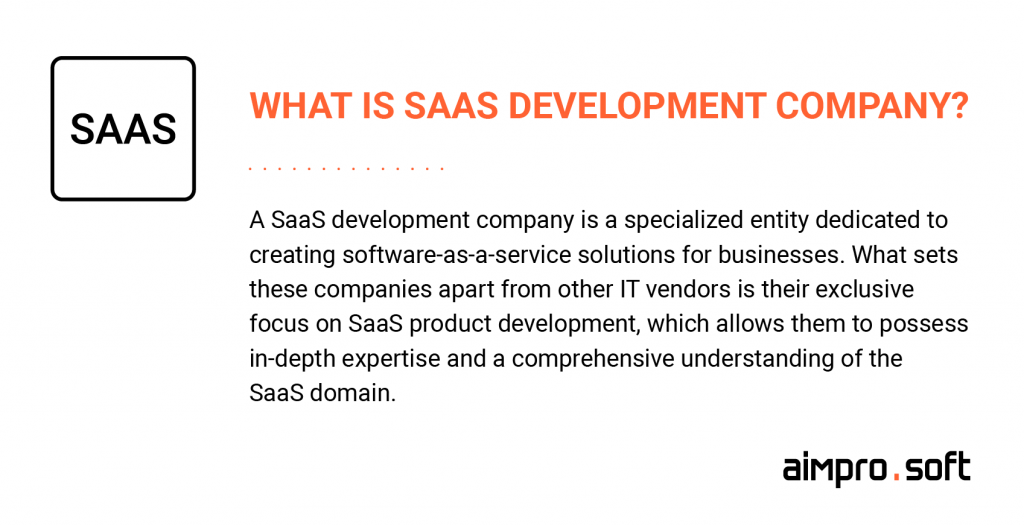
Source: https://www.aimprosoft.com/
In practice, an AI SaaS development firm ensures that AI capabilities remain accurate, secure, and scalable after launch, supporting continuous improvement while maintaining platform stability, compliance, cost, and operational efficiency.
The 10 Best SaaS Development Companies of 2026
1. Appkodes
Appkodes is an enterprise software development company founded in 2008 and based in India with a global delivery footprint. With over 15 years of experience, Appkodes has completed more than 2,000 projects and served 280+ clients worldwide, delivering scalable digital solutions across industries such as healthcare, ecommerce, live streaming, entertainment, and on‑demand services.
While originally known for enterprise mobile and web app development, Appkodes has expanded its expertise to support AI SaaS development, building intelligent, cloud‑native platforms that embed machine learning, predictive saas workflows, and real‑time automation directly into SaaS products.
AI & SaaS Capabilities: Appkodes’s AI SaaS development offerings combine traditional SaaS engineering with modular AI intelligence designed for scalability and real‑world usage:
✔ Custom AI model development: Tailored machine learning and AI engines that learn from business data and evolve over time.
✔ Multi‑tenant AI architectures: Cloud‑native SaaS systems that securely serve multiple customers while isolating data per tenant.
✔ Plug‑and‑play AI modules: Add intelligent search, recommendation engines, NLP, prediction services, and personalization features with reusable components.
✔ Continuous learning & MLOps: Built‑in feedback loops and deployment pipelines that ensure AI models improve with user interaction.
✔ Usage analytics & adaptive billing: Real‑time monitoring of AI consumption for usage‑based pricing and tiered SaaS plans.
✔ Enterprise‑grade security & compliance: Encryption, role‑based access, audit trails, and support for regulatory standards such as GDPR and HIPAA.
Appkodes’s AI SaaS development approach focuses on proactive intelligence, enabling systems that anticipate user actions, automate complex workflows, and provide technical depth on Microsoft Azure, ruby on rails, react native, data analytics services, and deliver personalized insights, transforming standard SaaS into strategic product brains rather than static tools.
Best Fit For: Startups, mid‑sized companies, and enterprises looking to embed scalable AI capabilities into SaaS platforms without building AI infrastructure from scratch. Appkodes is especially suitable for teams that require modular intelligence, continuous learning systems, and adaptive user experiences across multiple industries.
Notable Strengths:
- Longstanding industry experience with 15+ years and over 2,000 delivered projects, giving depth in both custom software and AI‑infused SaaS.
- Plug‑and‑play AI modules that accelerate time‑to‑market while enabling robust intelligence.
- Real‑time model evolution with continuous learning, making SaaS systems adaptive and future‑proof.
- Scalable MVP, secure multi‑tenant solutions that meet enterprise requirements for data isolation and compliance.
Customizable engagement models: Appkodes typically engages through a custom development and advisory model, working with clients to tailor AI SaaS roadmaps, integrate modular intelligent capabilities into software products, and deploy scalable systems.
Their process includes discovery, architecture, agile development, MLOps‑enabled deployment, and ongoing support, ensuring AI features remain performant and aligned to business growth.
2. C3.ai
C3.ai (founded in 2009 by Thomas Siebel) is a leading enterprise‑focused AI SaaS platform provider based in Redwood City, California. It delivers production‑grade AI software designed to help organizations unify data, build and operate large‑scale AI applications, and accelerate digital transformation across industries, including energy, manufacturing, financial services, government, and more.
AI & SaaS Capabilities: C3.ai offers a comprehensive suite of AI and SaaS tech stack that supports the entire enterprise AI lifecycle:
- C3 Agentic AI Platform: An integrated platform for developing, deploying, and operating enterprise‑scale AI applications with both agentic and generative AI capabilities. It enables collaboration across data science, IT, and business teams, and supports hybrid, cloud‑native, on‑premise, or edge deployments.
- C3 AI Applications: Over 130 turnkey enterprise AI applications tailored to use cases such as asset performance, supply chain optimization, CRM enhancement, sustainability, and defense & intelligence.
- Generative AI: A suite of domain‑specific generative AI solutions that provide high‑accuracy, enterprise‑ready insights with traceable sources and advanced reasoning across business data.
- Development Tools: Deep code, low code, and no code tools (including C3 AI Studio) that accelerate AI application development and deployment.
- Predictive Analytics & MLOps: Built‑in support for model training, lifecycle management, governance, and observability, enabling robust predictive capabilities.
Best Fit For: Large enterprises and government agencies with complex data environments and operational models that require scalable, secure, and production‑ready AI systems. C3.ai is particularly suited for organizations that need to operationalize AI across multiple business units and at a massive scale.
Notable Strengths:
- Proven scalability: Supports global deployments across industries, handling petabytes of data and millions of models.
- Industry‑specific saas solutions: Turnkey SaaS applications built for manufacturing, energy, finance, public sector, and more.
- Unified platform architecture: Reduces complexity and accelerates AI development with integrated data, model, and application layers.
- Strategic ecosystem integration: Works across major cloud providers (AWS, Azure, Google Cloud) and partners for broad enterprise adoption.
Engagement Model: C3.ai primarily delivers through a hybrid enterprise platform model combining:
- Platform licensing — Access to the core AI platform and ecosystem
- Turnkey enterprise applications — Prebuilt SaaS solutions for common use cases
- Custom implementations & extensions — Tailored AI solutions built on the C3 Agentic AI Platform to meet unique business requirements
3. DataRobot
DataRobot, founded in 2012 and headquartered in Boston, Massachusetts, is an industry‑leading enterprise AI SaaS platform provider that helps organizations automate the full AI lifecycle from model development to deployment and governance. Its mission is to make advanced AI capable of delivering business impact quickly and reliably.
AI & SaaS Capabilities: DataRobot provides a unified AI platform designed to support building, delivering, and governing AI solutions across departments and use cases. It includes:
- Automated machine learning (AutoML) capabilities for rapid model creation and deployment.
- Agentic and generative AI development tools that enable purpose‑built intelligent assistants and predictive models.
- Comprehensive AI governance and observability tools to ensure models are transparent, controlled, and compliant.
- Support for production‑scale deployments across cloud, hybrid, or on‑premise environments.
Best Fit For: Large and mid‑sized enterprises that require enterprise‑grade AI development, deployment, and lifecycle management across finance, supply chain, healthcare, manufacturing, and government sectors.
Notable Strengths:
- Pioneered key capabilities in AI automation and ML operations that simplify complex analytics workflows.
- Strong integration with enterprise systems and partner ecosystems (cloud, analytics, and compliance tools).
- Designed to support enterprise‑wide AI governance, reducing risk and accelerating adoption.
Engagement Model: Delivered primarily via an enterprise AI SaaS platform under subscription, with professional services for customization, integration, and governance support.
4. SoluLab Inc.
SoluLab is a custom AI software development company with more than 10 years of experience, 250+ developers, and 500+ global clients. They specialize in building bespoke AI systems, integrating advanced machine learning, natural language processing (NLP), computer vision, and predictive analytics into custom software and SaaS platforms.
AI & SaaS Capabilities: SoluLab’s AI platform development services include:
- Custom AI software development, tailored to unique business challenges.
- Machine learning and predictive analytics models that forecast outcomes and trends.
- NLP and computer vision systems to automate language and image/video‑based tasks.
- AI integration services to embed intelligence into existing applications.
- AI consultation, training, and strategy for adoption and scaling.
Best Fit For: Startups and mid‑sized businesses looking to incorporate AI deeply into SaaS products or custom applications with domain‑specific intelligence.
Notable Strengths:
- More than 40 AI projects delivered across varied industries.
- Expertise across AI domains such as generative AI, AI agents, and predictive systems.
- AI as a Service (AIaaS) support model to rapidly experiment and launch intelligent features.
Engagement Model: Project‑based and custom development engagements, from strategy and model building to deployment and maintenance.
5. Scalevista
Scalevista is a US‑facing bespoke software and digital engineering partner specializing in custom SaaS products, including AI‑enabled applications and generative AI solutions to help businesses modernize and scale. Their services range from MVP builds to full SaaS deployments supported by cloud and AI capabilities.
AI & SaaS Capabilities:
- SaaS application development with multi‑tenant architecture and scalable backend engineering.
- Custom software and cloud solutions tailored to business needs.
- Generative AI and machine learning product integration drive innovation.
- AI consulting and strategy to align technology with business goals.
Best Fit For: Businesses seeking flexible AI integration into custom SaaS platforms, with staff augmentation and full product engineering support.
Notable Strengths:
- ISO‑certified engineering focus and customer‑centric delivery approach.
- Ability to deliver both MVPs and full SaaS products with AI/ML components.
Engagement Model: Hybrid delivery project engagements, staff augmentation, and long‑term development partnerships.
6. Biz4Group LLC
Biz4Group LLC is a US‑based software and AI development company founded in 2003 in Orlando, Florida. With 20+ years in the industry and a team of 200+ experts, they help businesses design and build custom AI applications, intelligent automation, and integrated solutions across sectors such as healthcare, insurance, real estate, and more.
AI & SaaS Capabilities: Biz4Group offers a broad portfolio of AI services:
- Custom AI and machine learning development for enterprise apps.
- Generative AI and agentic AI solutions for text, visuals, and autonomous saas workflows.
- AI integration & automation services, embedding intelligence into business processes.
- AI app development and chatbot systems for customer engagement.
- AI consultation and MVP development to validate ideas rapidly.
Best Fit For: Startups to enterprises that need a full‑cycle partner for AI system engineering, from ideation and design to deployment and optimization.
Notable Strengths:
- Two decades of industry experience and hundreds of successful projects.
- Strong capabilities in AI automation, integration, and UI/UX design layered into smart applications.
Engagement Model: End‑to‑end product development, from strategy and design through enterprise solution rollout.
7. H2O.ai
H2O.ai is the company behind the open‑source H2O machine‑learning platform and commercial solutions like H2O AI Cloud that combine automated machine learning with enterprise‑grade capabilities. Founded in 2011, H2O.ai enables data science teams to build, deploy, and scale sophisticated machine learning and AI models.
AI & SaaS Capabilities:
- Automated machine learning (AutoML) to speed model creation and tuning.
- Distributed, scalable ML and analytics engines suited for large datasets.
- Open‑source foundations with enterprise layers for governance and deployment.
Best Fit For: Data‑intensive organizations seeking flexible, high‑performance AI and saas solutions with strong integration into analytics workflows.
Notable Strengths:
- Solid performance for complex predictive modeling.
- Strong open‑source community and adaptability.
Engagement Model: Platform subscriptions with enterprise support, consulting, and integration services.
8. ELEKS
ELEKS is a global software engineering company founded in 1991, with over 2,100 professionals and offices across Europe, North America, and Asia. Though headquartered in Estonia, it serves US clients with custom software, including AI and data engineering services.
AI & SaaS Capabilities: ELEKS provides
- AI & machine learning development (models, ML Ops).
- Generative AI and intelligent automation capabilities.
- Data engineering and analytics to support SaaS platforms.
Best Fit For: Enterprises and mid‑market firms looking for software engineering plus AI integration within complex systems.
Notable Strengths:
- Deep software engineering pedigree and global delivery reach.
- Broad industry coverage, including finance, energy, healthcare, and logistics.
Engagement Model: Project‑based development with long‑term support contracts.
9. Master of Code Global
Master of Code Global is a software engineering company known for conversational AI, chatbot systems, and intelligent experience platforms that enhance SaaS products with natural language and user‑centric AI features. Industry listings identify them for these capabilities.
AI & SaaS Capabilities:
- Conversational AI frameworks for SaaS interfaces.
- Chatbots and virtual assistants tailored to business workflows.
- Integration with enterprise systems to extend SaaS UX.
Best Fit For: Companies focused on customer engagement, support automation, and conversational UX enhancements.
Notable Strengths: Niche expertise in building AI‑driven interaction systems that deepen user adoption within SaaS platforms.
Engagement Model: Managed services and custom project delivery.
10. Simform
Simform is a US-based digital engineering company that specializes in building cloud-native, scalable SaaS applications designed for AI and data readiness. With extensive experience in software engineering, they integrate machine learning, analytics, and automation into custom SaaS products, helping businesses build intelligent and high-performance platforms.
AI & SaaS Capabilities:
- Cloud-native SaaS product development
- Data platform engineering with ML integration
- Predictive analytics system
- Full-stack product engineering and optimization
- UX and performance scaling
Best Fit For: Companies that need complex, scalable SaaS platforms with AI readiness, from early-stage development to full-scale deployment.
Notable Strengths:
- Deep technical engineering expertise with practical product experience
- Strong capabilities in AI integration, data engineering, and platform optimization
- Focus on building scalable, maintainable SaaS systems
Engagement Model: Flexible collaboration through dedicated teams, project-based work, or long-term engineering partnerships, covering strategy, development, and optimization.
How We Evaluated These Enterprise SaaS Development Companies
To ensure this guide remains objective, practical, and useful for decision-makers, we evaluated the 10 best SaaS development companies of 2026 using a consistent, non-promotional framework. The goal was not to rank vendors based on popularity or marketing visibility, but to identify teams with proven technical proficiency, real SaaS delivery experience, and long-term execution capability.
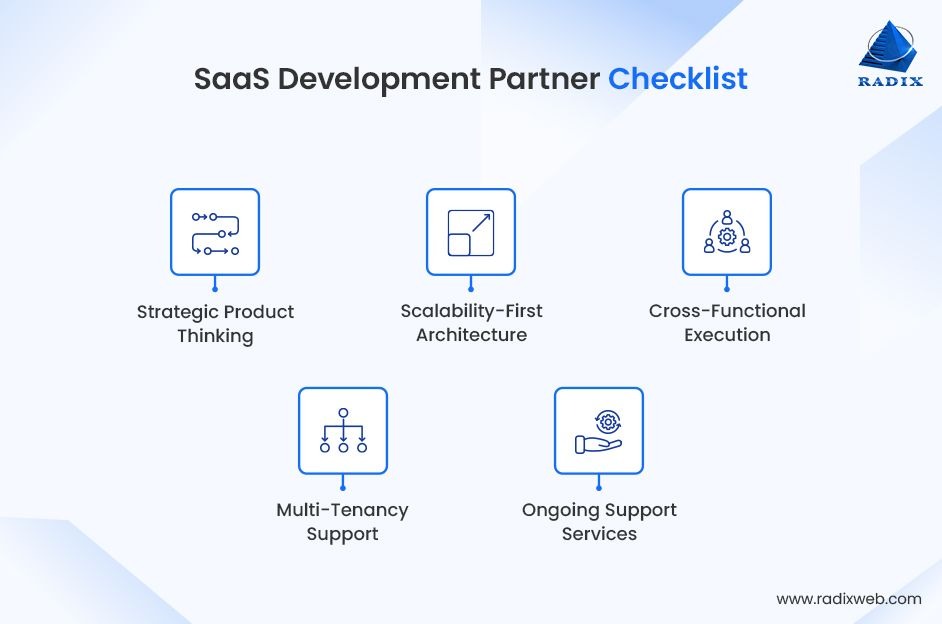
Source: https://radixweb.com/
Below are the key criteria used to assess and shortlist the saas companies featured in this list.
1. Depth of AI Expertise
We assessed each company’s hands-on experience across core AI disciplines, including:
- Machine learning and predictive modeling
- Generative AI and large language model (LLM) integration
- AI agents, automation, and decision intelligence
- MLOps practices for model deployment, monitoring, and retraining
Preference was given to companies that demonstrate production-level AI implementation, not just experimentation or API-level integrations.
2. Proven SaaS Platform Engineering Experience
AI capabilities alone are not sufficient without strong SaaS fundamentals. We evaluated whether companies have demonstrable experience in:
- Designing multi-tenant SaaS architectures
- Building scalable, cloud-native platforms
- Managing user access, subscriptions, and usage-based billing
- Supporting performance optimization and platform scalability over time
Only companies with real SaaS delivery track records, not generic software development claims, were considered.
3. Security, Compliance, and Data Governance
Given the data-intensive nature of AI SaaS products, we reviewed each company’s approach to:
- Data privacy and data protection
- Secure model deployment and access control
- Compliance readiness (such as GDPR, HIPAA, SOC 2, or enterprise governance standards)
- Model transparency, traceability, and auditability
Companies that embed security measures and governance into their development lifecycle, rather than treating them as add-ons, were prioritized.
4. Deployment, Monitoring, and Post-Launch Support
A key differentiator among premier SaaS development companies is their ability to support products after launch. We evaluated:
- CI/CD and deployment pipelines
- Model performance monitoring and drift detection
- Ongoing optimization and maintenance capabilities
- Long-term product evolution and feature scaling
The selected companies demonstrate the ability to operate and evolve AI SaaS platforms in production, not just deliver initial builds.
5. Breadth of Industry and Use-Case Experience
Rather than focusing on a single vertical, we assessed whether companies have experience delivering AI-powered SaaS solutions across:
- Multiple industries
- Different ai-driven SaaS business models
- Varying data complexity levels and operational environments
This ensures the companies listed can adapt AI and SaaS architectures to diverse business contexts, not just narrow use cases.
Why These Companies Were Selected
Among the many AI and software vendors in the market, the 10 best SaaS development companies of 2026 featured in this guide were selected because they consistently demonstrate a strong balance between advanced AI expertise and mature SaaS engineering practices.
Each shows clear evidence of real-world, production-grade AI SaaS deployments, differentiated approaches to designing and operating scalable platforms, and the ability to support products well beyond initial launch.
Collectively, these qualities set them apart from vendors focused primarily on AI tools, generic saas software development, or short-term implementation work, positioning them as capable long-term partners for building and evolving AI-driven SaaS platforms.
How to Choose the Right AI SaaS Development Company
Choosing an Advanced SaaS development company is not just a technical decision, it directly impacts product scalability, cost efficiency, and long-term viability. The right partner should align with your product’s current needs while supporting future growth. The following factors help guide that decision.
Product Complexity
Start by assessing how complex your SaaS product is today and where it’s heading. If your platform requires multi-tenant architecture, real-time processing, or deep system integrations, you’ll need a development company with proven experience building and maintaining complex SaaS platforms. Simpler products may not require the same level of architectural depth, but scalability should still be considered from the start.
AI Maturity
Not all products need advanced AI from day one. Some require basic automation or predictive features, while others depend on generative AI, intelligent agents, or continuous learning systems. Choose a company whose AI expertise matches your current maturity level and can evolve with your roadmap, rather than overengineering early or limiting future capabilities.
Data Readiness
AI performance depends heavily on data quality and availability. A strong AI SaaS development firm will assess your data sources, structure, and governance before implementation. If your data is fragmented or unstructured, the right partner should help design pipelines, storage, and validation processes before building AI models.
Budget vs. Scale
Early-stage products often need to balance cost with growth potential. The right development partner will help you build lean systems that scale efficiently, avoiding unnecessary infrastructure or AI complexity. For larger products, the focus should shift toward performance optimization, reliability, and long-term operational cost control.
Source: https://www.contus.com/
Long-Term Support
AI SaaS products don’t stop evolving after launch. Models require monitoring, retraining, and performance tuning, while platforms need updates, security patches, and feature expansion. Choose a company that offers post-launch support and demonstrates the ability to maintain and improve AI systems over time, not just deliver an initial build.
Cost of AI SaaS Development
| Stage | Cost Range | Focus / Goal | Key Components | Notes |
| MVP AI SaaS | $30,000 – $120,000 | Proof of concept; validate demand | Basic SaaS foundation (user access, core workflows, clean interface), 1 AI feature (automation/predictive model), lightweight infrastructure | Focus on minimal viable functionality; cost-controlled; early validation of user interest |
| Mid-Scale AI SaaS | $120,000 – $450,000 | Scale for real users and more data | Multi-tenant architecture, multiple AI features, structured data pipelines, automated deployments | Investment in stability, performance, and scalability |
| Enterprise AI SaaS | $450,000 – $2M+ | Full-scale, reliable, and compliant platform | Advanced AI systems, resilient infrastructure, strict security protocols & governance, continuous monitoring | Focus on long-term business operations, compliance, and reliable daily performance |
Common Mistakes to Avoid When Building an AI SaaS Product
Many AI SaaS projects struggle not because of bad ideas, but because of avoidable early decisions. Based on real-world product outcomes, the following mistakes appear repeatedly and often become expensive to fix later.
#1 Choosing AI Vendors Without SaaS Experience
One of the most common mistakes is working with AI vendors who understand models but not SaaS platforms. AI that performs well in isolation can fail once it’s placed inside a multi-tenant, user-facing product. Without SaaS experience, issues around scalability, tenant isolation, billing, and user access often surface too late. Successful AI SaaS products require teams that understand both AI systems and SaaS architecture from the start.
#2 Ignoring MLOps Until After Launch
Many teams focus on training models and assume deployment is a one-time step. In reality, AI models degrade over time as data changes. Without proper MLOps monitoring, retraining, versioning, and rollback, performance issues go unnoticed until users complain. Treating MLOps as an afterthought often leads to unstable products and growing maintenance costs.
#3 Underestimating Data Preparation Effort
AI does not fail because of algorithms it fails because of data. Teams frequently underestimate how long it takes to clean, structure, validate, and maintain data pipelines. Poor data quality leads to unreliable AI outputs, regardless of model sophistication. Investing early in data readiness saves time, cost, and credibility later.
#4 Overengineering AI Too Early
Another common pitfall is adding advanced AI before the product truly needs it. Generative AI, complex models, or agent-based systems can add cost and risk without clear user value. Strong AI SaaS products usually start with focused intelligence and evolve as usage patterns become clear.
#5 Treating Launch as the Finish Line
Effective AI SaaS products are never “done” at launch. Models need monitoring, platforms need optimization, and user behavior changes over time. Teams that don’t plan for post-launch support often face rising costs, declining performance, and frustrated users.
#6 Skipping Scalability Planning
Building for a handful of users is very different from supporting thousands. Ignoring scalability early can result in systems that work in testing but break under real-world usage. Designing for business growth from day one is far less expensive than rebuilding later.
The most successful teams treat AI SaaS development as a phased journey, not a one-time expense. Building with growth in mind from the start almost always costs less in the long run than fixing foundational issues later.
Conclusion
The future of SaaS is being rewritten, where AI, automation, and cloud-native intelligence define what’s possible. Businesses that embrace these changes and partner with the right teams will not just survive, they will shape entire industries and set new standards for innovation.
The 10 best SaaS development companies of 2026 are the pioneers of this future. These teams are building platforms designed to evolve with technology, scale effortlessly, and turn today’s bold ideas into tomorrow’s industry-defining solutions.
As the market grows more competitive, the real advantage will go to companies that can anticipate change, adapt quickly, and leverage technology strategically. By aligning with the right development partner, businesses can not only keep pace but lead, creating SaaS products that remain relevant, resilient, and ready for whatever the next wave of innovation brings.
FAQs
1. What is an AI SaaS development company?
A company that builds cloud-based software with AI integrated into core features, handling data pipelines, AI models, SaaS architecture, deployment, and ongoing optimization.
2. How long does AI SaaS development take?
- MVP: 3–6 months
- Mid-scale platform: 6–12 months
- Enterprise-grade: 12+ months
Time depends on saas projects’ complexity, AI features, and scalability requirements.
3. Is AI SaaS suitable for startups?
Yes. Startups can start small with lean AI features, validate the product quickly, and scale intelligence as the platform grows.
4. What’s the difference between SaaS and AI SaaS?
SaaS provides cloud software access. AI SaaS experience adds intelligence, enabling automation, predictions, personalization, or decision-making based on real data.
5. How do I evaluate AI expertise in SaaS vendor?
Check for production AI and cloud deployment, knowledge of ML, generative AI, and MLOps, strong data practices, and a track record of SaaS platform delivery.
6. Do I need to prepare my data before AI SaaS development?
Yes. Clean, structured data ensures AI models perform reliably. Fragmented or unprepared data increases cost and slows development.
7. Can AI SaaS products scale over time?
Absolutely. Well-designed AI SaaS platforms use scalable cloud infrastructure and multi-tenant architectures to grow with users, data, and features.

Arun Andiselvam
Founder of AppKodes. As a serial entrepreneur, I have successfully established five brands over the past 12 years. After creating a successful rank tracker for SEO agencies, I am currently dedicated to developing the world's first SEO Project Management software.