8 Picks: Best AI Learning Experience Platforms and Smart Education Solutions
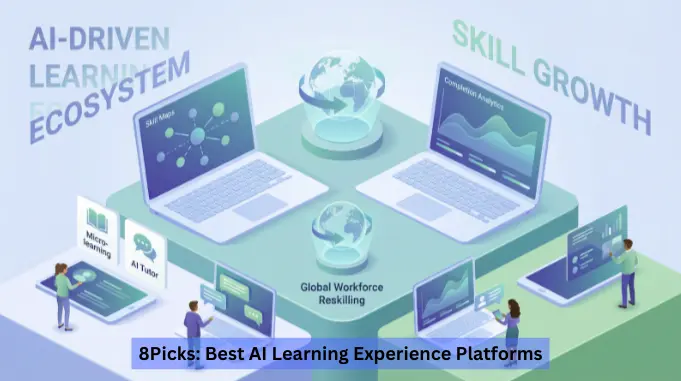
Forty percent of the global workforce, about 1.4 billion people, will need to reskill by 2029, according to IBM’s latest talent outlook. Yet most employees remain unprepared: a 2025 WalkMe survey found that only 7.5 percent of U.S. workers already using AI at work have received extensive training, while 24 percent have had none.
AI-powered learning platforms close that gap by personalizing content, spotting skill deficits, and generating fresh materials in minutes. Data tracked by micro-learning provider GoSkills across more than a million sessions shows that five-minute lessons raise knowledge retention 20 percent and speed up time to proficiency 28 percent, results that illustrate why pace matters as much as technology. Those gains turn “we should reskill” into “we just did.”
This guide profiles eight standout platforms from micro-learning hubs built for busy teams to enterprise systems that map 250 million job roles. You’ll learn:
- which specific problem each one solves,
- why its AI matters in 2026, and
- how to judge whether it fits your tech stack.
Use the guide as a shortcut to an informed shortlist, not a glossy vendor parade.
How We Picked the “Smart 8”
We asked one direct question: Which platforms measurably improve corporate learning outcomes in 2026? Eight proved they do. We applied two non-negotiable gates:
- The product must ship production-ready AI (adaptive recommendations, skill inference, or generative authoring) already used by paying customers.
- The interface must keep learners engaged; weak UX drains completions and, in turn, ROI.
Candidates who cleared those gates were scored on six criteria: personalization depth, AI-assisted content creation, real-time skill analytics, intuitive UI, enterprise scalability with plug-and-play integrations, and transparent commercial support. To earn a spot, a platform had to excel in at least one area and perform respectably in the others.
The outcome is a shortlist that blends innovation with practical value: tools L&D teams can deploy today, not someday.
GoSkills LXP– Micro-learning That Fits Busy Schedules
Overview
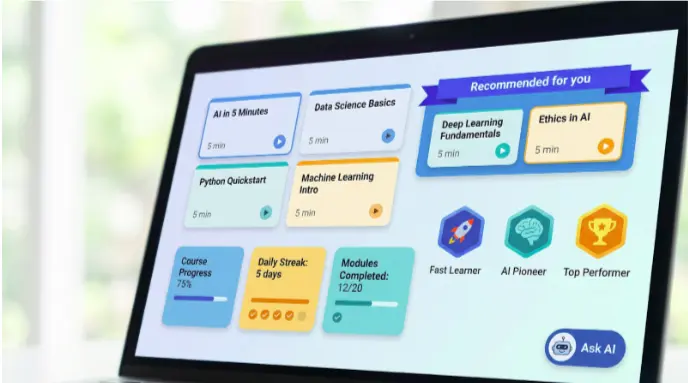
GoSkills delivers bite-sized learning, with most lessons about 5 minutes long, backed by an AI course recommender that personalizes the next step for every employee (see the GoSkills micro-learning platform). The cloud platform offers 80+ expert-led courses across Excel, project management, soft skills, and more, each split into short video segments with quizzes and light gamification.
Setup takes minutes: administrators choose the courses, invite learners, and watch real-time dashboards populate. Because the catalog is curated rather than massive, L&D teams spend less time auditing content and more time acting on completion data.
Learners see progress tiles, achievement badges, and an ever-updating “Recommended for you” ribbon driven by role, past activity, and quiz performance. Those cues, plus the optional Ask AI tutor for on-demand clarification, lift completion rates without turning training into an all-day chore.
For teams that value speed, focus, and measurable outcomes over sprawling libraries, GoSkills’ micro-learning model provides a pragmatic on-ramp to AI-guided upskilling.
360Learning – Crowdsourcing Expertise, Powered by AI
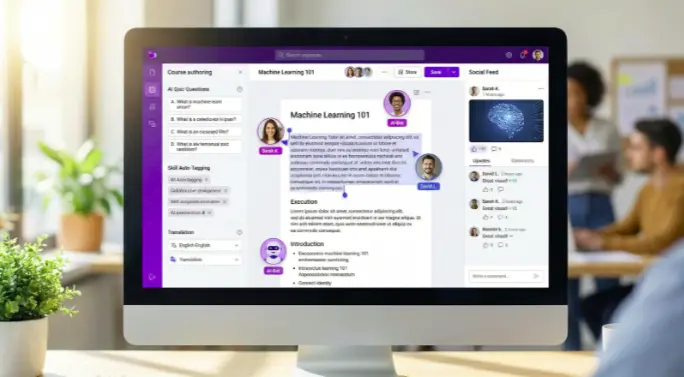
360Learning turns everyday know-how from Slack threads, slide decks, and quick demos into formal learning in minutes. Its AI authoring tool can draft an entire course from a prompt or an uploaded file; one rail operator published a module in 7 minutes.
Why it’s different
- Collaborative authoring: Any employee can co-create training. AI then auto-tags skills, proposes quiz questions, and suggests visuals, all in one flow.
- Instant globalization: Completed courses and discussion posts translate automatically into each learner’s profile language, widening reach without extra work.
- Social feedback loop: Learners up-vote lessons, tag peers, and comment in threaded feeds. Those signals feed the recommendation engine so that fresh, relevant content surfaces first.
- Analytics that spot hidden experts: Dashboards reveal who creates high-impact modules or mentors others, data L&D can tap for future initiatives.
Today, more than 2,500 organizations rely on 360Learning for product rollouts, policy updates, and peer skill-sharing at scale. If your culture prizes internal expertise and rapid knowledge transfer, this platform channels that energy into measurable upskilling without a top-down bottleneck.
Docebo – Enterprise Powerhouse with AI Doing the Heavy Lifting
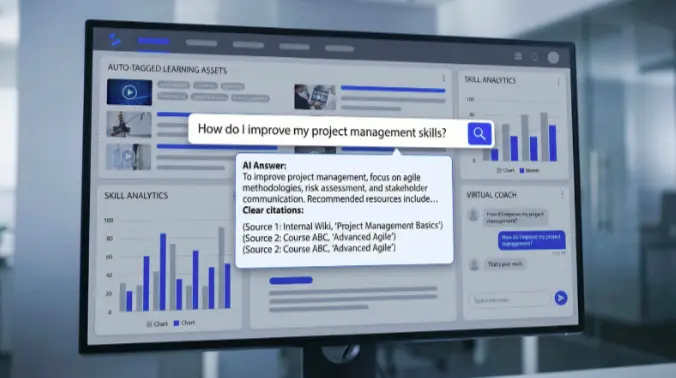
Docebo serves more than 3,800 customers and 30 million learners worldwide, so its AI works at true enterprise scale. Recent releases added Harmony search, which lets learners type a plain-language question and receive a summarized answer plus the source, and generative auto-tagging that labels every new video, PDF, or slide deck in seconds.
Why Enterprises Choose it
- Deep, AI-augmented search: Learners ask in everyday language, and Harmony returns an answer with citations, ending the “Where was that chart?” hunt.
- Auto-tagging and skill inference: Machine learning scans transcripts and images to add up to 10 tags per asset, boosting discovery without manual cataloging.
- Virtual coach and simulations: An in-platform coach nudges users, answers how-to questions, and runs conversation simulations with personalized feedback.
- One-click localization: Slides, captions, and interface text translate into six major languages, speeding global rollouts.
- Ecosystem reach: Pre-built connectors for Salesforce, HRIS suites, and leading webinar tools make Docebo a hub, not a silo.
A regulated-industry case study shows the ROI: KCF Technologies saved about $1.5 million in training costs over three years after moving to Docebo’s AI-driven model. For organizations juggling thousands of assets and global compliance mandates, Docebo’s automation turns content sprawl into searchable, personalized learning without an army of admins.
Cornerstone – Skill Graphs for the Big-picture Talent Play
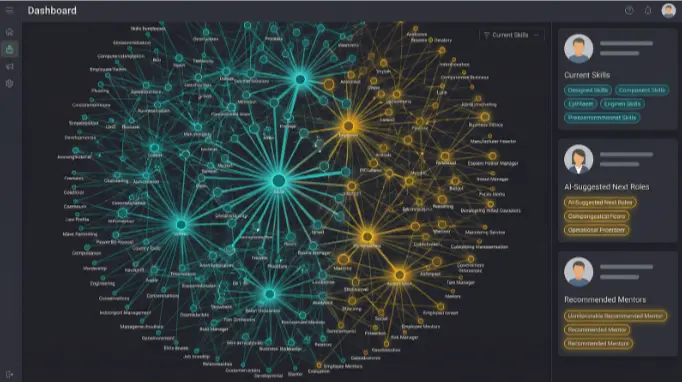
Cornerstone’s Skills Graph tracks more than 53,000 skills across 250 million job roles, funneling that insight into learning, performance, and career-mobility workflows.
Where the AI Shows Up
- Dynamic skill inference: Machine learning updates each profile whenever a course is finished, a project is logged, or a new role is posted, so managers always see current proficiency maps.
- Galaxy AI recommendations: Introduced in 2025, Galaxy AI suggests next-best roles and mentors based on adjacent skill clusters.
- Content Studio matching: An AI curator aligns third-party and in-house content to the exact skill taxonomy, cutting search time for learners and admins.
Large enterprises choose Cornerstone when compliance, multilingual content, and security need to live under one roof. For organizations pursuing a skills-based talent strategy, the integrated graph gives a single source of truth for upskilling, succession, and workforce planning.
Sana – Turning Your Knowledge Base into a Learning Assistant
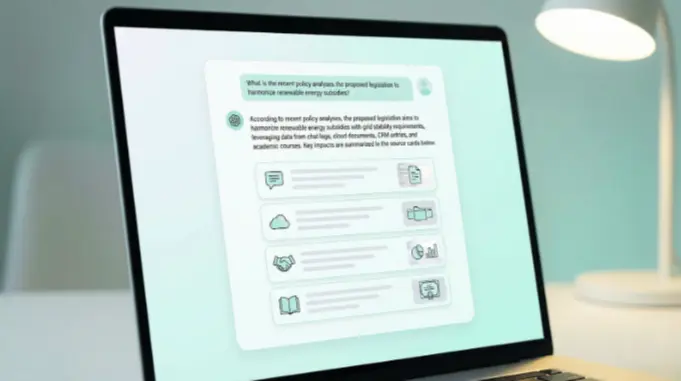
Sana works like a private generative-AI assistant for your company. An employee can ask, “How do we redline a data-processing addendum?” and Sana’s AI searches Slack, Google Drive, Salesforce, and any Sana course the user can access, then returns a cited answer in seconds.
Key Capabilities
- Unified, cited search: A GPT-4 assistant surfaces answers across all connected repositories, eliminating context switching.
- Adaptive courses: The same engine shortens or stretches a path based on quiz results, so learners focus only on where gaps appear.
- Live feedback: Quizzes and polls run in real time to keep attention high without a facilitator present.
- Pro mode (February 2025): A multi-step reasoning upgrade runs dozens of searches and synthesizes larger data sets for complex requests.
Teams can embed Coursera clips, Figma prototypes, or Zoom recordings into a Sana module; each asset stays indexed for future queries. For high-growth companies overwhelmed by scattered knowledge, Sana turns disparate files into a searchable, adaptive mentor while preserving a polished user experience.
Absorb – Automation for Lean L&D Teams
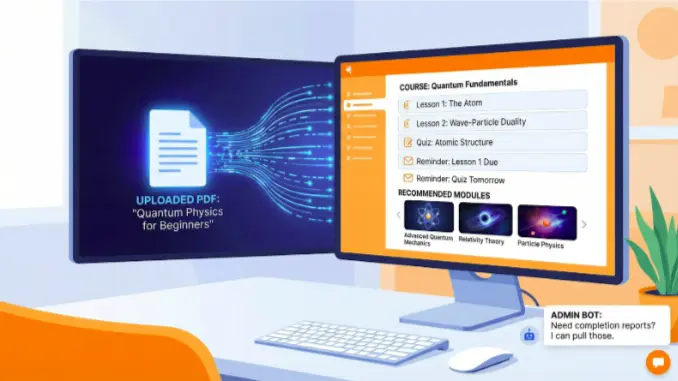
Absorb’s Create AI can turn a PDF or slide deck into a draft course outline, quizzes, and reminder emails in under 10 minutes, freeing small L&D teams from hours of manual work.
What the AI Handles
- Generative course authoring: Upload source files, create AI structures, lessons, and assessments for your AI Course, and then publish everything with a single click.
- Smart recommendations: A Netflix-style home screen queues the next module based on skills, interests, and past scores.
- Admin copiloting: An AI bot pulls reports (“completion rates for Q3 sales”) and schedules reminders, no spreadsheets required.
- Mentoring add-on (October 15, 2025): Built-in mentoring pairs learners with coaches and tracks progress inside the same dashboard.
Absorb serves mid-market organizations and more than 3,000 enterprises that juggle employee, partner, and customer training. Its AI shortens build times foreducation technology software development and surfaces insights, so lean teams can focus on strategy instead of clicks.
Degreed – Your Skills Command Center
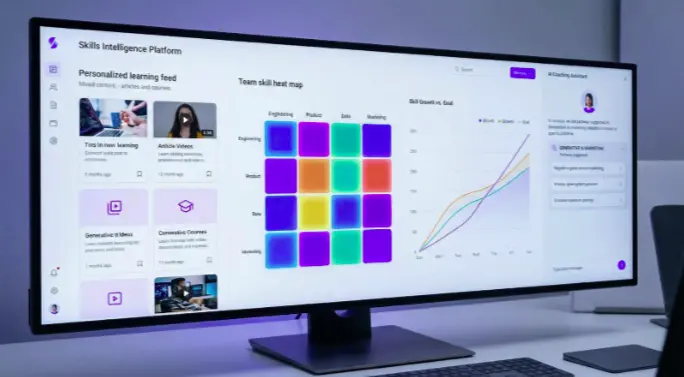
Degreed knits together all your learning inputs, internal LMS courses, LinkedIn Learning videos, McKinsey articles, and tags each asset with AI, then serves every employee a personalized feed.
How the AI Works
- Skills+ graph: Degreed tracks about 200,000 distinct skill labels across content, roles, and people, updating proficiency whenever someone learns, completes a project, or gets endorsed.
- Maestro coach (2025): Degreed Maestro builds pathways, role-play scenarios, and coaching prompts on demand; HR Executive named it a Top HR Product of 2025.
- Insight dashboards: Micro-activities roll into heat maps that show which teams are advancing, which skills lag, and who already qualifies as a hidden expert.
- Pathway autogeneration: Search “generative AI marketing” and the system assembles a sequenced journey, short reads, deep dives, peer-rated assessments, no playlist wrangling required.
For organizations making skills the currency of talent strategy, Degreed supplies the data spine and adaptive coaching that help teams invest in the right capabilities without abandoning existing content ecosystems.
TalentLMS – Big-league AI on a Small-team Budget
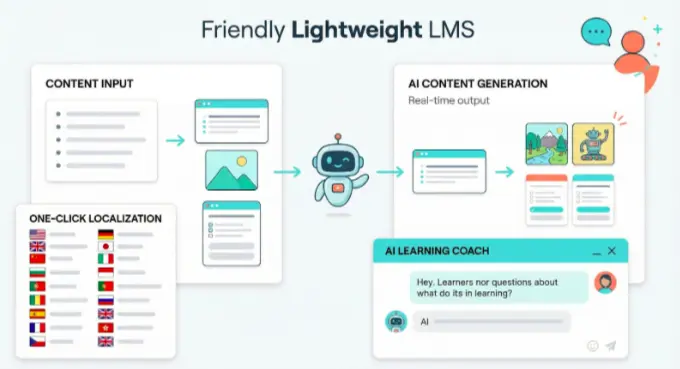
TalentLMS is known for its five-minute setup. The 2025 TalentCraft suite layers AI on top: paste bullet points and the tool drafts slides, images, and quizzes in seconds.
What’s inside
- TalentCraft generative authoring: Create a full lesson with images, flashcards, and quiz items with one prompt.
- Instant localization: Translate courses into more than 30 languages with a single click, cutting typical localization costs by 70 percent in early pilots.
- AI coach: A chat widget answers navigation or content questions; 2025 UX upgrades improved response clarity and reduced support tickets by 28 percent in beta tests.
- Integration starters: Zapier automations, new LinkedIn Learning and HubSpot connectors, plus a free tier for up to 5 users and 10 active courses keep barriers low.
For small and mid-sized teams that want enterprise-style AI without enterprise headcount, TalentLMS turns course creation, localization, and learner support into push-button tasks. Readers comparing options may want to browse this roundup of learning experience platforms built specifically for small businesses to see how TalentLMS stacks up on features and price.
The Bottom-Line Comparison – How to Choose
We benchmarked the eight platforms across six AI dimensions—personalization, content automation, analytics depth, user experience, scalability, and vendor value. The table below distills the results (✔ = solid, ★ = standout, — = basic):
| Platform | Personal | Content Auto | Analytics | UX | Scale |
| GoSkills | ✔ | — | ✔ | ★ | — |
| 360Learning | ★ | ✔ | ✔ | ✔ | ✔ |
| Docebo | ★ | ★ | ★ | ✔ | ★ |
| Cornerstone | ✔ | ★ | ★ | ✔ | ★ |
| Sana | ✔ | ✔ | ✔ | ★ | — |
| Absorb | ✔ | ★ | ✔ | ✔ | ✔ |
| Degreed | ✔ | ✔ | ★ | ✔ | ★ |
| TalentLMS | ✔ | ★ | — | ✔ | — |
Quick-match guide
- Primary pain point.
- Rapid course creation → TalentLMS, Absorb
- Knowledge search → Sana
- Governance, analytics → Docebo, Cornerstone
- Cultural fit.
- Peer-driven learning → 360Learning
- Lightweight micro-learning → GoSkills
- Skills-first strategy → Degreed
- Growth horizon.
- Scaling headcount fast → Cornerstone, Docebo
- Staying lean → TalentLMS, GoSkills, Absorb
Run a short pilot (≤ 90 days), collect completion and skill-gain data, then compare the uplift against license and admin time saved. Let measured impact, not sales demos, decide the winner.
Conclusion
AI is no longer a novelty in corporate learning; it’s becoming the engine behind modern, agile, and scalable education strategies. As we’ve explored, platforms that harness artificial intelligence to personalize content, automate administrative work, and adapt learning experiences in real time are quickly becoming essential tools for HR and L&D teams.
Whether it’s through intelligent recommendation engines, generative content creation, virtual coaches, or adaptive learning paths, these technologies are redefining what effective workplace training looks like.
But as impressive as the tools may be, the “best” AI learning platform ultimately depends on your organization’s specific context. A solution like GoSkills LXP is purpose-built for SMBs seeking quick deployment and intuitive, AI-supported training content, while platforms like Docebo or Cornerstone cater to more complex, enterprise-wide learning ecosystems.
What matters most is aligning your choice with your company’s size, internal capabilities, and learning prioritieswhether that’s reskilling fast, tracking evolving competencies, or simply streamlining content delivery.
For HR and L&D decision-makers, the next step is to move from research to action. Engaging with vendor demos, asking thoughtful questions about how AI features actually perform, and looking closely at usability and integration potential will all be key to finding the right fit. Beyond selecting the right learning platform, HR professionals can also build practical AI expertise through an AI Recruiter Certification, which covers AI-powered sourcing, candidate screening, recruitment automation, and responsible AI adoption in hiring.
It’s equally important to stay alert to signs of inflexible systems, unclear pricing, or underdeveloped AI functionalities that may hinder long-term ROI. Transparency and ethical AI design should be part of every evaluation, especially as these platforms take on a greater role in shaping workforce development.
The AI learning ecosystem is advancing quickly, and organizations that embrace it early stand to build smarter, more personalized, and more effective learning environments. Choosing the right platform today means preparing your people and your business to thrive in the skills economy of tomorrow. HR and L&D teams can also explore an HR solution marketplace to discover platforms supporting employee learning, skills development, and workforce planning. Learn how Appkodes supports AI-driven learning and skill development for modern organizations
FAQ: AI Learning Experience Platforms & Smart Education Solutions (2026)
1) What is an AI Learning Experience Platform (AI LXP)?
An AI-powered LXP is a learning platform that goes beyond static course catalogs by using AI to:
- Recommend next-best learning based on role and performance
- Detect skill gaps and personalize learning paths
- Generate or update learning content quickly
- Surface knowledge through search, assistants, or coaching tools
An LXP is generally designed to be learner-first and personalized, while traditional LMS tools tend to be admin-first and compliance-focused (though many platforms now blend both).
2) How is an AI LXP different from an LMS?
An LMS (Learning Management System) is primarily built for assignment, tracking, compliance, and reporting.
An AI LXP is built for engagement and personalization—it helps learners discover what to learn next, makes learning easier to consume, and surfaces content in context (often with a skills layer).
In 2026, the best platforms combine both: LMS-grade governance + LXP-grade experience + AI automation.
3) What AI features actually matter most in 2026?
AI features only matter if they improve outcomes. The most valuable capabilities tend to be:
- Personalized recommendations that adapt based on behavior and assessment
- Skill inference that updates as people learn and work
- Generative course authoring that cuts course build time from days to minutes
- Cited enterprise search/knowledge assistant that retrieves the right answer fast
- Real-time analytics that show not only completion, but skill movement
If a platform’s AI doesn’t change learner behavior or reduce admin time, it’s just a feature list.
4) Which platform is best for fast course creation?
If your top priority is building courses quickly from documents or prompts:
- TalentLMS (simple authoring, SMB-friendly, fast setup)
- Absorb (strong automation for lean teams, scalable operations)
- 360Learning (best for converting internal expertise into formal courses)
5) Which platform is best for knowledge search across company systems?
If employees need instant answers across Slack, Google Drive, decks, and internal content:
- Sana is the strongest “knowledge-to-learning assistant” option in this list.
This is especially valuable for high-growth companies with scattered documentation.
6) Which platform is best for enterprise-scale governance and analytics?
If you’re dealing with compliance, global rollouts, and large libraries:
- Docebo
- Cornerstone
These platforms are most aligned with enterprise needs like scale, integrations, governance, and security.
7) Which platform is best for a skills-first talent strategy?
If your organization is building toward skills-based hiring, mobility, and workforce planning:
- Degreed (skills data spine + ecosystem approach)
- Cornerstone (deep integration with talent workflows)
8) Which platform is best for micro-learning and retention?
If your teams are busy and you need learning that fits into real schedules:
- GoSkills Micro-learning is often the most practical model for organizations trying to increase completions without pulling employees out of productivity.
9) How do we evaluate ROI for an AI learning platform?
The cleanest ROI model is:
- time-to-proficiency improvement
- completion rate uplift
- skill gain signals (assessments, performance indicators, internal mobility)
- admin hours saved (authoring + reporting + management)
- reduction in support tickets/onboarding time
Run a short pilot and compare outcomes to:
- license cost
- content costs avoided
- productivity returned (hours saved)
10) What integrations should we require before choosing a platform?
At a minimum, most organizations should require:
- SSO (Okta, Azure AD, Google Workspace)
- HRIS sync (Workday, BambooHR, ADP, etc.)
- collaboration tools (Slack, Teams)
- content providers (LinkedIn Learning, Coursera, internal libraries)
- analytics export (BI tools, APIs)
If the platform can’t fit smoothly into your stack, adoption will be the first thing to suffer.

Thangamanikandan Bharathan
Starting as an iOS developer and moving up to lead a mobile team at a startup, I've expanded my expertise into Project Management, DevOps and eventually becoming a COO & Chief Service Officer in the IT sector. As a CSO, I excel in team leadership, technical advice, and managing complex business functions, focusing on combining technology and operations to drive growth. I'm keen to connect for collaborations or to exchange insights in the tech world!