How Startups Use OKRs to Build Better Products Without Slowing Development Down
You started with clarity. At least, it felt that way.
Small team. Clear vision. A product to build and a deadline to hit. Decisions were fast because the options were limited. Communication was easy because everyone sat in the same room – or the same Slack channel. Development moved quickly because nothing was in the way yet.
Then real users showed up. And everything got complicated. Feature requests started stacking up. Bugs surfaced at the worst moments. Integrations became non-negotiable.
Every customer conversation added something new to the list. What once felt like focused, purposeful building started to feel like running in several directions at once – fast, but not necessarily forward.
This is the point where most startups don’t slow down because of effort. They slow down because of the direction.
Why More Progress Can Start to Feel Like Less
In the early stages, the goal is simple: ship something that works. There’s one objective, loosely defined, and the whole team is aligned around it by default.
Once the product is live, that simplicity disappears.
Suddenly, you’re managing user-requested features, performance improvements, third-party integrations, onboarding updates, bug fixes, and a growing backlog of technical debt. Each area is legitimate. Each has a stakeholder. Each feels urgent to someone.
Source: https://www.profit.co/
The problem isn’t knowing what to build. It’s knowing what to build first.
Without a clear answer to that question, effort gets distributed across everything. The team is busier than ever. Output is high. But nothing moves far enough, fast enough, to create real impact. Progress becomes invisible not because it isn’t happening, but because it’s happening in too many places at once.
The Question That Changes Everything
The shift most successful product teams make isn’t structural. It’s cognitive.
They stop asking “what should we build next?” and start asking “what outcome are we trying to achieve?”
It sounds simple. The implications aren’t. When development is organised around outcomes rather than output, the entire prioritisation dynamic changes. A feature request isn’t evaluated on its own merits; it’s evaluated on whether it moves the needle on something that actually matters right now.
A team focused on improving user activation makes different decisions than a team working through a backlog. Same people, same codebase, very different results.
This is exactly the gap OKRs were designed to close.
What OKRs Actually Do for a Product Team
OKRs give development work a destination.
Instead of maintaining an ever-growing list of tasks and debating priority in every sprint, teams define a clear objective, the outcome they’re working toward, and a small number of key results that measure whether they’re getting there.
It might look something like this:
Objective: Improve the new user onboarding experience
Key Results
- Increase activation rate by 25%.
- Reduce drop-off through onboarding by 30%.
- Cut time-to-first-action in half.
With that defined, every development decision has a filter. Features, fixes, and experiments get evaluated against a single question: Does this contribute to the objective? If it does, it moves up. If it doesn’t, it waits.
This doesn’t mean ignoring users or dismissing feedback. It means being deliberate about sequencing. The best product teams aren’t the ones who say yes to everything – they’re the ones who know exactly what they’re saying yes to, and why, and when.
Keeping Everyone Pointed in the Same Direction
As teams grow, development challenges no longer occur in isolation. Product, marketing, and commercial teams all have opinions about what gets built. Without a shared framework, those opinions create noise – and noise costs time.
Visibility is what solves this.
OKR software gives every team member – and every stakeholder – a real-time view of what the current priorities are, how progress is tracking, and where attention is needed.
Platforms like OKRs Tool let you define objectives, assign ownership, and monitor progress without chasing updates or sitting through alignment meetings.
No more scattered updates. No more competing interpretations of what the roadmap means. Just a clear, shared picture of where the team is headed and how far along they are.
When everyone can see the objective, the arguments about priority largely stop. The framework makes the decision before the meeting starts.
Structure Doesn’t Slow You Down, Ambiguity Does
The most common pushback founders have about introducing frameworks is that they’ll slow development down. More process, more overhead, less speed.
The opposite is true.
Source: https://www.getjop.com/
Ambiguity is the thing that slows teams down. Time spent debating priorities, revisiting decisions, context-switching between unrelated tasks – that overhead is enormous, and most teams don’t even see it because it doesn’t show up on a sprint board.
A lightweight OKR framework removes that overhead. Priorities are defined. Decisions are faster. Developers spend more time building and less time figuring out what to build.
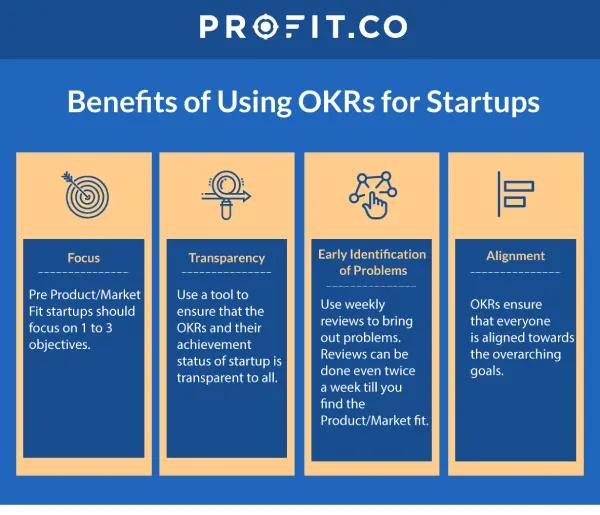
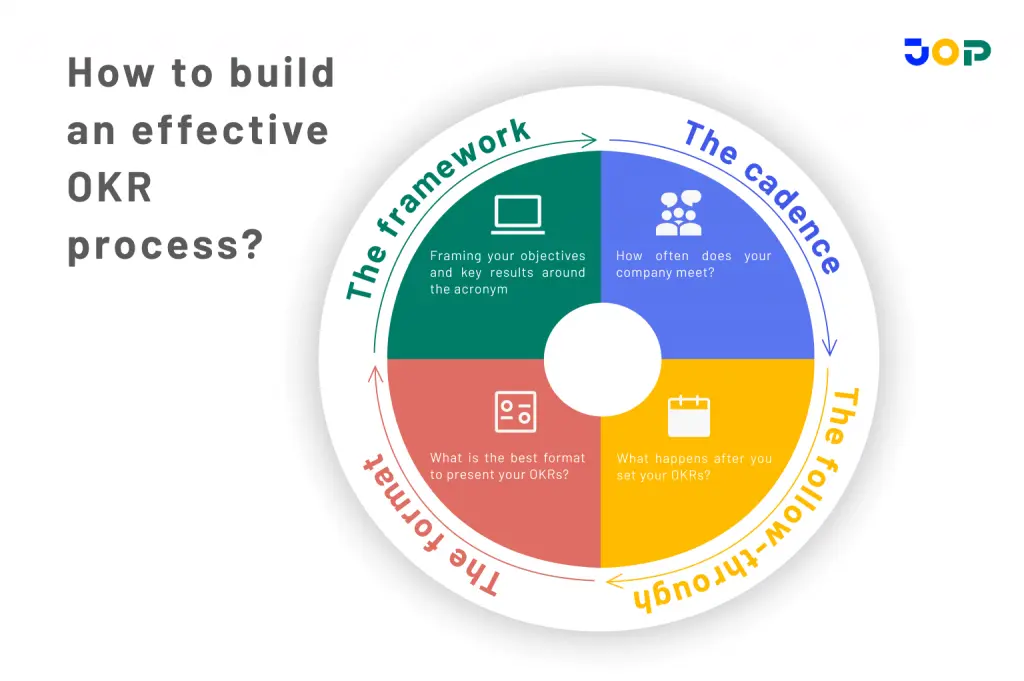
The keyword is lightweight. Startups don’t need elaborate systems. They need one clear objective, two or three measurable key results, and a weekly check-in to keep things honest. That’s it.
The Goal was Never to Build More
Shipping fast matters. But shipping the right things, consistently, in the right direction – that’s what actually builds a product worth using.
As startups grow, maintaining that direction gets harder. More ideas, more stakeholders, more complexity. Without a system that keeps the team aligned, the backlog wins. The loudest voice wins. The most recent customer request wins.
Platforms like Appkodes help bring structure to this complexity by supporting teams with the tools they need to stay aligned and focused.
OKRs give teams a way to stay deliberate without slowing down. To move quickly and purposefully at the same time.
Because in the end, the goal was never to build more. It was always to build what matters – and to keep building it, quarter after quarter, without losing the thread.

Thangamanikandan Bharathan
Starting as an iOS developer and moving up to lead a mobile team at a startup, I've expanded my expertise into Project Management, DevOps and eventually becoming a COO & Chief Service Officer in the IT sector. As a CSO, I excel in team leadership, technical advice, and managing complex business functions, focusing on combining technology and operations to drive growth. I'm keen to connect for collaborations or to exchange insights in the tech world!