How to Evaluate the Right AI Solutions for Your Fintech Startup

Something unusual is happening inside the financial world quietly, steadily, and faster than most founders expected. Conversations with customers, once dictated by human bandwidth, are now shaped by intelligent systems that learn in seconds.
For example, in the UK, more than a third of these interactions already involve AI, and soon nearly half will.
As finance becomes borderless and multilingual, AI has slipped into the frontline, helping banks and FinTechs respond quicker, identifying potential risks earlier, and supporting customers in ways that were impossible a decade ago.
Globally, the momentum is unmistakable. The AI-in-finance market, valued at USD 38.36 billion in 2024, is projected to surge to USD 190.33 billion by 2030.
Gartner’s data tells a similar story: 58% of organizations now use AI in their financial workflows, and 40% have already expanded into more advanced AI solutions. For entrepreneurs, this isn’t just a trend; it’s a signal.
The tools shaping tomorrow’s financial landscape are already here, maturing fast, and shifting what customers expect.
But here’s where the story becomes urgent for business owners. With AI taking over translations, fraud detection, compliance support, and everyday financial interactions, founders must make deliberate choices.
The right AI solutions can accelerate growth and simplify operations; the wrong ones can create compliance risks, data issues, or wasted investment. In a market evolving this quickly, knowing how to choose the right AI-driven financial tools is becoming a crucial entrepreneurial skill.
What AI Really Means for the Finance Sector Today
Artificial Intelligence (AI) is transforming the way financial services operate, enabling smarter decision-making, increased efficiency, and enhanced risk management. At its core, AI refers to systems designed to mimic human intelligence, learning from data, detect patterns and insights, and solving complex problems.
In finance, AI can act like a high-speed analyst, sifting through massive datasets to uncover investment opportunities and optimize portfolios.
AI Technologies You Should Know
Artificial Neural Networks (ANNs): Modeled after the human brain, ANNs excel at identifying patterns and relationships within complex datasets. Financial institutions use them for credit scoring, fraud detection, and predicting market trends.
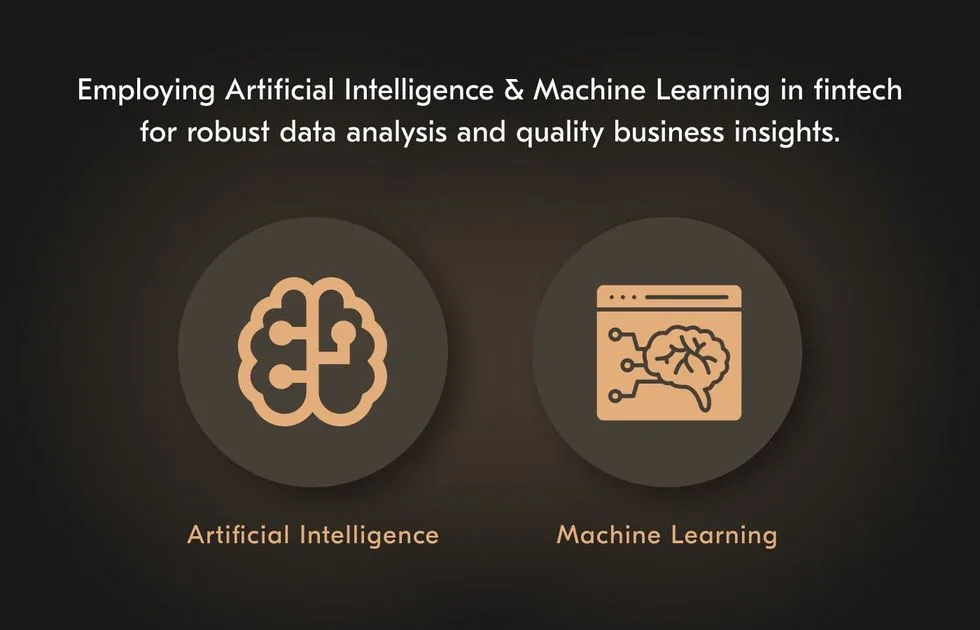
Machine Learning (ML): A branch of AI, machine learning focuses on algorithms that improve as they process more data. In finance, ML helps banks and fintechs forecast trends, evaluate client risk, and detect anomalies by learning from historical data.
Source: https://acropolium.com/
Deep Learning: An advanced form of machine learning, deep learning employs layered neural networks to analyze massive datasets. It powers high-frequency trading, sophisticated risk modeling, and advanced predictive analytics.
Natural Language Processing (NLP): NLP allows computers to understand and interpret human language. Financial applications include extracting insights from earnings reports, analyzing customer interactions, and monitoring news for actionable intelligence.
Large Language Models (LLMs) & Generative AI: Built on deep learning and NLP, LLMs such as ChatGPT and Bard can generate text, summarize reports, and even simulate financial scenarios. They are increasingly used for automated reporting, scenario planning, and predictive financial modeling.
Computer Vision: This branch of AI enables systems to process and interpret visual information. In finance, it supports identity verification, document processing, chart analysis, and security monitoring.
Expert Systems: Unlike data-driven AI models, expert systems operate based on a predefined set of rules to make decisions. In finance, they are valuable for compliance checks, risk evaluation, and automated advisory services—situations where structured knowledge is essential.
Robotic Process Automation (RPA): RPA leverages software “robots” to handle repetitive tasks, rule-based tasks. Financial institutions use it to automate invoice processing, bank reconciliations, and report generation, boosting efficiency and reducing human error.
Why AI-Driven Finance Matters for Founders Like You?
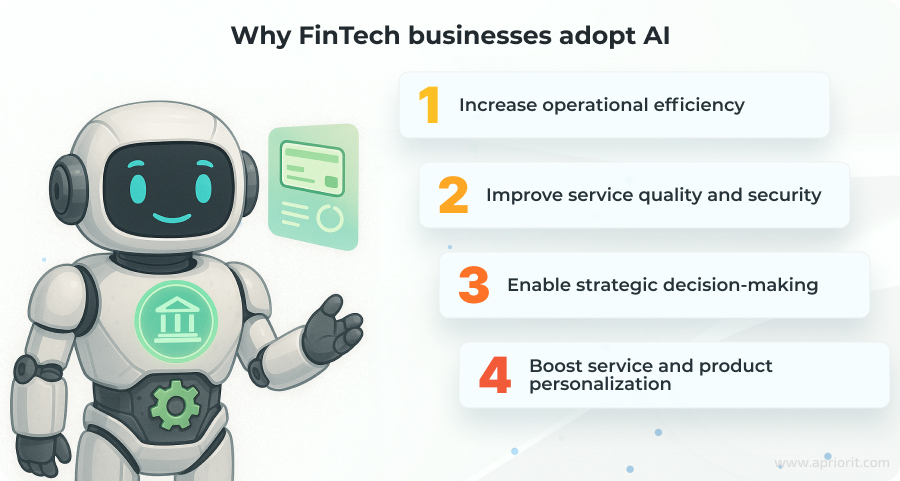
For FinTech founders, AI-driven finance is more than an operational upgrade; it directly shapes product credibility, market trust, enhances operational efficiency, and competitive survival. Unlike general startups, FinTechs live in a high-stakes environment where financial accuracy, transparency, and trust aren’t optional; they are your product.
1. AI Shapes the Credibility of Your FinTech Product
In FinTech, your internal financial hygiene becomes part of your brand trust. If your own reporting, reconciliation, or risk tracking is weak, it shows in your product decisions. AI-driven finance ensures internal operations are clean, auditable, and real-time, which naturally strengthens the reliability of your customer-facing solutions:
- better risk models
- cleaner transaction logic
- more accurate customer insights
FinTech founders build better products when their internal numbers are sharper.
Source: https://www.apriorit.com/
2. AI Helps You Navigate Regulation Before You Face It
FinTechs eventually collide with compliance, KYC, AML, audit trails, SOC2, PCI, RBI/SEC requirements (depending on region). AI-driven finance helps founders prepare long before regulators come knocking by automating:
- anomaly detection
- transaction monitoring
- detailed logs
- suspicious activity patterns
- industry-grade reporting
This reduces legal risk and ensures you don’t scale into a compliance disaster.
3. AI is the Fastest Way to Build Investor Confidence
FinTech investors don’t just fund ideas; they fund financial discipline. When founders show real-time dashboards, predictive revenue curves, and clean financial flows powered by AI, it signals:
- operational maturity
- better control of unit economics
- reduced risk of data leakage
- readiness to scale. This instantly elevates you above competing FinTech startups that still rely on manual spreadsheets.
4. AI Turns Transaction-Level Chaos into Intelligence
FinTech systems generate massive, high-frequency, multi-source financial data that can overwhelm early teams. AI helps founders convert this noisy data into:
- behavioral insights
- customer risk scores
- churn prediction
- loan repayment patterns
- recurring revenue patterns
- fraud fingerprints
Without AI, FinTech founders drown in their own data. With AI, this data becomes a competitive asset.
5. AI Reduces Founder Stress from Financial Complexity
FinTech founders aren’t just managing a business; they’re managing miniature financial ecosystems. Stress doesn’t come from workload; it comes from the fear of missing something critical:
- a spike in fraud
- a cash flow trap
- a margin collapse
- a compliance oversight
AI becomes the always-on watchdog that surfaces issues instantly, easing cognitive load and letting founders focus on product and growth, not firefighting.
Types of AI-Driven Financial Tools to Consider
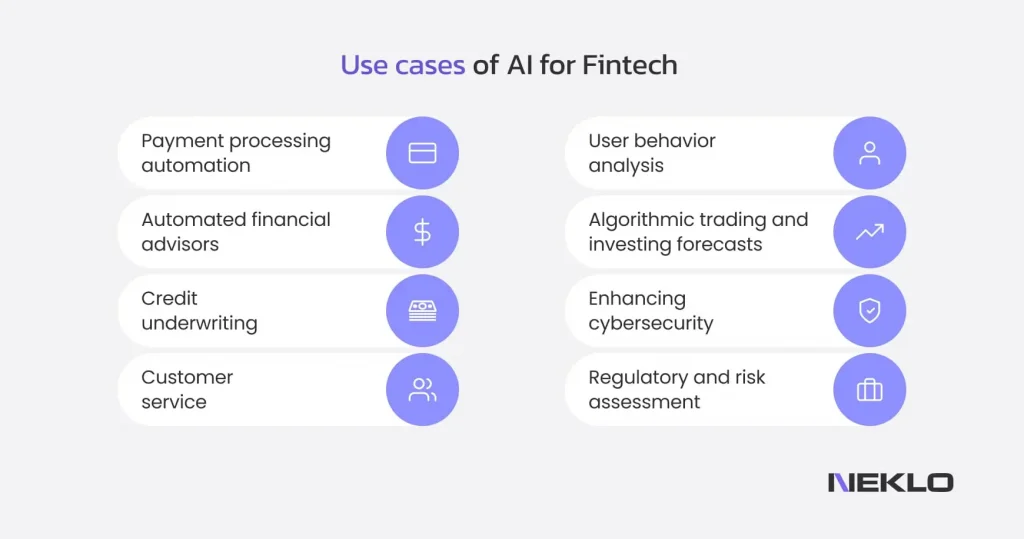
Owners handle vast amounts of data at a time, so they need AI financial tools. It helps with cost reduction. Also read large volumes of financial data and turn it into clear insights that drive smarter decisions and give better customer support.
| Tool Type | What It Does | Example Tools |
| AI Bookkeeping & Accounting | Automates data entry and reconciliation | QuickBooks AI, Zoho Books AI, Pilot |
| AI Cash Flow Forecasting | Predicts income, expenses, and burn rate | Finbox AI, Float |
| AI Expense Management | Categorizes transactions, automates approvals | Happay, Expensify AI |
| AI Tax & Compliance | Calculates taxes, ensures regulatory compliance | ClearTax AI, Avalara |
| AI Fraud Detection & Payment Intelligence | Monitors transactions for anomalies | Razorpay Magic, Stripe Radar |
| AI FP&A & Scenario Planning | Simulates pricing, revenue, and market outcomes | Vena, Planful |
How to Implement AI Tools Without Disruption
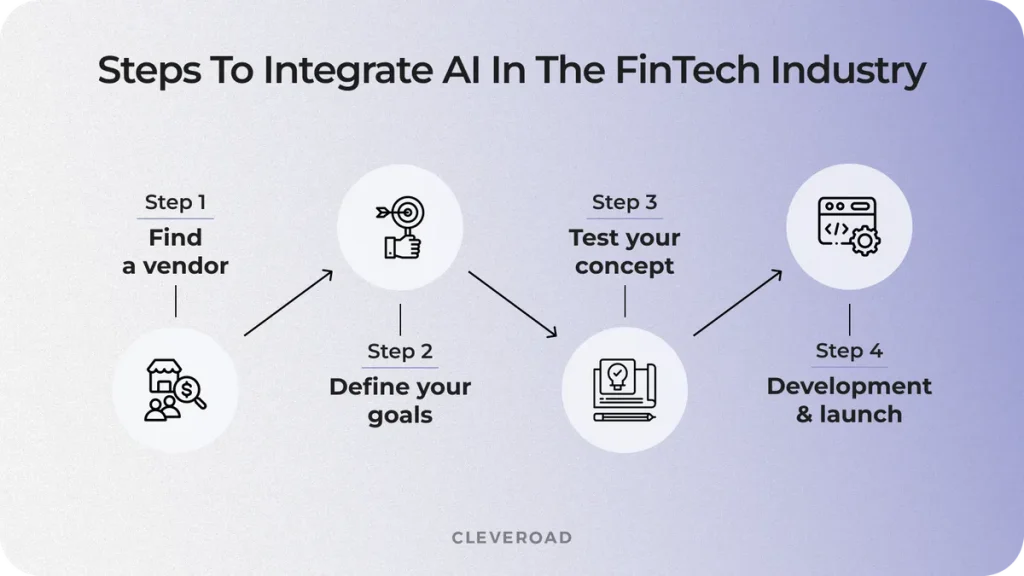
Implementing AI doesn’t have to be complicated, but doing it right requires the right support. With a skilled development team, even beginners can integrate AI tools smoothly without costly mistakes. Here’s how it works:
Step 1: Identify the Core Function to Automate
Start with a single financial process, such as audit preparation or Financial reporting automation. The development team helps assess which areas will benefit most, ensuring you focus on the tasks that drive the biggest impact on AI solutions. Jumping into multiple processes at once can create confusion, errors, and frustration.
Step 2: Prepare and Organize Your Data
Data is the foundation of AI. Developers work to clean, structure, and migrate accurate financial data into the new system. Attempting this alone often results in duplicates, missing entries, or misaligned data problems that can skew AI predictions and smarter decisions. Proper data preparation ensures the system produces reliable insights from day one. Additionally data annotation tech makes it easier to label and organize datasets, helping AI systems work more accurately and reliably.
Step 3. Set Clear Goals and KPIs
Together with the development team, define measurable outcomes like time saved, error reduction, or improved cash flow visibility. Developers can set up dashboards, alerts, and tracking mechanisms, so performance is monitored continuously and adjustments can be made quickly.
Step 4. Gradual Automation
AI features should be rolled out step by step. The team tests each function, identifies bottlenecks, and refines workflows before adding new tools. Going full-scale from the start risks operational disruption and missed opportunities for optimization.
Source: https://www.cleveroad.com/
Step 5. Training and Onboarding
Developers guide staff on using the AI tools effectively, teaching how to interpret outputs and act on recommendations. Without proper onboarding, even the most powerful AI can sit idle or be misused.
Step 6. Continuous Monitoring and Optimization
AI is not a “set and forget” system. Developers monitor performance, tweak algorithms, and ensure the AI evolves alongside your business. This ongoing support prevents small issues from snowballing into major problems.
Step 7. Seamless Integration Across Systems
The development team handles all technical aspects API connections, workflow alignment, and system compatibility, so AI tools fit naturally into your existing financial processes. This prevents disruptions and ensures all systems communicate effectively.
Key Considerations for Choosing AI Tools in FinTech Startups
Choosing the right AI tool for your business doesn’t have to be a guessing game. Founders can take a structured approach using the F.E.A.S.T. Framework, which evaluates fintech solutions across five critical dimensions:
#1 Fit
Does the AI tool address your specific business challenge, and can it integrate seamlessly with the systems you already use? For FinTech startups, a single tool rarely covers everything. Instead, look for specialized fintech solution for fraud detection, customer insights, or risk scoring that work together through APIs, enabling smooth data flow and smarter decision-making.
#2 Ease of Use
Even the most powerful AI is useless if it’s complicated. Choose tools that are intuitive, easy to navigate, and don’t require a specialist to set up. A user-friendly interface saves time, prevents frustration, and ensures your team actually leverages the technology.
#3 Accuracy & Trust
Reliable AI insights are essential for informed decision-making. Look for tools that clearly explain how outputs are generated, maintain consistent data classification, and provide a transparent audit trail. When insights are trustworthy, your team can act confidently and manage risk effectively.
#4 Security & Compliance
Handling sensitive financial data demands strict safeguards. Prioritize tools that comply with global regulations like GDPR, CCPA, or PCI DSS, and ensure features such as bank-grade encryption and robust data protection are included. Choosing secure, compliant solutions protects customer information and preserves your company’s credibility.
#5 Scalability
Finally, consider your growth trajectory. Will the AI tool scale with your team, transaction volume, and revenue? Is pricing flexible for early-stage businesses? Scalable tools ensure your investment continues to deliver value as your business expands.
Must-Have Features in Modern AI Financial Tools
Many entrepreneurs get confused about which features to include. In that confusion, they often overlook the must-have features and end up wasting valuable time integrating the wrong ones.
1. Real-Time Dashboards
A clear, visual overview of your cash flow, transactions, and financial health at any moment. This helps founders make informed decisions quickly without digging through spreadsheets.
2. Automated Reconciliation
Automatically matches payments, invoices, and bank transactions, eliminating manual work. It reduces errors and ensures your accounts are always up-to-date.
3. AI-Based Transaction Categorization
Sorts income and expenses intelligently, giving you organized insights. This makes it easier to track spending patterns and spot areas for optimization.
4. Predictive Cash Flow
Uses historical data and AI models to forecast future income and expenses. Founders can plan for runway, growth, or unexpected costs with confidence.
5. Fraud and Anomaly Detection
Monitors transactions in real time to detect unusual activity. Early alerts prevent financial losses and protect both the business and its customers.
6. Automated GST/Tax Estimation
Calculates taxes automatically based on transactions, reducing errors. This saves time during filing and ensures compliance with regulations.
7. Invoice Automation
Creates, sends, and follows up on invoices automatically. It ensures timely payments and reduces administrative workload.
8. Integration with Banking and Payment Gateways
Connects your AI tools directly to your banking systems and payment platforms. Seamless integration improves workflow efficiency and minimizes data silos.
9. Custom Reporting
Allows you to generate reports tailored to your startup’s unique needs. This helps stakeholders understand performance, spot trends, and make better decisions.
10. Vendor Management Intelligence
Tracks supplier performance, payments, and contracts in one place. AI insights help negotiate better terms and optimize vendor relationships.
Source: https://neklo.com/
Budget Considerations for Founders: Understanding Costs, ROI & Real Savings
Bringing AI into your financial operations is a budgeting decision. For a founder like you, the smartest approach is what? Instead of automating your entire finance stack, begin with one high-impact process such as expense reconciliation, payment automation, or revenue tracking.
Full Cost Breakdown
AI tools often appear affordable at first glance, but real budgeting requires a full view of every cost layer. Here’s what to account for:
- Software Cost: Most tools fall between $20–$200/month, with pricing increasing based on users or transaction volume.
- Implementation: Integrations or developer support can range from $100–$1,000, depending on complexity.
- Data Preparation: Cleaning outdated records or formatting data may cost $50–$300 in internal time or outsourcing.
- Training Time: Onboarding your team typically amounts to $20–$50/hour per person.
- Scaling Costs: As your business grows, plan for an additional $30–$150/month for advanced features or higher usage.
Understanding these layers helps avoid surprise expenses and supports confident long-term planning.
Evaluating ROI the Founder-Friendly Way
AI adoption should generate measurable returns within a few months. A simple way to evaluate this is:
ROI = (Time Saved + Errors Reduced + Revenue Recovered) – Total Costs
You can expect gains such as:
- Saving 10–40 hours/month of repetitive work (worth $200–$800+)
- Cutting financial errors by 60–80%, reducing losses of $100–$500/month
- Recovering missed revenue or delayed payments worth $200–$1,000/month
- Avoiding the need to hire early, saving $2,000–$4,000/month
When founders actually calculate this, integrating AI often proves more affordable than expected.
Practical Savings You’ll Notice Immediately
The real benefit of AI solutions isn’t futuristic features, it’s everyday savings apart from cost savings:
- Operational savings from fewer manual tasks
- Improved productivity across finance and operations
- More stable cash flow from better forecasting
- Lower risk of penalties due to accurate recordkeeping
- Reduced hiring needs because automation handles routine tasks
Even a tool costing $30–$150/month often replaces one or two full days of manual work each week, making it a high-value investment rather than an expense.
Make a Confident, Founder-Smart Investment
You’re ready to invest when,
- The tool solves a current pain point
- Monthly time savings exceed its cost
- You see clear reductions in mistakes and revenue leakage
- Your cash flow comfortably supports $30–$200/month
With this structured, practical approach, founders can adopt AI without financial pressure and clearly see how its transformative power can reduce costs, improve operational efficiency, and accelerate business process automation
Practical Takeaways for Founders
- Start with your biggest pain point, and invest small first.
- Pilot and measure ROI before scaling.
- Track KPIs to justify further investment.
- Scale gradually, add tools only when ROI is proven.
- Consider flexible pricing like subscription or usage-based plans to keep resources manageable.
By approaching AI budgeting as a step-by-step process, you can avoid overspending, ensure every tool delivers real value, and build AI capabilities that enhance personalized experiences.
Why Choosing the Right AI Fintech Provider is Essential for Your Fintech
According to the Citi Treasury and Trade Solution (TTS) Survey 2024, 93% of banks, insurers, and asset managers expect AI to boost profitability over the next five years. This statistic underscores the critical importance of AI integration.
Case 1: Unauthorized Transactions Due to Poor Integration
A growing fintech startup had multiple systems for payments, wallets, and banking APIs that weren’t properly integrated.
One day, a batch of transactions failed to sync between the wallet and the bank system, allowing duplicate charges to go unnoticed for several hours. Customers were frustrated, trust dropped, and the finance team scrambled to manually reconcile accounts.
With the right AI fintech provider, such gaps are monitored in real-time. Automated reconciliation and alert systems detect inconsistencies immediately, flagging unusual activity for review. At scale, many institutions rely on a Treasury-grade escrow platform to safeguard funds during reconciliation, audits, or regulatory reviews.
A dedicated team ensures all systems communicate seamlessly, reducing human error and protecting both the business and its customers.
Case 2: Identity Fraud Due to Weak Security Protocols
Another fintech startup experienced a cyber threat where fraudsters exploited weak KYC checks and login vulnerabilities, creating multiple fake accounts and transferring funds undetected. The breach wasn’t caught until significant funds had been misappropriated, causing both financial loss and reputational damage.
An AI fintech provider with advanced security measures can detect unusual account behavior, flag suspicious patterns, and enforce multi-layer authentication, preventing such attacks.
Beyond technology, having a knowledgeable team ensures continuous monitoring, rapid incident response, and ongoing improvement of security protocols.
Partner with Appkodes
Choosing the right AI FinTech partner becomes much easier with Appkodes, a leading startup mobile app development company by your side.
With years of experience in AI development services, FinTech, and full-stack app development, we help you identify which solutions will truly move your business forward, whether it’s optimized customer service, improved customer satisfaction, better resource allocation, or processing huge quantities of unstructured data.
Our team works closely with founders to assess risks, clarify technical possibilities, and design AI-driven systems that align with your financial workflows.
From leveraging AI solutions that lower costs to implementing process automation solutions for dynamic content and financial operations, we ensure every system is built with precision and long-term stability.
Beyond strategy, Appkodes manages the entire technical execution from integrating APIs and payment systems to developing secure, scalable mobile and web apps.
Our AI solutions and models are rigorously tested for accuracy, fairness, and performance, while our data engineering pipelines transform raw, unstructured inputs into clean, reliable datasets with maximum predictive power.
Backed by a strong portfolio across industries and proven client success stories, we deliver solutions that enhance automation, improve financial accuracy, and streamline daily operations end-to-end.
With Appkodes, you don’t just get a development vendor; you gain an ongoing technology partner committed to growth, efficiency, and long-term innovation.
We train your team, monitor performance, and continuously optimize your AI systems as your startup scales. If you’re ready to strengthen your financial product with reliable AI tools and an expert in financial software development, connect with Appkodes and build your next FinTech innovation with confidence.

Arun Andiselvam
Founder of AppKodes. As a serial entrepreneur, I have successfully established five brands over the past 12 years. After creating a successful rank tracker for SEO agencies, I am currently dedicated to developing the world's first SEO Project Management software.