What Happens When SaaS Ignores AI? Key Challenges & Solutions for Founders
Picture two SaaS startups launching simultaneously. OptiFlow tried something different; they quietly studied what customers wanted and used smart tools to make work easier. DataStream stuck to the usual way, trusting their product and users were enough.
Two years later, OptiFlow had doubled its users and cut churn by 30%. DataStream? Still struggling with slow growth and unhappy customers. On the surface, they looked similar, but something invisible made all the difference.
Today, 76% of SaaS companies are using AI in their operations, and ignoring it can quietly hold a company’s business model back. For bootstrapped companies, the stakes are higher as small inefficiencies can hurt growth. The structural shift AI brings is already reshaping how teams work.
The problems of skipping it aren’t loud; they’re quiet but serious. Without it, customer support slows down, workflows get messy, and insights into users come too late.
Small issues stack up and start slowing growth, even when dashboards look fine. It’s like driving a car with a blindfold; the gauges seem perfect, but the road ahead is full of hidden bumps.
Of course, using it isn’t a magic fix. Companies need to handle data carefully, avoid biased decisions, and make sure the tools are used correctly. Teams also need the right skills to understand the insights. What happens when SaaS ignores AI?
Skip these steps, and what should help can actually cause trouble. Done right, though, it becomes a silent partner in spotting patterns, making work smoother, and helping teams make faster, smarter choices.
For SaaS founders, ignoring this invisible factor isn’t an option anymore. The key is to use it wisely, align it with your company’s business model, and build a culture that welcomes innovation. Those who do this don’t just survive, they lead, delight.
Why SaaS Platforms Struggle: Key Issues That Hurt Growth and Retention
These are visible problems you can track, measure, and somewhat plan for. But the real threats are quieter. They creep in unnoticed, slowly eroding growth, sapping user engagement, and making scaling far tougher than anyone anticipates.
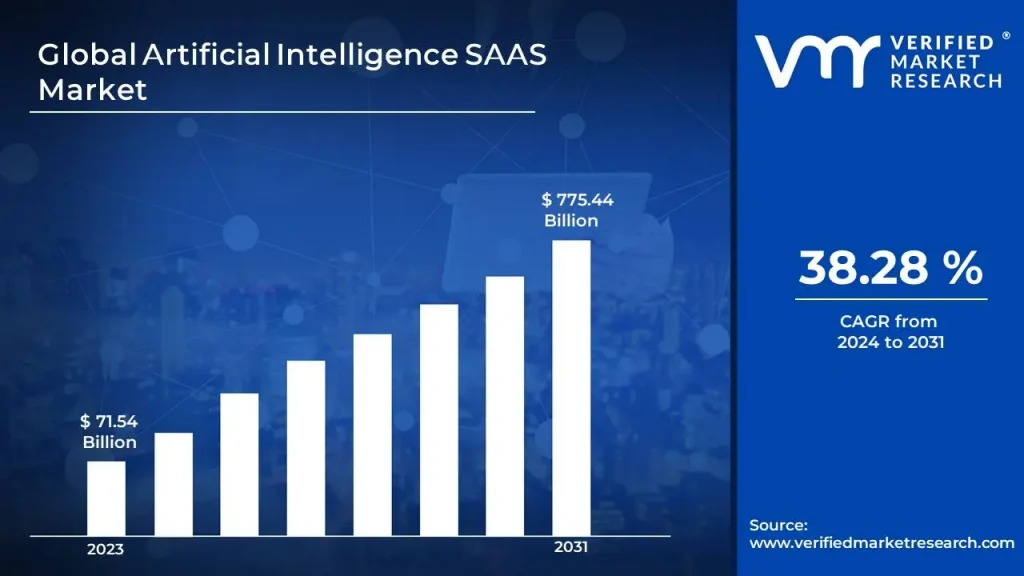
Source: https://www.verifiedmarketresearch.com/
1. Healthcare SaaS
In healthcare platforms, teams might notice a slight dip in patient interactions. But what they often miss are the tiny signs: skipped features, incomplete workflows, or patients quietly dropping out of care plans.
These little things may not set off alarms, but over time, they add up. Research shows that poor engagement with digital health tools can cut patient retention by up to 20%. Missing these subtle signals doesn’t just hurt the business; it hurts people, too. Disengaged patients are less likely to follow care plans or recommend your platform to others.
2. Finance SaaS
For finance platforms, small transaction hiccups slightly slow processing, unclear notifications, and minor interface issues might feel harmless at first. But even a tiny 1% increase in friction can quietly cost millions for high-volume financial services.
Over time, these small annoyances chip away at trust, and customers may silently switch providers without a word. It’s an invisible ongoing revenue leakage that dashboards can’t always show, but it can seriously affect growth and profitability.
3. Edtech Platforms
Learners don’t always tell you when they stop using features, so disengagement can go unnoticed. On paper, engagement may look fine, but behind the scenes, adoption can stall. Course completions drop, personalized learning experiences lose impact, and teams often notice the problem only when it’s too late.
Studies show that up to 30% of learners disengage mid-course without leaving feedback, a silent churn that can undermine the platform’s effectiveness.
4. Logistics Tools
Routing delays, inventory mismatches, and fragmented updates may seem minor, even trivial. But together, they create bottlenecks, inflate costs, and frustrate clients.
Research shows that small inefficiencies can raise operational costs by 15–20% and delay deliveries, damaging reputation even when dashboards suggest everything is running “normally.”
No matter the industry, the message is clear: the challenges you can see are the easy ones. The real danger lies in the subtle, hidden problems, the quiet issues that slowly erode growth, engagement, and efficiency. And this is exactly what happens when SaaS ignores AI: those risks remain unchecked until they become roadblocks
Real-World Examples: How AI Solves Their SaaS Challenges
Have you ever looked at a SaaS dashboard and thought, “Everything looks fine…so why aren’t we growing faster?”
Many platforms appear healthy on the surface, but what quietly holds them back? Things like fragmented data, unnoticed bugs, subtle churn, or slow problem resolution rarely show up in reports, yet they silently affect the product and users’ experience.
That’s where AI steps in, not as a buzzword but as a practical problem-solver.
By analyzing patterns humans might miss, predicting risks, and highlighting inefficiencies, AI is transforming how SaaS platforms operate. Let’s take a closer look at real-world examples showing AI in action:
#1 Healthcare platforms often deal with patient records spread across labs, imaging systems, and EHRs. This can make it frustrating for clinicians to find accurate information quickly. AI helps by unifying these records and flagging inconsistencies.
For example, one hospital network improved its data completeness by 35% using AI-driven mapping, helping doctors make faster, more confident decisions.
#2 Even small bugs can ruin user experiences and slow down development. Sentry, a popular monitoring platform, uses AI to automatically detect bugs and suggest fixes. This means developers spend less time searching for problems and more time building features users love.
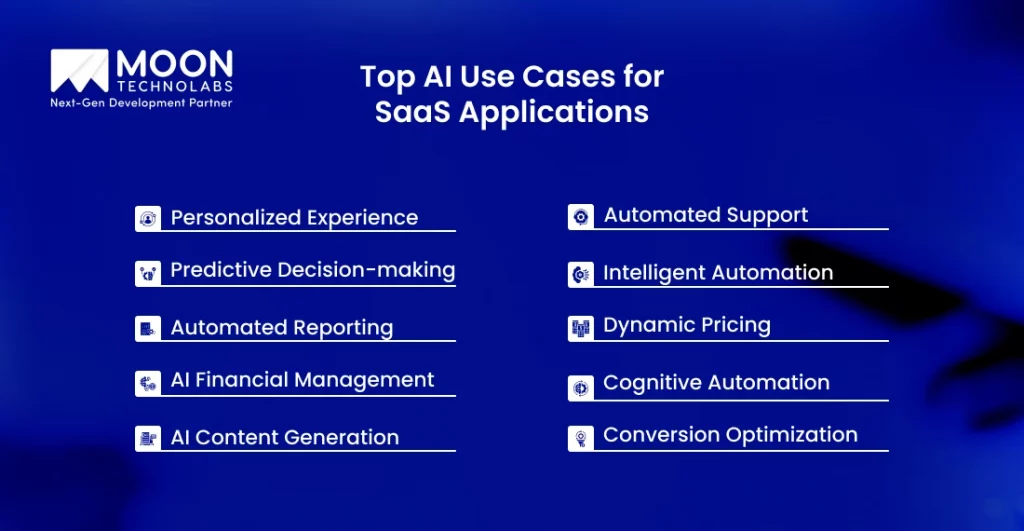
Source: https://www.moontechnolabs.com/
#3 In legacy banking systems, recurring income and failures are often blamed on vendors or management. But when Generative AI agents were combined with the “Five Whys” method, banks discovered that 70% of incidents were actually caused by internal code issues. By spotting the real root causes, problems could be fixed proactively instead of repeatedly resurfacing.
#4 Turning a product idea into a working SaaS app can be intimidating for non-technical founders. Databutton lets users write a plain-language prompt, and AI generates the full-stack code for them. Suddenly, indie developers can bring ideas to life without being coding experts.
#5 Manually reading thousands of app reviews is exhausting. Platforms like AppRadar use AI to analyze reviews and automatically summarize user sentiment. Developers can instantly see what users love, what frustrates them, and where improvements are needed, helping them respond faster and smarter.
#6 Many SaaS platforms struggle to identify subtle opportunities for growth. DevRev uses AI to predict customer needs and detect hidden patterns in engagement. By understanding users better, teams can act proactively, offering features or solutions before users even realize they need them.
#7 Security threats are often subtle, and if ignored, they can escalate quickly. BBVA uses AI in its Google SecOps platform to detect, investigate, and respond to threats in seconds, instead of hours or days. This gives teams peace of mind and keeps users safe.
How AI Turns Subtle Signals into Strategic Advantages
In today’s fast-moving business environment, this ability to anticipate change, preserve knowledge, and make smarter decisions can be the difference between thriving and falling behind.
Even the most attentive teams can miss small but critical shifts in behavior, trends, or performance. AI fills this gap. This approach is already becoming mainstream: as of 2025, 76% of SaaS companies are using or exploring AI to improve their operations.
Beyond spotting, AI also preserves institutional knowledge. Lessons from past projects, historical decisions, and patterns can fade as teams evolve or employees leave, but AI captures and organizes this information, making it accessible for future decisions.
This approach to knowledge management has a measurable impact: 87% of SaaS companies report improved growth rates through AI-driven personalization.
1. Understanding User Behavior Deeply
AI can do what even the most attentive team members sometimes miss: notice tiny user habits. Maybe a user hesitates on a feature, goes back a few steps, or skips a part of the workflow. AI can spot these subtle signals and help predict what users might do next, letting you fix issues before they become big problems.
2. Turning Data into Stories
Numbers alone are overwhelming. AI can translate complex data into simple, actionable stories. Instead of just saying, “Feature X isn’t used,” it might explain, “Users drop off here because this step feels confusing,” helping your team act with clarity and purpose.
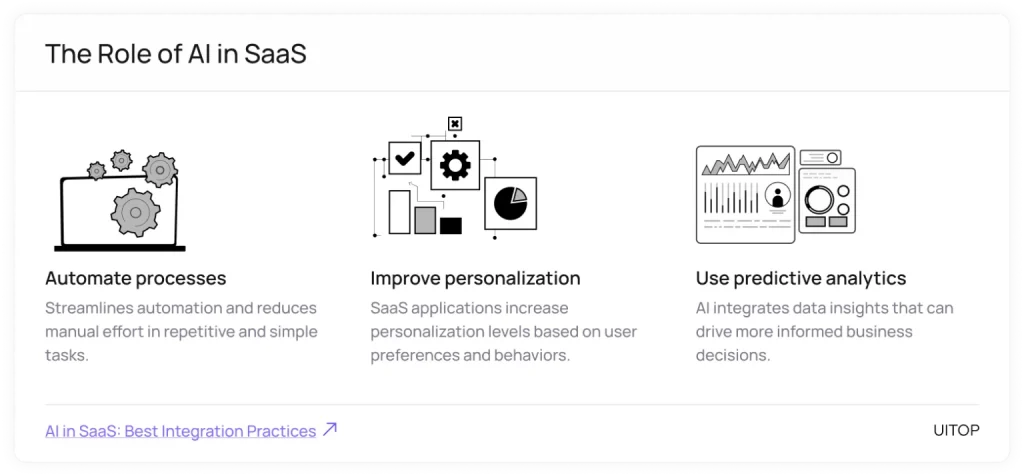
Source: https://uitop.design/
3. Revealing Hidden Workflow Connections
Sometimes, delays in one team silently impact others. AI can map these invisible links so you see how one small hiccup can ripple across the entire platform. Think of it as having a backstage map of your company’s operations.
4. Reading Emotional Cues
Users leave traces of their feelings, frustration, delight, or confusion through how they interact with your platform. AI can pick up on these subtle signals, helping you understand your users’ emotions and respond proactively, keeping them happy and engaged.
5. Spotting Silent Feature Decay
A feature that once thrilled users can slowly lose relevance. AI tracks these changes, even if usage metrics seem “fine,” helping you update, retire, or improve features before they drag down the user experience.
6. Finding Hidden Product Synergies
AI can reveal opportunities you might never have considered, like two features that could work together beautifully or workflows that can be streamlined. It helps your team discover new ways to delight users and create value.
Best Practices for Using AI in SaaS
At first glance, your SaaS company may look healthy: dashboards are green, teams are shipping features, and users are signing up. But if growth feels slower than expected, retention keeps slipping, or engagement looks flat despite all the hard work, you’re not alone.
Many SaaS founders face hidden struggles that standard metrics don’t reveal. The good news? With AI-powered insights and the right development strategies, these struggles can be turned into growth opportunities.
1. The Busy Work Trap
Your team looks productive, tickets closed, pull requests merged, and features released. But despite all the motion, revenue and growth metrics barely move. This is the “progress mirage.” Research shows that up to 70% of dev teams spend one-fifth of their time on tasks that add no real business value.
Why it Happens
Teams prioritize activity over outcomes.
Processes pile up with unnecessary reviews and approvals.
Nobody is measuring the impact of work, only the volume.
The Fix – Step by Step
AI-driven dashboards filter out noise and highlight work that truly impacts KPIs like retention, revenue, or activation.
Workflow automation cuts repetitive tasks like testing, bug triage, or release approvals that eat time without adding value.
Expert dev teams restructure processes, set up CI/CD pipelines, and coach teams to focus on output that aligns with business growth.
The Outcome: Your team’s energy starts translating into measurable results, not just busy work.
2. Users Who Log In but Don’t Stay Engaged
Users sign up, log in regularly for a few weeks, then engagement starts dipping. On the surface, logins look fine, but deeper engagement tells a different story, leading to churn.
Why it Happens
Metrics track only logins, not true product interaction.
Onboarding doesn’t personalize quickly enough.
Users don’t see ongoing value after initial signup.
The Fix – Step by Step
AI tracks in-app behavior, not just logins, but which features are being used and how often.
Predictive models flag users likely to churn based on early usage patterns.
Personalized nudges (emails, prompts, recommendations) are triggered automatically to re-engage them.
Dev teams integrate AI across platforms so engagement data is seamless, giving you a complete view of user health.
The Outcome: Instead of watching users quietly leave, you catch disengagement early and bring them back.
3. Stuck in Old Decision Loops
Your team keeps choosing what worked before. It feels safe, but limits innovation. Predictive analytics suggest new opportunities, but habitual thinking blocks them. Studies show teams miss half of data-driven opportunities due to bias.
Why it Happens
Reliance on “gut feel” instead of data.
Fear of risk when trying something new.
Decision-making culture is stuck in repetition.
The Fix – Step by Step
AI detects anomalies and blind spots, surfacing insights that humans often overlook.
Recommendation engines suggest next-best actions, not just raw data.
Teams test AI-backed ideas with small experiments before scaling, reducing risk.
Dev teams embed decision intelligence tools into workflows so insights guide strategy directly.
The Outcome: Decisions become smarter, faster, and less biased, driving innovation instead of repetition.
4. Missing Emerging Trends Until It’s Too Late
By the time you notice a shift in user behavior, competitors have already launched new features or pricing models. You feel like you’re always playing catch-up.
Why it Happens
Human observation is too slow for fast-moving markets.
Subtle signals (like micro-segments) don’t show up in standard dashboards.
Teams wait for obvious changes instead of spotting early ones.
The Fix – Step by Step
AI-powered analytics scan behavior patterns across segments in real time.
Micro-trend detection highlights emerging niches (e.g., a subset of users using features in unexpected ways).
Alerts are automated, so your team is notified instantly of shifts.
Dev teams build predictive dashboards that continuously surface these insights.
The Outcome: Instead of reacting late, you adapt early, becoming the SaaS others try to catch up with.
5. Projects That Drift Off-Track
Everyone’s working hard, but projects slowly drift from company goals. Productivity drops 15–20% when work isn’t aligned, and founders feel like energy is being wasted.
Why it Happens
Lack of visibility across departments.
Teams measure success by task completion, not goal alignment.
Communication silos between product, marketing, and ops.
The Fix – Step by Step
AI alignment trackers map tasks to company objectives and highlight when they’re off.
Cross-functional dashboards unify marketing, product, and dev goals in one place.
Dev teams implement OKR-linked systems that keep projects accountable to strategy. Using specialized OKR software can help streamline this process and improve visibility across teams.
The Outcome: Every initiative drives the company in the same direction, maximizing effort and ROI.
6. Knowledge That Slips Away
A senior developer leaves, and suddenly your team spends weeks solving problems they had already fixed years ago. Knowledge fades, and you lose momentum.
Why it Happens
Decisions and lessons aren’t documented.
Institutional memory relies on individuals.
Past project insights aren’t accessible to new team members.
The Fix – Step by Step
AI-powered knowledge vaults capture past decisions, outcomes, and lessons learned.
Contextual search tools let teams find answers instantly.
Dev teams maintain and update these systems so they grow with every project.
The Outcome: Organizational wisdom compounds over time instead of walking out the door.
Source: https://www.veritis.com/
7. Innovation That Stalls
When Saas ignores AI, your product feels predictable. Features don’t excite users, updates feel incremental, and churn rises. Studies show 60% of users leave when products feel stale.
Why it Happens
Teams are stuck in maintenance mode.
Lack of time for creative exploration.
No system for surfacing new feature ideas.
The Fix – Step by Step
AI suggests workflow improvements and feature experiments based on usage.
Routine tasks are automated, freeing dev time for innovation.
Dev teams run lightweight A/B tests to validate new ideas quickly.
The Outcome: Products stay fresh, engaging, and competitive.
8. Features That Fade Without Notice
That shiny feature you launched last year? Users have stopped caring, but no one notices. Over time, the product becomes bloated, harder to use, and less loved.
Why it Happens
No real-time monitoring of feature usage.
Lack of data on evolving customer needs.
Fear of retiring features once built.
The Fix – Step by Step
AI tracks feature engagement continuously.
Impact scoring ranks features by contribution to user retention and satisfaction.
Dev teams set up feedback loops so features are updated, repurposed, or retired.
The Outcome: Your product stays lean, focused, and perfectly in sync with what users actually want.
Why Some SaaS Challenges Require Specialized Knowledge?
Adding AI to a SaaS platform isn’t just about installing a tool; it’s about weaving intelligence into the very fabric of your product.
Only experienced development teams know how to make AI a natural part of automated workflows, features, and functionalities, and user interactions, so it actually drives real impact.
By leveraging machine learning development services, they unify scattered data from user behavior and feature usage to market signals, ensuring AI insights are accurate, actionable, and tailored to your platform’s goals.
Unify scattered data from user behavior and feature usage to market signals so AI insights are accurate, actionable, and tailored to your platform’s goals.
But it doesn’t stop there. These teams build AI models, such as machine learning models that learn and adapt as users and markets change, keeping your product ahead of the curve.
They also ensure top-notch security and compliance, from HIPAA in healthcare to GDPR, so sensitive data is always protected. Most importantly, they turn AI insights into action, optimizing engagement, retention, and growth rather than letting valuable recommendations sit unused.
Without a skilled development partner, hidden SaaS challenges remain invisible, leaving founders blind to inefficiencies, missed opportunities, and silent disengagement, which can quietly stall growth and let competitors pull ahead when SaaS ignores AI.
Partner with Appkodes for Smarter Automation and AI-Powered Solutions
Appkodes is a leading startup mobile app development company. We can be your partner, specializing in task automation software and building workflow automation tools that help businesses to streamline operations and boost efficiency.
With years of experience in process automation tools and integrating advanced business logic in software, Appkodes’ development team empowers companies to transform repetitive tasks into seamless, intelligent processes through AI SaaS development.
By partnering with us, our clients gain access to cutting-edge AI technology that is changing the way businesses operate. We don’t just implement tools; we design solutions tailored to each business’s needs.
From automating daily operations to creating complex decision-making workflows, our expertise ensures that clients can focus on growth while minimizing manual effort and errors.
Whether it’s enhancing productivity, improving accuracy, or leveraging AI-driven insights, Appkodes supports businesses in adopting the latest workflow automation tools and task automation software.
With our solutions, companies can accelerate processes, optimize resources, and stay ahead in a rapidly evolving digital landscape.

Arun Andiselvam
Founder of AppKodes. As a serial entrepreneur, I have successfully established five brands over the past 12 years. After creating a successful rank tracker for SEO agencies, I am currently dedicated to developing the world's first SEO Project Management software.