Challenges in AI Application Testing and Best Practices
In the last ten years, there has been a growing trend of incorporating AI in automation software testing. This is due to the increased use of applications, the large number of users, and the requirement to deliver perfectly working applications as soon as possible.
According to Grand View Research, the AI market size is expected to grow at a CAGR of 36% between 2024 and 2030. We cannot underestimate the advantages that AI application testing brings, the main ones being the acceleration of testing, the improvement of the quality of software verification, and the speed of delivery to the market.
Any organization that has not incorporated the use of AI in testing should do so in order to be at par with other organizations. By making use of a trustworthy AI testing tool like Testgrid Cotester, these software companies should embrace this approach toward success and growth.
However, do not forget that testing with the help of AI tools is not always easy, and you will encounter a number of challenges. This blog will discuss them in detail and will also provide you with a list of best practices to follow so you can overcome them effortlessly.
A Brief Overview of AI Testing and its Benefits
AI testing involves using artificial intelligence to make software testing smarter, faster, and more efficient. Primarily, AI testing applies machine learning technology to learn from the previous tests and helps you generate, run, and manage test cases methodically.
AI testing is different from other traditional testing methods as it automates many processes, including test case generation and result analysis. The use of AI in testing can help testing teams get better results with fewer mistakes and at a lower cost.
Benefits of AI Testing
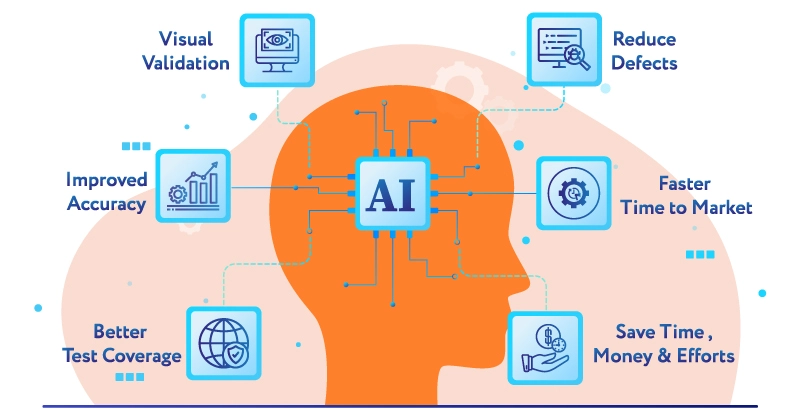
- Faster Test Creation: Produces a large number of test cases quickly, even for challenging contexts.
- Improved Accuracy: Eliminates human faults, offering accurate and competent results.
- Comprehensive Coverage: Can find several scenarios and edge cases that are difficult to notice if done manually.
- Accelerated Testing Cycles: Cuts down the testing time and time to market.
- Continuous Testing: Complements continuous integration and continuous development, enabling continual quality assurance.
- Cost Efficiency: Helps reduce one’s time spent in manual efforts, thus cutting costs.
- Rapid Feedback: Enables quicker insights into the quality of applications to be delivered, allowing for quick resolution of problems.
Source: https://www.testbytes.net/
Through the use of AI, testing teams can avoid the drawbacks associated with conventional testing and deliver quality applications in record time.
Key Challenges in AI Testing and Suggested Solutions
Here are the common hurdles testers face during AI testing:
1. Lack of Quality Data
AI testing outcomes depend on the quality of data that is fed into it in order to perform its operations. The data must be correct, varied, and current. However, such data is not easy to obtain, particularly when testing new software.
Lack of complete or skewed data distorts the outcome that AI is expected to produce. Moreover, problems such as improper labeling and outdated data make testing difficult and limit how AI can learn and adapt.
Solution: Datasets should be diverse, adequately labelled, and recent. One of the ways of procuring accurate information is to use reliable sources to obtain data and update it frequently.
2. Ethical Issues
Questions about issues of data privacy, biases, and responsibility arise since testing normally entails sensitive user data, and that is why such data should be protected.
One of the challenges is the transparency of the decision-making process within AI, as many of the models work in a way that makes it hard to explain how they arrive at their conclusions.
Solution: Apply strict measures to protect data and utilize multiple data sets to reduce the possibility of biases and their effects, and make AI decision-making more publicly traceable.
3. Lack of Trained Resources
AI testing involves expertise in Machine Learning and programming, among others. But it is not easy to come across professionals with such specialized skills.
Other challenges include the fact that existing team members may not have the right training to deal with different AI testing situations. This scarcity of skills limits the use and proper implementation of AI testing in organizations.
Solution: Spend money on training the staff and hiring AI specialists to guide testing activities. This can include targeted upskilling through cybersecurity courses, especially for teams working on models that handle sensitive data.
4. Lack of Knowledge and Guidelines
AI testing is still an emerging discipline, and there are no best practices or norms for the process. A lot of organizations do not embrace AI because they either lack information or are afraid of change.
In the same way, the integration of AI can be an expensive procedure demanding considerable capital expenditure to meet technological demands, which poses a factor of discouragement to corporations.
Solution: Conduct seminars like online meetings or webinars to create awareness in teams. Analyze the current state of testing to see in which areas it is possible to expect the biggest impact from the introduction of AI.
5. Need for Human Element
AI can mimic people’s actions and behavior, but it still cannot replace human creativity and intuition. It lacks a proper understanding of cultural matters and exploratory testing and is unable to generate logical test cases beyond its training data set.
Human testers are needed to fine-tune results from AI systems, fill the gaps, and ensure that the testing meets the expectations of the user.
Solution: Integrate human testers with AI systems to take advantage of the two approaches in order to get the best results.
Guidelines to be Followed While Implementing AI Testing Tools
These best practices can help you get the best outcomes while testing applications with AI tools:
#1 Understand the Raw Data
Make sure the actual data for testing contains no errors, such as typos or missing values. Review the data with the help of business experts if needed, and check for bias or inconsistencies that could skew results. Understanding the limitations of your data helps set realistic expectations and improves confidence in the outcomes.
#2 Measure and Record Results
Track and monitor the testing process carefully. Keep a clean master dataset for testing and reuse it to test new scenarios. The results should be audited regularly to make sure that they are still applicable to business needs.
If there are problems, change your strategies to get better results rather than continue to do things wrong.
#3 Collaborate and Guide the Team
AI testing tools usually require teamwork and cooperation. Concentrate on how your employees can be trained to gain better insights into the workings of AI systems and ensure everyone on your team cooperates with each other.
Define what you want to achieve with AI to ensure that the process is oriented to your business needs.
#4 Use Complementary Tools
End-to-end testing cannot always be done fully with the help of AI testing tools. Recognize those gaps and combine them with other tools for a more comprehensive approach.
Source: https://www.alphabin.co/
#5 Ensure Security
AI testing is always associated with third-party tools, which makes it vulnerable to security threats. Consult with cybersecurity professionals in order to protect the environment for your tests and avoid vulnerabilities to hackers and legal troubles.
Conclusion
Once you understand the difficulties of AI testing and apply these methods to overcome them, you can be sure that your testing is more reliable. The choice of the right AI testing tool is vital in this matter. Ensure that you opt for a testing platform that has a good track record and has been delivering consistent results for organizations.
If these practices are adopted, along with the effective use of automation, you are assured of completing the testing and development process on time and developing an app that provides the intended quality and effectively meets users’ expectations.
Conversely, poor AI integration can hinder these outcomes, so careful planning and adherence to best practices are essential to fully leverage AI in testing. Appkodes supports this process by providing solutions that help teams implement AI testing efficiently and maintain development consistency.

Thangamanikandan Bharathan
Starting as an iOS developer and moving up to lead a mobile team at a startup, I've expanded my expertise into Project Management, DevOps and eventually becoming a COO & Chief Service Officer in the IT sector. As a CSO, I excel in team leadership, technical advice, and managing complex business functions, focusing on combining technology and operations to drive growth. I'm keen to connect for collaborations or to exchange insights in the tech world!