How Poor AI Integration Turns Automation into a Business Nightmare

Imagine AI as a model car. In the right hands like yours, it can change your fate and take your business from zero to sixty in record time.
From retail to e-commerce, from manufacturing to logistics, AI has the power to transform business operations, streamline workflows, and drive growth. But hand the keys to someone who’s never driven or who ignores the manual, and the same car can crash spectacularly.
Imagine this: as an entrepreneur, you buy the latest AI platform, dream of full automation, and jump in without a roadmap. What happens next?
You push the accelerator, tweak settings without understanding them, and expect everything to run perfectly. Instead, you hit dead ends without a steady foundation. What was meant to be a smooth ride turns into a business wreck.
Too many startups make this mistake. They assume that just having the tool is enough to succeed. They skip safety checks, ignore proper training, and underestimate the complexity of AI. Just like a sports car, AI demands respect, precision, and careful handling. Without it, even the most promising technology can spin out of control.
But when mismanaged, whatever you didn’t imagine can happen; automation gone wrong becomes a full-blown business nightmare. But you are not like them. Here is your treasure.
In this post, we’ll uncover the risks of poor AI integration in business and show how entrepreneurs across industries, from retail and e-commerce to manufacturing and logistics, can take control, turning AI from a potential disaster into a powerful growth engine.
The Hidden Costs Behind AI Project Failures Businesses Can’t Ignore
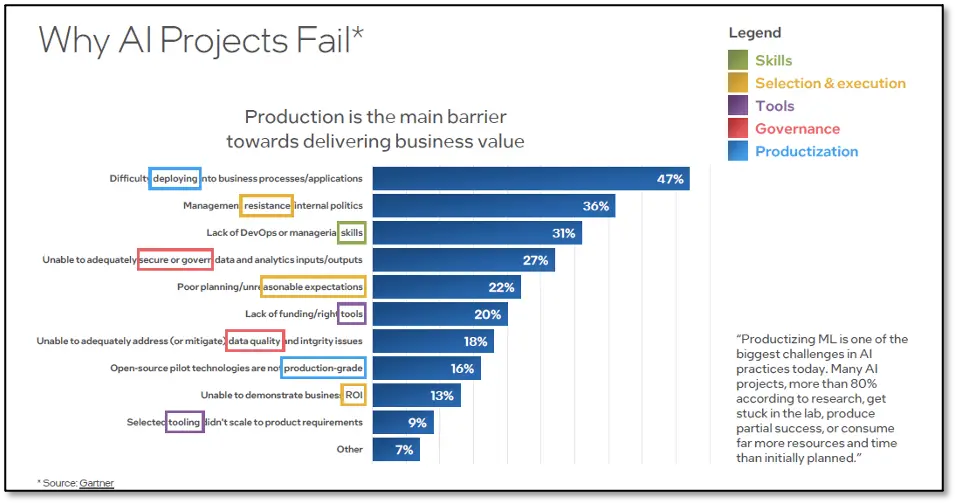
According to Gartner, nearly 85% of AI projects fail. And as Troy Demmer, co-founder of Gecko Robotics, puts it, even the most advanced AI predictive models are not immune to failure can happen if the foundations are weak.
When these projects collapse, they don’t just disappear; they leave behind hidden costs that quietly damage a business over time. Think of them as monsters that creep in when AI implementation goes wrong.

Source: https://www.compunnel.com/
1. The Financial Drain
Poor data quality alone costs organizations an average of $12.9 million per year. But that’s just the beginning. Failed AI projects often require additional spending on consultants, system replacements, and emergency fixes.
What was once seen as a cost-saving innovation quickly becomes a financial vampire, silently draining budgets and leaving less room for innovation. In volatile times, it becomes even more important to Follow Today’s Stock Hotspots to stay aligned with financial realities that may influence strategic decisions.
2. The Reputation Shadow
AI failures rarely stay hidden. Service delays, inaccurate recommendations, or repeated glitches create negative experiences that customers remember.
Once customer trust is shaken, it’s difficult to rebuild. The reputational damage lingers, making it harder to attract new customers and easier for competitors to win over your existing ones.
3. The Operational Storm
Broken AI doesn’t just sit quietly; it disrupts everything around it. Instead of streamlining processes, it creates chaos by producing flawed outputs or interrupting workflows.
Employees spend hours troubleshooting, bypassing systems, or double-checking results. Productivity drops, morale suffers, and the promised efficiency turns into a storm of inefficiency.
4. The Customer Exit Door
Perhaps the most dangerous cost of all. When customers lose confidence, they rarely make a fuss; they just leave. They move quietly but steadily to competitors who deliver smoother, more reliable AI-driven personalized experiences.
Once they step through that exit door, the effort and expense required to win them back is far greater than the cost of getting AI integration right in the first place. So, why do most fail?
Why Most Founders Fail at AI Integration?
Founders don’t usually fail at AI because the technology itself is weak; they fail because they rush.
To prove this, an Infosys survey revealed that 95% of C-suite and director-level executives had negative customer experiences with AI in the last two years. That means AI missteps can become a direct threat to your business’s existence.
Source: https://www.futurismtechnologies.com/
Take real-world examples.
#1 European Retail Chain
A retailer managing over 15,000 SKUs relied on fragmented systems, spreadsheets, siloed data, and poor coordination between online and offline channels. Instead of optimizing stock, AI forecasts ended up causing mismatches: excess inventory piles of low-demand items in some stores and constant stockouts of popular products in others.
#2 Global Fashion Retailer
Operating across 10 countries with over 270 stores, this brand faced outdated systems, delayed processes, and manual planning. Without centralized visibility, its AI-driven system couldn’t align supply with demand. The result? Frequent markdown losses, unsold inventory, and missed opportunities on sales.
#3 Indian Grocery & Dairy Chain
One of India’s largest retail networks suffered from inaccurate forecasting and no unified system. This created both overstocking waste and empty shelves, frustrating customers. Only after fixing their data pipelines and integrating AI forecasting did they streamline operations and cut losses.
These examples reveal a hard truth: AI doesn’t fail on its own; founders fail when they treat it as plug-and-play.
1. Skipping alignment with business goals
2. Ignoring data cleanup
3. Neglecting a change management system creates cracks that quickly widen into full-blown failures.
As Andrew Ng reminds us, “AI is a tool, not a miracle worker.” Just like any tool, its impact depends on how it’s used. For entrepreneurs, the lesson is clear: if AI is handled with strategy and care, it can power rapid scale.
Without it, even the most advanced AI models can stall business growth and turn a potential advantage into a costly liability. The next step is knowing how to do it right.
How to Do it Right: A Smarter Approach to AI Integration
Studies show that 20% of people believe AI boosts their business growth, and over 80% say it helps entrepreneurs enhance customer engagement. Clearly, successful AI integration isn’t just an advantage; it’s a must-have.
1. Foundation: Align with Business Needs, Not Hype
The first checkpoint is clarity. AI is everywhere in the news, but that doesn’t mean every tool fits every business. Even though some AI tools can be your co-founder, Entrepreneurs should start by asking:
Does this solution solve a real pain point in our operations?
For example, an e-commerce startup struggling with abandoned carts may not benefit from a chatbot as much as an AI-driven recommendation engine that personalizes product suggestions.
Without aligning AI with actual goals, the technology quickly becomes an expensive gadget instead of a growth driver.
2. Clean Slate: Fix Data Before Integration
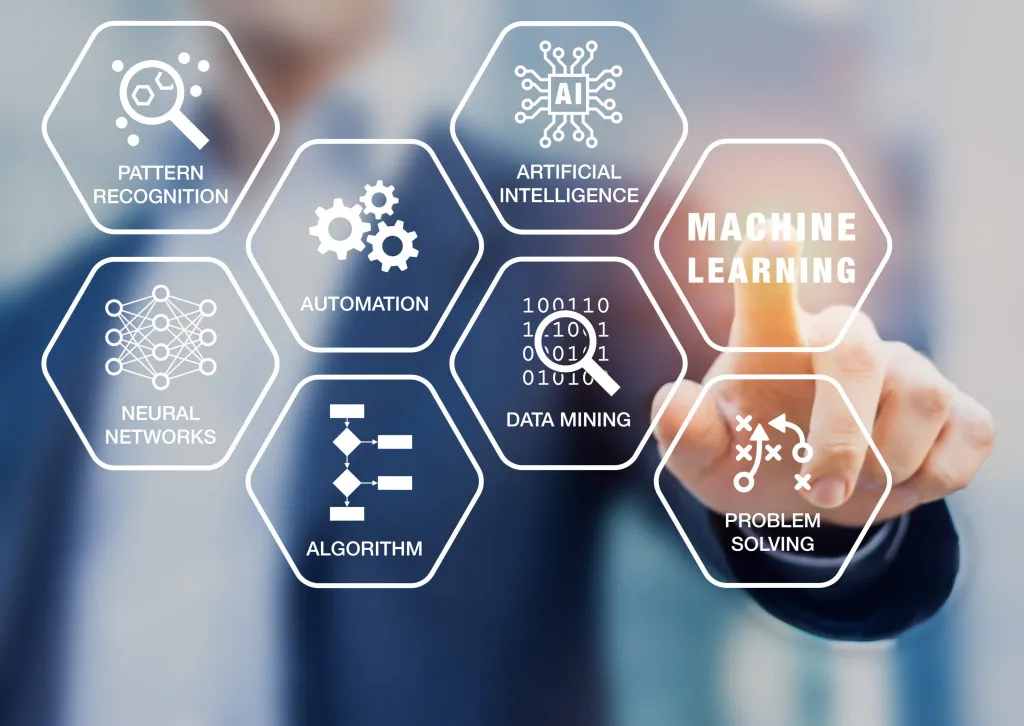
Artificial Intelligence systems are only as good as the data that powers them. In the U.S., poor data quality costs companies about $15 million each year, and across the whole economy, it could add up to around $3.1 trillion in losses every year.
Before introducing AI, businesses need to clean their house, eliminate data silos, resolve inconsistencies, and remove errors.
Consider a logistics company trying to forecast delivery times: if half the data is outdated or fragmented across departments, the AI will produce unreliable results. A clean slate ensures the system learns from accurate data, consistent inputs, and delivers real value.
Source: https://www.thedailymba.com/
3. The Human Factor: Secure Buy-in Early
AI isn’t just about algorithms; it’s about people. Employees are often the ones who will interact with these tools daily, and if they see AI as a threat, resistance will rise. Involving teams early through workshops, pilot projects, or training sessions can flip the narrative from fear to empowerment.
For instance, in healthcare, when nurses were shown how AI tools could reduce paperwork and free up time for patient care, adoption rates improved significantly. The human oversight is what turns skepticism into enthusiasm.
4. The Measuring Stick: Define Success Clearly
Without measurable goals, even promising AI projects face the risks of poor AI integration in business, drifting without direction. Businesses should define success clearly before rolling out AI.
Is it cutting customer service response time by 30%?
Reducing inventory waste by 15%?
Increasing repeat purchases by 20%?
Clear KPIs act as a roadmap, allowing founders to track progress and make adjustments along the way. This checkpoint ensures AI is tied directly to business outcomes, not just activity.
5. The Support System: Train, Guide, and Adapt
AI integration doesn’t end with deployment; it’s an ongoing process. Teams need training, guidance, and ongoing support to feel confident using new tools. Otherwise, frustration builds, and adoption stalls.
For example, when a retail chain introduced an AI-powered demand forecasting system, success came only after continuous training sessions and a feedback loop that allowed employees to raise challenges and see improvements over time. A strong support system transforms AI from something “imposed” into something embraced.
When businesses move through these checkpoints deliberately, they avoid the domino effect of failure and instead build a strong framework where AI fuels growth, streamlines operations, and empowers people at every level. Real-world examples show how these ideas work in practice.
Case Studies: Lessons from the Field
Failures often teach as much or even more than successes, especially in the world of AI integration. Real-world examples reveal why execution matters more than the technology itself, even in AI software development.
The Stellar Success
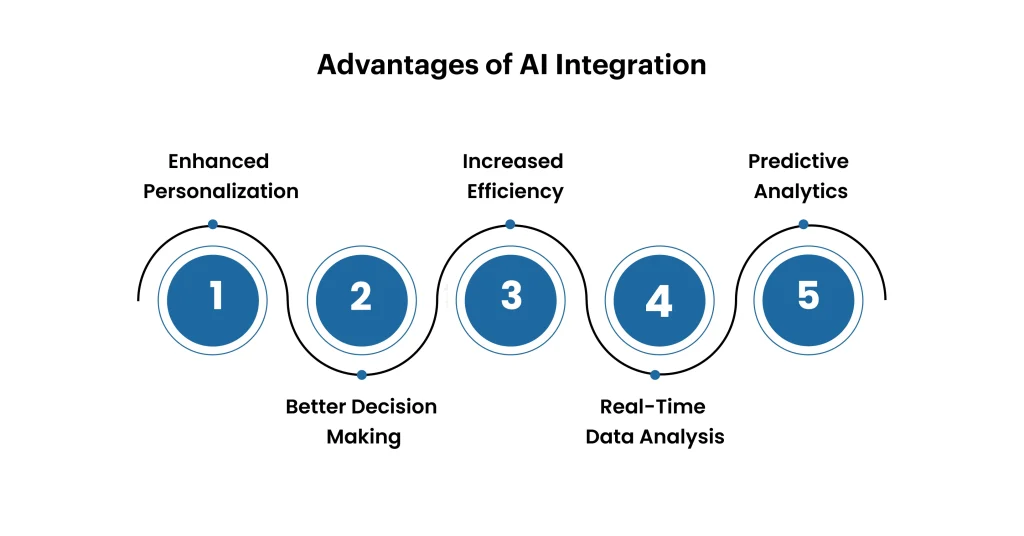
Starbucks is a good example of using AI well. Their system looks at millions of customer interactions, like what people buy, their preferences, and local trends, to give the right personalized offers and recommendations.
This kind of right personalization helps customers come back more often, builds loyalty, and strengthens trust in the brand. The key to Starbucks’ success is not just the AI itself, but how they use it: they have clear goals, strong data systems, and keep improving based on results.
Another example is GE. They use AI to predict problems in industrial equipment before they happen. By monitoring sensors in real time, the AI can warn about potential failures, so maintenance can be done early.
This saves millions by preventing costly downtime. GE succeeds because it aligns AI with its business strategy, uses high-quality data, and integrates it smoothly into its operations. This way, AI becomes a dependable tool that improves efficiency.
Source: https://www.openxcell.com/
The Lesson for Entrepreneurs
AI’s impact depends less on the sophistication of the tool and more on how it’s implemented. Key factors include:
- Align AI initiatives with business goals and measurable KPIs.
- Ensure high-quality, structured, and integrated data feeds.
- Involve cross-functional teams to support adoption and troubleshoot challenges.
- Start small, iterate, and scale gradually rather than chasing hype.
In short, the difference in a transformative success is execution, planning, and disciplined implementation. Get to know strategies that help you avoid pitfalls so that you can get your results smoothly.
Proven Strategies to Avoid AI Pitfalls and Maximize Results
Imagine your AI strategy as a house. Its stability depends on four strong pillars. If even one of them weakens, the whole structure shakes. But when all four are strong, your AI foundation stands tall, resilient, and ready to weather challenges.
1. Vision & Roadmap
AI success starts with clarity. A clear vision, backed by a structured roadmap, ensures AI aligns with long-term business goals instead of becoming a collection of scattered experiments.
Cross-functional collaboration, bringing in IT, operations, and business leaders, keeps projects grounded in real needs.
Example: A retail company with a roadmap for customer personalization avoided wasting on irrelevant tools and focused on measurable results.
2. Data Discipline
Data is the foundation of trust. Without discipline, AI outputs are unreliable.
Strong governance, access controls, anonymization, and quality checks ensure that AI models are trained on clean, secure, and ethical data.
Example: A healthcare provider anonymized patient records while strengthening access controls, ensuring compliance with HIPAA, and building reliable diagnostic models.
3. Security First
AI systems can be a magnet for cyber threats if security is an afterthought.
Building security from day one with penetration testing, risk assessments, and continuous monitoring protects sensitive business and customer data.
Example: A financial startup integrated fraud detection AI but secured it with real-time monitoring, preventing breaches before they escalated.
4. Adaptive Intelligence
AI isn’t a “set-and-forget” tool. To stay relevant, systems need continuous monitoring, real-time feedback loops, and dynamic evaluation.
Adaptive intelligence ensures the AI learns and evolves alongside shifting market demands, customer behaviors, and regulatory environments.
Example: An e-commerce platform that added adaptive learning to its recommendation engine saw conversion rates climb steadily as the system adjusted to seasonal buying trends.
When these four pillars—Vision, Data, Security, and Adaptability stand firm, your AI integration won’t just survive; it will thrive. Strong pillars protect against collapse, turning AI from a fragile experiment into a durable growth engine. Here are some more you should know.
Additional AI Practices That Truly Work for Business Growth
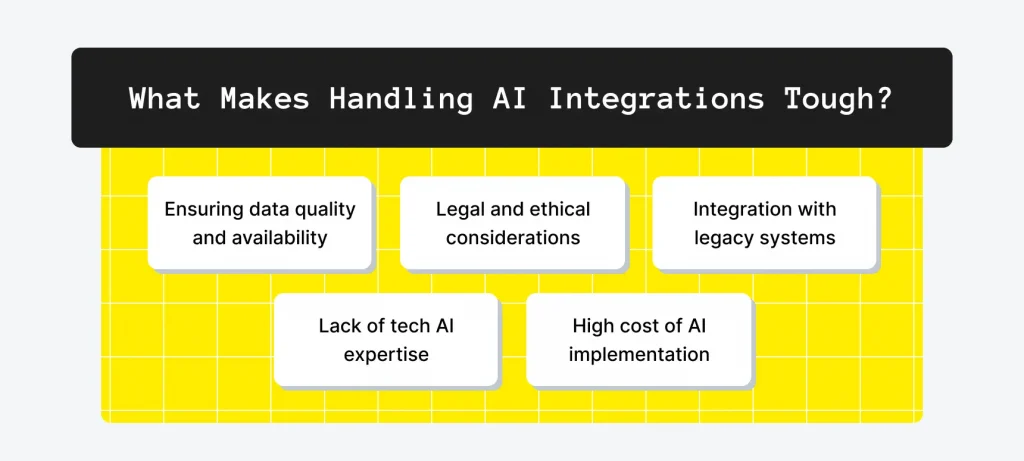
Designing a successful AI strategy is like building a strong structure. If every layer isn’t carefully planned, the risks of poor AI integration in business can cause the entire system to collapse.
Source: https://www.upsilonit.com/
1. Bounded Use Cases
Begin by defining clear, specific AI applications. Avoid chasing every trendy tool. Focus on problems where AI can provide measurable value.
Example: A retailer might prioritize AI for inventory forecasting or personalized recommendations instead of attempting AI for all functions at once. A strong foundation ensures that efforts are focused and achievable.
2. Governance Frameworks
Governance acts as the skeleton of your AI system. Policies for data quality, ethics, compliance, and accountability hold the system together.
Example: Make data privacy and regulatory compliance a standard practice to reduce the risks of poor AI integration in business, protecting both stability and reputation.
3. Minimum Viable Data (MVD) Layer
Just as a building needs utilities to function, AI needs clean, accessible, and structured data. Start with an MVD layer, a focused dataset that powers early AI models without overcomplicating the system.
Example: A healthcare startup might start with anonymized patient records for predictive diagnostics before scaling to larger datasets, reducing risk while proving value.
4. Balanced AI Portfolio
A diversified AI approach balances high-impact experiments with reliable, smaller initiatives. Like an architect balancing floors, windows, and walls, entrepreneurs should design a portfolio that combines strategic bets, incremental improvements, and operational efficiencies.
Example: Combining AI-driven demand forecasting (large-scale) with rule-based automation for order routing (small-scale) creates a resilient and balanced strategy. Behind these lies a deeper truth, want to know?
The Untold Data Reality That Can Make or Break Your Business
Poor AI integration can do more harm than good. Even the most advanced AI can analyze data patterns and predict outcomes, but only if its insights are aligned with real business goals. When the connection between AI and strategy is weak, predictions can actively steer your business in the wrong direction.
Behind every AI dream lies a sobering reality: technology alone cannot deliver results.
AI is only as strong as the data it relies on, making data the foundation that makes or breaks AI success. Without proper practice, even the most advanced algorithms can fail to generate valuable insights.
Poor Data Limits Decision-Making
Studies show that 69% of companies admit that low-quality data restricts their ability to make effective decisions. Inaccurate, incomplete, or inconsistent data can mislead complex AI models, resulting in flawed predictions that drive poor business choices.
Unstructured Data Creates Barriers
About 45% of businesses identify unstructured data emails, PDFs, images, and logs, as their biggest obstacle to AI adoption. AI thrives on structured, clean, and well-labeled data. Without proper organization and preprocessing, extracting actionable insights becomes time-consuming, error-prone, and expensive.
AI-Readiness is Rare
Only 8.6% of companies are fully prepared for AI deployment. Most organizations underestimate the time, resources, and expertise required to make their data AI-ready.
This gap leads to failed AI initiatives, wasted budgets, frustrated customers, and teams. A structured approach to AI readiness data audits, standardization, and governance is essential before launching any AI project. The solution lies in skilled developers, but why?
Why Do the Right Developers Make All the Difference?
Poor AI integration doesn’t fail because of weak technology; it fails because of weak execution.
But here’s the catch: too many entrepreneurs rush to adopt AI simply because it’s trendy, without asking the critical questions of why they need it, where it should be applied, and how it will be deployed. Businesses that rush into automation without aligning processes, fixing data, or preparing teams often trigger a domino effect of failures.
The result? Disappointing outcomes that fall short of expectations. But this is avoidable. The good news is that with structured strategies and continuous evaluation, AI can transform from a liability into a competitive advantage. The truth is that AI success depends on expertise as much as it does on technology.
Because of this, developers who understand both business needs and technical depth can be the right choice. They ensure that AI is integrated not as a gimmick but as a growth engine, secure, scalable, and user-friendly.
In the end, the difference between a nightmare and a breakthrough often comes down to having the right team behind the code, especially when facing challenges in integration, models trained on biased datasets, ethical concerns in deployment, and the constant push to balance productivity and efficiency.
With the right data scientists guiding the process, these hurdles can be transformed into opportunities for long-term success.
Turning Insight into Action with Appkodes
While understanding the risks of poor AI integration in business is important, preventing them is even more critical. With Appkodes, a leading startup mobile app development company, as your partner, you get guidance that keeps your AI journey smooth and reliable.
Many companies struggle with partial or biased data, information coming from multiple data sources, or handling huge amounts of data.
We step in to clean, organize, and prepare it properly. We also set up the right data storage solutions so nothing is lost and everything stays secure. Once the foundation is ready, we help train AI models that give you accurate, reliable, and future-ready results.
At Appkodes, we go beyond development—we act as your end-to-end AI partner, offering comprehensive AI development services. Here’s how we can help you.
Plan with Clarity – Together, we choose the right AI use cases so you invest only where it really matters.
Solve Data Problems – From managing data to fixing quality issues, we turn messy information into clean, usable insights.
Build with Purpose – Our custom AI solutions are designed to be secure, scalable, and built around your business goals.
Launch Without Stress – We deploy AI smoothly, avoiding workflow breakdowns or data chaos.
Train and Improve Models – We make sure your AI learns from the right data and keeps getting better over time.
Support That Lasts – After launch, we stay with you, updating and optimizing so your AI always delivers value.
If you’re tired of AI experiments that don’t deliver and want a solution that truly boosts productivity and efficiency, Appkodes can be the right partner to guide you from planning to success.

Arun Andiselvam
Founder of AppKodes. As a serial entrepreneur, I have successfully established five brands over the past 12 years. After creating a successful rank tracker for SEO agencies, I am currently dedicated to developing the world's first SEO Project Management software.