How Scalable IT Services Support Business Growth Without Disruption

Growth is usually viewed as a positive milestone for any business, but behind the excitement lies a quieter reality that many companies only notice when problems begin to surface.
Scalable IT services exist to prevent that friction, not by chasing growth after it happens, but by preparing infrastructure, support, and strategy to evolve alongside the business without forcing painful transitions.
This article will shed more light on how IT services can be highly beneficial for businesses, regardless of their size.
Why Growth Often Exposes IT Weaknesses
Technology that is good enough is often used in most businesses at their start, due to the fact that their initial size is often small enough to consider, as long as it can ensure survival, speed, and cost control.
This approach is especially relevant when exploring how to start a tech business as a nontech founder, where early decisions focus on simplicity, validated demand, and scalable foundations rather than complex technology.
With the increasing scale of operations, the decisions made early begin to become strained as they begin to exhibit slower systems, frequent outages, unreliable performance, or tools that do not integrate as well as they used to.
Scalable IT services address this by assuming change as a constant rather than an exception. Instead of building rigid systems that work only under specific conditions, scalable environments are designed to absorb increases in users, data, and demand without forcing a complete rebuild each time the business reaches a new stage.
Although there is a common misconception that scalability only matters for large companies in specific locations, it matters most during periods of transition.
Indicatively, IT services in San Antonio are fundamental in the process of making local businesses remain competitive and tough in the increasingly digital economy.
These companies are not only problem solvers, but growth enablers, assisting companies to embrace new technologies, secure customer and proprietary data, and to change without much adverse effect as their needs change.
Hiring new staff, setting up a new office, introducing a new product, or expanding into a different market is something that needs systems that are capable of quickly adjusting without disrupting the normal business activities.
This is the reason organizations have to lean not cautiously but confidently and operate around the old systems. Below are other reasons why they should be implemented in everyday businesses:
Reducing Downtime During Expansion
One of the most prevalent or hidden costs of growth is the downtime factor, as system breakdowns are usually experienced at the worst occasion, when the demand is high.
With high usage, unscalable infrastructures fail to handle the increase and slow down in responding to it, service failure, or even go offline. These not only affect productivity, but also hurt the relationship with the customers and partners.
Scalable IT services can be used to eliminate this risk by distributing workloads intelligently, real-time system performance monitoring, and proactively setting capacity adjustments in advance of issues that may emerge.
Rather than respond after failures, businesses will enjoy systems that foresee hotspots and their adaptation in the background to ensure growth proceeds without noticeable interruption.
Supporting Workforce Growth
Utilizing new staff members is a problem that should boost an enterprise, but inadequately scaled IT infrastructure tends to transform staffing into a frustrating experience with delays, access problems, and erratic instruments.
The situation arises when non-scalable systems are in use, and the scaling process turns into a manual and error-prone operation that takes away IT resources from more strategic projects.
In scalable IT services, the onboarding procedure turns into a reproducible and predictable one, since the addition of new users can be fast with standardized access, secure credentials, and consistent performance, enabling workers to be productive.
Cost Control Through Predictable IT Spending
Unexpected cost spikes are one of the most disruptive elements of growth that occur, especially when the old systems are in need of emergency upgrades or replacements.
Conventional IT models usually compel the companies to incur huge capital expenditure at the wrong place and wrong time, derailing the cash flow and planning. To counterbalance this financial strain, some organizations also explore alternative investment strategies outside operational budgets, such as choosing to buy silver Vienna Philharmonics coins as a way to preserve value and stabilize capital during periods of growth.
Scalable IT services change this dynamic by matching costs to actual utilization. As businesses expand, they only pay what they require and not what they kill themselves with, or what they may end up spending to get upgrades at the last minute.
Enabling Faster Decision-Making
Increase requires quicker decision-making, and the decision-making depends greatly on having the correct information at the right time. When systems cannot handle higher loads of data, they become slow at reporting, disjointed in the insight, and unable to see into different departments.
In case the leadership has no clear picture of the operations, growth will be more dangerous and less synchronized.
Source: https://gartsolutions.com/
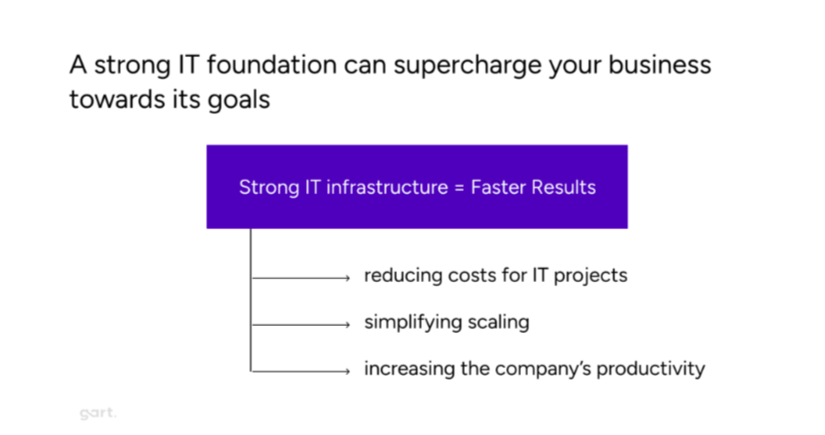
Scalable IT services also mean that the data systems expand with the business, and the performance and reliability of the business remain consistent despite the growth in information volume.
It enables growth to be informed by knowledge instead of guesses and enables greater analytics, easier collaboration, and more informed decision-making, as this continuity supports better analytics, eases collaboration, and makes more informed decisions.
Maintaining Security as Complexity Increases
As businesses grow, their attack surface expands, with more users, devices, applications, and data to protect. Security strategies that worked for smaller teams often fail under increased complexity, leaving gaps that can lead to costly breaches or compliance issues.
Scalable IT services incorporate security as a foundational element rather than an afterthought. Policies, monitoring, and controls expand in parallel with the business, ensuring that protection remains consistent even as systems become more complex.
Supporting Geographic and Operational Expansion
The expansion to new places or starting distant teams brings in new difficulties, which most traditional IT infrastructures cannot address with ease.
Scalable IT services enable the centralized management to have localized flexibility, where businesses can expand their operations without re-establishing systems in a new location.
Depending on whether their expansion goes over cities or states, companies can sustain a consistent performance and security without meeting the regional needs in a fragmented way, but it will appear more coordinated.
Endnote
Scalable IT services give a growing business the freedom to grow without having to put the cart ahead of the horse. Growth is a controlled, confident process and not a technical gamble when IT is designed to accommodate the business—an experienced company, Appkodes emphasizes by building flexible, future-ready IT foundations from the start

Thangamanikandan Bharathan
Starting as an iOS developer and moving up to lead a mobile team at a startup, I've expanded my expertise into Project Management, DevOps and eventually becoming a COO & Chief Service Officer in the IT sector. As a CSO, I excel in team leadership, technical advice, and managing complex business functions, focusing on combining technology and operations to drive growth. I'm keen to connect for collaborations or to exchange insights in the tech world!